A few words on venous congestion, thresholds, and physiology. #FOAMed


So I’m really glad to see that recently, a lot of discussion has been taken place on the topic of right sided failure and venous congestion, which has huge clinical applications. Even more so, the fact that a lot of individual practitioners have taken this on and have been applying it clinically with physiological results is really amazing.

So a common question that has been popping up revolves around clinical thresholds of significance, and I thought it was worth clarifying that we need to stay away from a pure threshold approach, but rather try to embrace a holistic cardio pulmonary and whole body assessment.

So here’s my two cents:

Thank you, love to hear any comments!

Philippe

ps obviously, this type of discussion will be what H&R2020 will be chock full of!


H&R2019 Lecture Series: Felipe Teran on Intra-Arrest Hemodynamics! #FOAMed, #FOAMcc

Here is an awesome lecture by Felipe Teran from this year’s H&R:


In resus, there is no one size fits all.


For anyone who missed H&R2019, you can still catch the Essentials!


But more importantly don’t forget that registration for H&R2020 is now open!


cheers!


Philippe

The Resus Tracks: Josh Farkas on Sepsis Metabolic Resuscitation and the CITRUS-ALI Study. #FOAMed


So metabolic resuscitation is a topic that both Josh (@Pulmcrit) and I are really interested in. We were looking forward to the CITRUS-ALI study. The results, to me, are good. They continue to establish the fact that there are no real side effects, particularly renal, as this was a concern to some (despite the already large data sets – particularly in the Matsuda study), and in an even higher dose than the Marik study.

Of course since the study was not designed to show a mortality benefit, it wouldn’t be clean to tout their results from that angle, but it certainly should be hypothesis-generating (imagine the cheers from the pundits who would certainly have used it in reverse had the mortality been increased instead!!!).  So for me, it changes nothing, because – if my institution hadn’t decreed (for no legitimate reason I can see) that I cannot use it in patients that I feel would benefit – I would still use it as an adjunct to septic shock management.

There are more studies around the corner, and hope they will come out before next may, so that Josh can give us an update for H&R2020 (#Hresus20)!

Here is our chat:


cheers


Philippe

H&R2019 Lecture Series: Weimersheimer (@VTEMsono) on Massive Transfusion. #FOAMed, #FOAMer

Sorry for the delay, been bogged down in getting H&R2020 off the ground! But here is another goodie from H&R2019, my good friend Peter W. on an ever-important trauma topic.  Enjoy!

Weimersheimer on MT – H&R2019.


cheers


Philippe

ps for anyone interested, H&R2019 On Demand can be found here!

POCUS Skill: Bedside Percutaneous Cholecystostomy. #FOAMed, #FOAMcc

So one thing we all pretty much agree on is the importance of source control. Biliary sepsis is one of the more common causes of intra-abdominal sepsis, and among those, there is a not insignificant proportion of cases where a percutaneous drainage procedure is indicated, often related to an elevated surgical risk.

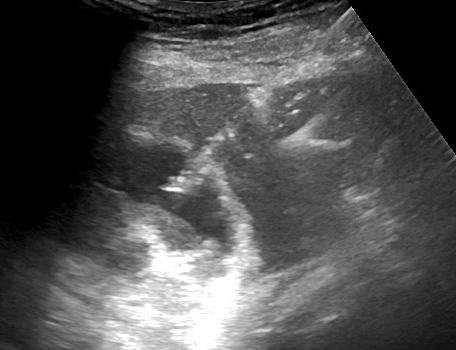
This is the case of a 90 year old man with severe aortic stenosis and a perforated cholecystitis with sepsis (AKI, delirium, coagulopathy) admitted to our ICU. Due to the aortic stenosis, surgical mortality was felt to be quite elevated, hence a percutaneous procedure was done.

I am sharing this to make the case that a percutaneous cholecystostomy is not outside the reasonable skill set of a clinician who is both POCUS competent and has solid guided procedural experience (central lines, thoracic or abdominal pigtails, etc) and in my opinion falls into that same category as pericardiocentesis. All the more so for clinicians working in community hospitals without the luxury of a 24/7 IR team, because in many cases, it is simply not reasonable to wait many hours for source control – the fact that the patient may make it alive to the next morning to have a drainage procedure is not relevant, as the ongoing sepsis over several hours may be something he or she does not always recover from in the ensuing days and is not a risk worth taking unless there is no other viable option. In our center the critical care physicians perform this intervention when IR is not available.

Here, an in-plane approach was chosen with a trans-hepatic route in order to avoid potential peritoneal spillage.

POCUS Pearls: 

(1) Always visualize the guidewire inside the intended space.

(2)When dilating, make sure the proximal part of the guidewire within the target area “disappears” ultrasonographically, confirming entry of the dilator. Why? In some cases the wall may give more resistance (particularly an inflammed pericardium) and the dilator may remain outside – cannulation with the catheter will be impossible.

Procedure:


POCUS Clips


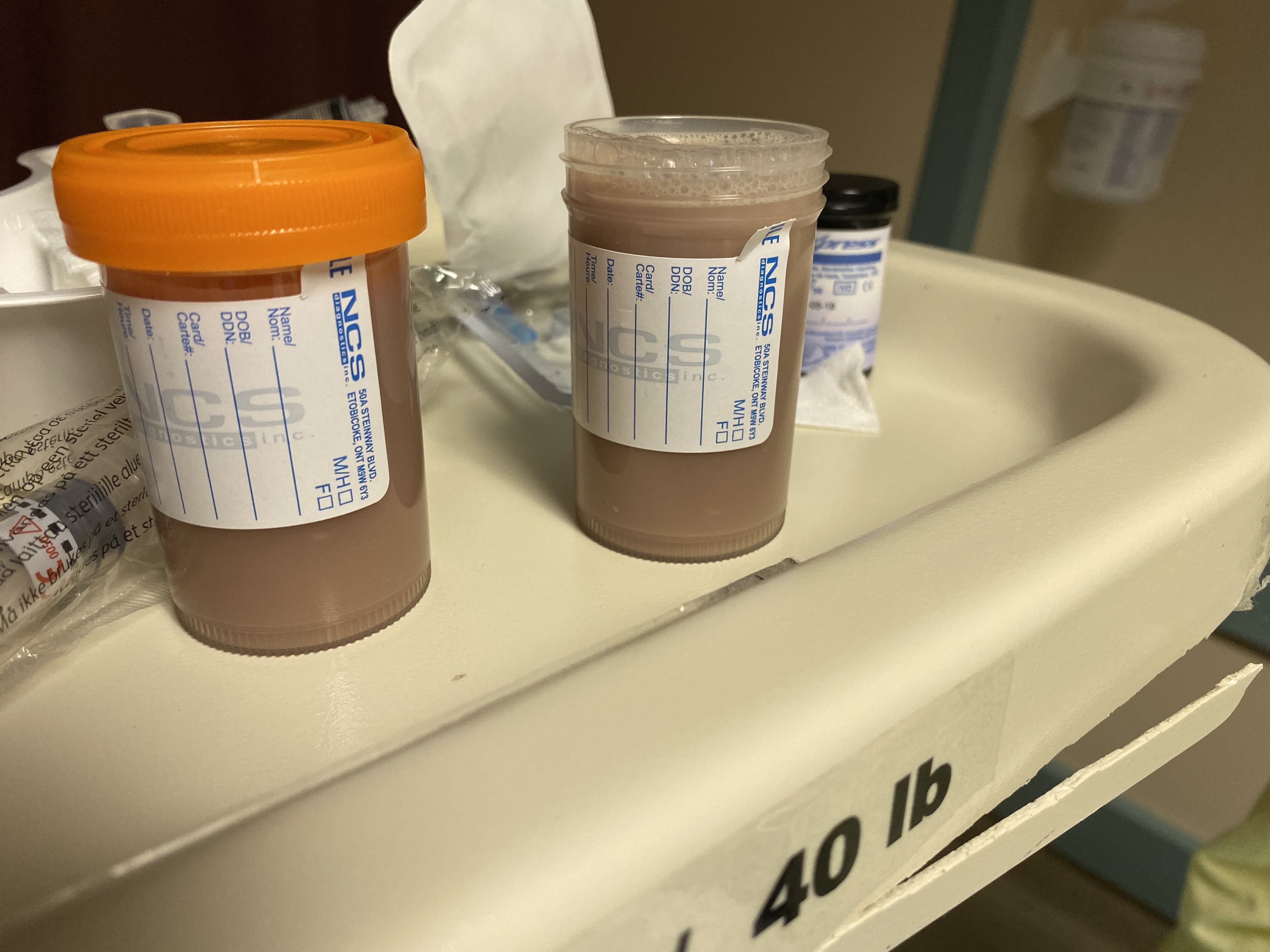
And the nasty stuff:


Some relevant articles:

https://www.ncbi.nlm.nih.gov/pubmed/12040818

https://www.ncbi.nlm.nih.gov/pubmed/29519331


Love to hear of others’ experience,


cheers

PS if anyone wants a perc chole workshop at H&R2020 , let me know!


Philippe

The Resus Tracks – A Chat w/Lars Chapter 1. #FOAMed, #FOAMcc

So for anyone not familiar with Lars (@LMSaxhaug on Medtwitter), if you are into applied resuscitation physiology, this is someone to follow. He seems to be Norway’s answer to Korbin Haycock (@khaycock2).

He is a POCUS researcher and currently a Cardiology/Internal Medicine Trainee, and I hope someone who will help take POCUS to another level. I’ve been meaning to chat with him for a while after some incredible threads on twitter really pushing the applied bedside physiology envelope.

So here is our first discussion, with a few more planned in the near future as we get down to the nitty gritty. But everything does need an intro.

So here is our discussion:

I think Lars makes some excellent points, particularly the need for global hemodynamic assessment, not having a narrow, almost single parameter threshold approach, as well as his point on adaptative tachycardia – though I am not in full agreement about the atrial fibrillation, but most definitely agree that most of the cases in the ICU are secondary, and deciding how much it is contributing to the hemodynamic compromise isn’t always clear.

Looking forward to further discussions, and I smell a panel discussion with Korbin and Jon-Emile on RVOT doppler!


cheers


Philippe


The Hospitalist & The Resuscitationist. Montreal, May 21-22. (R)Evolution. Don’t miss it. H&R2020 #Hresus20

COVID UPDATE – H&R2020 Postponed!

So final decision was taken a few days ago to postpone H&R2020, for several reasons, mainly to be consistent in limiting large groups of humans in a room, but also fully understanding that the attendance of many faculty and participants is already in doubt, and we do not want to put forth a sub-par educational event. We are targeting september, tentatively 23rd to 25th, to be confirmed.

The options are the following:

We will (a) issue full refunds or (b) hold your spot for september. Each participant should please let us know which works best for you by emailing hospresusconference@gmail.com.

Please follow this page for further developments.

The H&R Team

We’re really excited for the third edition of H&R!

Last year was great, all thanks going to our awesome faculty, and this year, we’re planning on taking it yet to another level. We’ve added some new faculty members who’ll be bringing some interesting perspectives, and there will be a pervasive theme across the two days to really get everyone’s understanding and management of the oft-overlooked venous/right side of things, woven in among the other key topics that last year’s attendees and the scientific committee chose. This is a clear evolution in clinical practice that, paired with POCUS, is really a game changer across a wide range of pathologies. Expect to leave from these two days with at least one extra notch on your belt.

The importance of careful fluid resuscitation has been gaining attention in the last years – take for instance the great work being done by Manu Malbrain at IFAD (International Fluid Academy) who just had their symposium. Treating fluids like the drugs that they are should be our goal.

In addition we have picked a number of important topics, with the idea to share knowledge and practical skills at therapeutic decision points, or else to bring attention to bleeding-edge topics that, though not widespread today, hold promise for further fine-tuning of resuscitation. One in particular is the use of the pulmonary artery catheter, whose use, though having fallen out of mainstream favour, persisted in many areas where clinicians were able to properly use this powerful monitoring tool. We feel it is poised to make a comeback among high-level resuscitationists. For some, it may be a matter of refreshing and re-polishing, and for the new generation, a good time to learn.


PRE-CONFERENCE COURSES!

There’s 4 of them, all on May 20th:

  1. The Hospitalist Course (full day)
  2. The Resuscitationist’s Toolbox (half day AM)
  3. Resus TEE (full day)
  4. Jiu-Jitsu for MDs (half day PM)

So, some slight structural adjustments. The Hospitalist angle now gets a pre-conference course, focusing on very practical, applied and critically important topics for the ward patients, including solid POCUS workshops to get some hands-on work on and great participant to faculty ratios. For the full programme of The Hospitalist Course see here.

 

We will do a Resuscitationists’ Toolbox pre-conference in which to learn or practice certain key skills for the high-level resuscitationist, such as REBOA, the PA catheter, surgical airways and more.

Felipe Teran and his team will bring back Resuscitative TEE, and registration is opening Thursday December 12th!  There are only 24 spots, and until march 1st, priority will be given to H&R2020 registrants. Participants must first register for H&R2020, then email hospresusconference@gmail.com and indicate they want to attend the TEE course, following which a unique code will be provided which will be necessary for course registration at resusicativetee. After March 1st, remaining spots will be released for non-conference attendees. (HINT – last year, the course sold out in 5 days!!!)

Here is how to register after having obtained the code:

or https://www.resuscitativetee.com/montreal (direct link) scroll down to Register button
And yes, the Jiu-Jitsu workshop is back by popular demand!


THE MAIN EVENT!

The two main conference days will be packed full of interesting talks, both by traditional but exceptional academics, as well as many of the top notch #FOAMed educators. The tail end will have some awesome workshops for those who want to add to their skill set.

And, on a first-come, first-served basis, Early Bird Registrants will be able to book some one-on-one time with faculty – The Personal Workshop –  for hands-on or discussion or skills workshop. To do so, register for the free early bird workshop and email hospresusconference@gmail.com to indicate your choice of instructor and topic!

Organized by The Critical Care & Ultrasound Institute for the Santa Cabrini Intensive Care Service at the CIUSSS E-MTL.


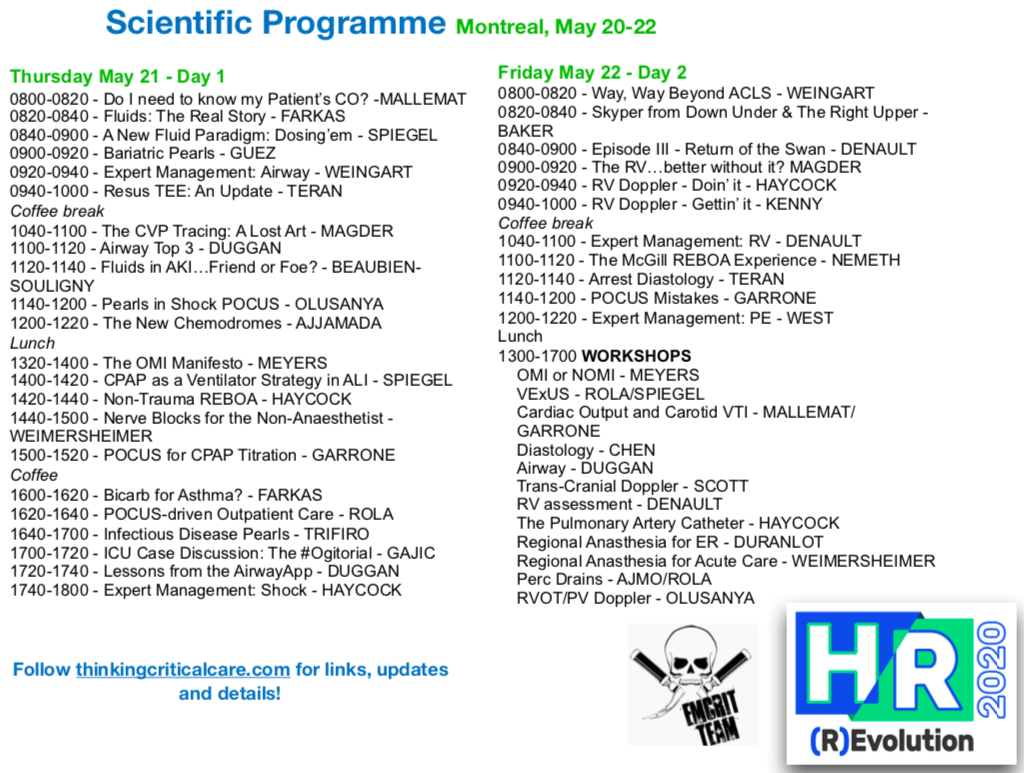
So here is the programme:
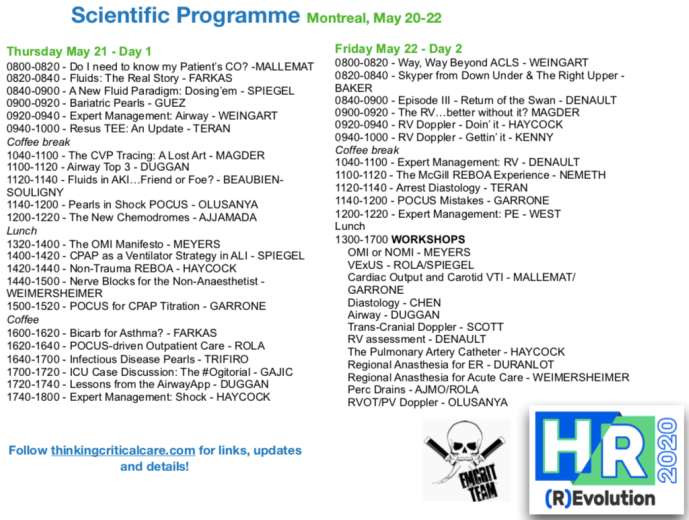
and in pdf: H&R 2020 Poster

All of this will be in Montreal, Quebec, Canada, most probably Santa Cabrini Hospital, but full details to follow!

Follow the blog and bookmark this page for conference updates!

The lineup so far… and more to come!
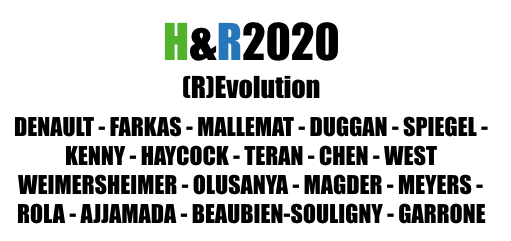
See you there!

 

Click Here to register!


Scientific Committee

Dr. Carol Zambrana

Dr. Philippe St-Arnaud

Dr. Joe Nemeth

Dr. Quoc Huy Ton-That

Dr. Mario Rizzi

Dr. Philippe Rola

 

The Resus Tracks: A Chat with Domagoj Damjanovic! #FOAMed, #FOAMcc, #FOAMer


So I recorded a chat with Domagoj (@domagojsono in the twitterverse), an anaasthetist-resuscitationist-intensivist from Freiburg a few months ago, but with H&R2019 and its aftermath, been slow in processing a lot of stuff I’ve got stocked… Apologies!

So in this one, DOmagoj and I discuss a bunch of resus topics, from eCPR to tissue oximetry. I’m really jealous of the fact that he does prehospital work with an ECMO van!!! …and with cool gear and of course, POCUS!

Here is the chat, hope it leads to thoughts, discussion and contribution!

And here are some links:

low budget ultrasound simulation
and here’s the editorial in Resuscitation,

cheers


Philippe


Part 2! RV Doppler: Resistance vs. Back Pressure. Jon-Emile Kenny & Korbin Haycock! #FOAMed #FOAMer #FOAMcc #POCUS

So these two had some follow up discussion in regards to this prior post, which is definitely worth a read. My editorial comments in bold.

Korbin:

Jon-Emile, thanks for your follow up and taking the time to look at the studies I referenced. I hadn’t seen your reply until Phil posted this. I gather your concerns primarily rest on the assumption that mPAP would rise higher (due to reaching the limits of the compliance of the pulmonary vasculature) than the rise in LAP, causing an increase in the delta mPAP-LAP and thus making the TRpg/RVOT VTI methods invalid as a way to know what the PVR is, as well as the concept of a calculated PVR in cases of significantly elevated LAP.

I absolutely believe you are right in postulating that this does indeed occur, but I think that the fact that the LAP  required to be significantly increased to cause this phenomenon would tend to “blunt” the delta between the mPAP and LAP as well, therefore also simultaneously helping to decrease the pressure/flow ratio that we are taking about to calculate PVR. In other words, the LAP required to cause what you are talking about also serves to pull back the error in PVR calculation a bit too. I’m sure there is a complex interplay between pulmonary vascular compliance and LAP that would make prediction of all this difficult in real life, but again I do agree with you that this is real and perhaps, common.

Having said that, I still think that the PVR estimation by the TR/VTI method works as there were enough patients with elevated LAPs included in the studies I showed you and the findings were replicated. After listening to your concerns, I will probably wonder a bit now about how close the predicted PVR is to the actual PVR when I see elevated LAP as well though!

Which brings me to my next point. I don’t think I would be fooled by a calculated PVR error scenario because I’m going to have a good idea about if there is elevated LAP or not due to the fact that I’m also seeing the left side of the heart dynamics on POCUS. Furthermore, I can get a relatively good idea about how high a LAP is by applying some Doppler techniques as well. Where this can get a bit murky is when I suspect elevated PVR and also see elevated LAPs on POCUS at the same time.

In an offline email exchange between you, I, and a group of people I thought would be interested, I presented one of these cases where I believed there to be both increased PVR and LAP. So the question at hand was what was causing the patient’s hemodynamic compromise. In the email, I purposely included information about the pulmonary valve regurgitant jet as it was very apropos to your points and the concerns you had described. The answer to the question of whether the PVR elevation was artifactual (due to what you have described) or real, was settled in both our minds by the fact that in the pulmonary valve regurgitant jet Doppler pattern, there was clear evidence that there was quite a gap between the LAP and the dPAP, thus pretty much proving a pre-capillary elevated PVR mechanism was in play as well as the elevation in LAP to the cause of the pulmonary HTN.

So I’d like to reinforce what you have pointed out, as it really is a key point: If you need to know if the PVR is real or not, the delta of the dPAP to LAP is really the only way to know for sure. However, I think I can still trust my assessment by looking at the echo as a whole and putting everything together in the occasional cases where a PR jet isn’t available to see as well.

Again, thanks so much Jon for pointing out where things may go sideways with your superior and deep understanding of physiology. You are really great to discuss these things with!


Jon-Emile:

Thanks for turning this into a dedicated post Phil.

I rambled my way around saying that my concern is the gold standard, not echo! If i were Rory, I would have called my post “The Case of The Flawed Gold Standard” (he may already have used this title).

The flawed gold standard is the calculated pulmonary vascular resistance from a right heart cath (note that in the pulmonary hypertension literature, that the PA Catheter-based definition does not include PVR!). One reason that PVR is not used is because of its many physiological/mathematical problems – probably first made explicit in the mid 1980s

Versprille A. Pulmonary vascular resistance. A meaningless variable. Intensive Care Med. 1984;10(2):51-3. PMID: 6715677

Korbin, I have no doubt that when you perform bedside TTE, that you have a very keen ability to discern left-sided PVR elevations from “true” pulmonary vascular PVR elevations – but not everyone is you! It actually doesn’t take very high left atrial pressures to cause the calculated PVR to rise and what i find most troubling is the nomenclature – because of the therapeutic implications. Calling it elevated “pulmonary vascular resistance” implies that **pulmonary vascular** resistance is high (even though it may not be) – so there may be the desire to give pulmonary vasodilators … which can make things worse! (see the SIOVAC trial).

That’s my clinical question exactly. Should I give pulmonary vasodilators or no?

What I’d really be interested to see … would be to measure the TRpg/RVOT VTI in patient with true hypertensive emergency (ideally without hypoxemia or significant pulmonary problems) – before, during and after treatment. I suspect that a very high LV afterload on presentation could cause the TRpg/RVOT VTI to be elevated (and if you put a right heart cath into the patient, the calculated PVR would also be high), even though the problem is, arguably, entirely in the systemic circulation. In theory, treatment with systemic vasodilators would lower impedance of the systemic circulation (the LV afterload) without any true ‘pulmonary vasodilation” — yet, I suspect that the TRpg/RVOT VTI would fall with therapy.

I know Korbin is now on the hunt for this exact patient. Looking forward to Part 3 of this discussion when he does find him or her!


cheers


Philippe