Cerebral & Somatic NIRS (Near InfraRed Spectroscopy) in shock states: tailoring therapy. (PART 1) #FOAMed, #FOAMcc

So I’d mentioned using NIRS to monitor and tailor therapy a few months ago, and promised a more in-depth discussion to come, so here we go.

For this not familiar with the technology or the concept, NIRS measures tissue saturation, predominantly venous. Hence physiologically it is akin to central/mixed venous gases, but localized. Cerebral NIRS found its foothold in the OR with carotid and cardiac surgery, but its use is now expanding. Given typical knowledge translation time of a decade, it should end up joining ETCO2 as a routine vital in monitored units, but probably not soon enough.

So in our unit at Santa Cabrini Hospital in Montreal, we’ve had this technology for about a year (the INVOS system), and have been studying its uses. In this time, three applications have stood out:

  1. Finding the “Sweet Spot” for vasopressors.
  2. Confirmation that therapeutic interventions are hemodynamically appropriate.
  3. Cardiac arrest: CPR adequacy, prognostication and detecting ROSC.


  1. Finding the “Sweet Spot” – I think (hope) that anyone reading this with professional interest understands that pressure does not necessarily equal perfusion.  With that in mind, adjusting vasopressors to a pressure makes little sense, and represents at best a guesstimate of perfusion, which is what we really are after. We can all agree, however, that a certain minimum pressure is required, but whether that is 65, 55 or 45 MAP no one can say for sure.  So the way I like to use it is to establish a baseline and watch the direction of the tissue saturation with vasopressor therapy. If the saturation begins to drop off, we may have reached a point at which excessive vasoconstriction is worsening tissue perfusion, and that inflexion point may represent the upper beneficial limit of the vasopressor – this may happen to be under 60 or 65 of MAP.  However, it is key to understand that this inflexion point is reflective of the current state of hemodynamics, such that a change in volume status or cardiac output, in one direction or the other, would likely change the position of this physiological point.  For example,  a volume depleted patient may reach a decreasing tissue saturation point at 55 MAP, but, once volume replete, may reach a higher MAP of 65 or above before a drop in saturation is seen.  Conversely, a patient whose best tissue saturations were around 65 MAP who suffers an MI and sudden drop in cardiac output may now see his perfusion compromised at that same MAP, which would now be achieved with a greater vasoconstriction, less cardiac output and consequently, poorer flow… I posted a case discussion which illustrates this.
  2. Confirmation that therapeutic interventions are hemodynamically appropriate – I feel this is really important. When a patient’s life is literally on the line, and knowing that our interventions are seldom without potential nefarious side effects, it is poor medicine to be introducing a therapy without having some form of monitoring – preferably multiple – that we are headed in the right direction, or at least not making things worse. Of course, we already do this – with BP, sat, lactate, CCO, ultrasound, ETCO2 – but I think using a realtime measure of tissue saturation adds to this. It is also my firm opinion that integrated, multimodality monitoring is necessary – at least until someone develops some form of mitochondrial monitoring which tells us that the cytoenergetics are sufficient to survive. Until then we are stuck with surrogate markers and many of them (e.g. lactate) are the result of complex processes that preclude them being a simple indicator of perfusion adequacy. For instance, when giving a fluid bolus/infusion – after having determined that the patient is likely fluid responsive AND tolerant – one should expect to see an increase in ETCO2 (other parameters being constant), an increase in CO, an increase in NIRS values. The absence of such response should make one reconsider the intervention, because without benefit, we are left only with side effects.

Here is a patient’s cerebral (top) and and somatic (thigh – bottom) and CO values. This patient had an RV infarct and was in shock.

IMG_7948IMG_7946


Following initiation of dobutamine, this is what occurred:

IMG_7951IMG_7949

Given that we cannot always predict the response to an inotrope – depending on the amount of recruitable myocardium, it is reassuring to see an improving trend. This enabled us to decrease the vasopressor dose significantly.

Note that, so far, and unless some good evidence comes out, I don’t use a goal value, and so far, I have not identified a value that is predictive of prognosis. However, downward trends usually bode very poorly. For instance, I had a severe chronic cardiomyopathy patient whose cerebral saturation was 15%!!!  But more surprisingly, she was awake, alert and hemodynamically stable. Adaptation.

Part 2 and the stuff on cardiac arrest coming soon!

Please, anyone using NIRS in shock, share your experience!


cheers


Philippe

Musings with Jon-Emile & Philippe 2: Putting Jon on the Spot!!! #FOAMed, #FOAMcc, #FOAMer

So in this second instalment, I put Jon-Emile on the spot about some common clinical scenarios which, to me, contain a bit of dogma. Let’s see if physiology will give us the bottom line!


I think these are actually really important, because just too many times, I hear people automatically saying that in RV infarct, the patients need a lot of fluids, and in PE and tamponade as well.  I’m not so sure that’s always true, so I thought it would be a good idea to review this physiology with s real pro!


enjoy, and love to hear some comments!


cheers


Philippe


Bedside Ultrasound Case: Look Left and Right! #FOAMed, #FOAMus

So I get a patient in the ED who had chest pain and a decreased LOC, vomited and got intubated. I see this elderly (88 yrs old) gentleman a couple of hours after presentation, after basic management including some plavix and heparin for a mildly elevated troponin.

Of course, by now you all realize that a rapid CUSE (Critical UltraSound Examination) is what I start with, after an ultrabasic history.

So my first couple of views show a more-or-less normal IVC, and here is the parasternal long axis:

Anything exciting here? Not really, nothing to hang your hat on at a glance.

Ok, so thanks to FOAM, I recently decided to add the right parasternal view to my regular exam, both to look for lung sliding (I admit I sometimes skip this when not specifically looking for pneumothorax) but also to possibly see some right sided pericardial abnormalities, etc… Here is what I see:

Hmm… A large, vascular structure that seems to have two lumens… a flap? Back to the patient exam, and the left toe is upgoing  and seems more flaccid in the left upper extremity…

Lets creep up the vascular path to the neck vessels:

Here, we can clearly see that most of the carotid lumen (lower right) doesn’t have any flow. That’s suboptimal. In fact, only a small crescent of flow between 3 and 6 o’clock is seen.

Here is the CT:


So here we can clearly see the dissected ascending aortic aneurysm that extends into the right carotid artery.

Due to advanced age and dismal overall prognosis, support was discontinued after discussion with the family.

I thought this would be a great case to share due to the fact that it could have been an initial bedside diagnosis, but I have to say I consider it fortuitous that I happened to look right, then up – which I easily could not have done. Not that it made any difference in this case, but on the next one, it just might!


Thanks FOAM!


cheers


Philippe


Is medicine approaching a philosophical crossroads? Critically important meanderings by Dr. Lynn! #FOAMed, #FOAMcc

So I feel really honoured that some fantastically bright and forward-thinking people take precious time out of their days to read my rants, and even more so to leave some comments.  I sometimes feel that the message contained in these is actually more important than what I spewed out in the first place, so here is quite an essay by Dr. Lawrence Lynn:

Excellent. This may be the Critical Care Quote of 2014.

“The N=1 principle: remember that we are never treating hundreds of patients at once, and we do not have to decide what is best for most (which is what an RCT generally answers) but what is best for the one patient we are treating.”

In fact when RCTs use a simplistic unified guessed phenotype as a surrogate of a complex disease (e.g. sepsis) in a highly heterogeneous population of critically ill subjects, one cannot even say that the RCT tells what is best for “most” since the first question a scientist trying to understand the validity of the “true state” under test would say is “most of what”, Of course when a free (unboxed) scientist learns that the true state was defined by a guess the discussion is over.

This SCCM will be the 25th anniversary of the guessed sepsis and septic shock criteria. It marks 25 years of failed and non-reproducible sepsis trials using the guessed criteria as standards. The beribboned SCCM speakers will rise to the podium and speculate on and on about what all of these studies might mean. None of them will formally call for reform of the science. Thomas Kuhn shows us that they cannot call for reform any more than those holding the guessed geocentric model could call for reform. “Though they may lose faith.. they will not abandon the dogma which led them to crisis” .

So it is up to you, the young women and men to speak up and demand reform. 25 years if failure is enough. How long will you sit silently in the audience and listen to P values responsive to guesses from a few well meaning docs from another era.

Stand up as a group at this SCCM and demand reform. Let this anniversary ring in a new chapter in critical care research.

If you have not read this editorial below, read it before the SCCM. No one argues that this is not the true history of sepsis science but no one has the courage to stand up and demand reform.

Maybe the 25 year anniversary of failure as a function of using guesses as gold standards could provide the impetus. The world depends on you. There is no backup.

http://www.ncbi.nlm.nih.gov/pubmed/24383420


Here is the solution for a scientific revolution. First read this guide to Dr. Kuhn’s book “The Structure of Scientific Revolutions”. (especially chapter 4)

http://philosophy.wisc.edu/forster/220/kuhn.htm

Then the young docs (and any of the old guard willing to break from the 25 year old dogma) should move together at the SCCM meeting, and plan to do so before the meeting in social media to collectedly call for reform of the science.

If only one calls for reform, of course grants, promotions, etc can dry up for that person. That is of course what those on academic tenure tracks are afraid of. Young academics are taught to rub elbows with the thought leaders, not to formally and publically question the leaders fundamental dogma. Sure you can go your own way a little off the path, for example, questioning whether or not a given threshold is the right one. However this freedom is a façade, as one cannot question whether there actually is a unified phenotype of “sepsis” definable by simple thresholds without risking much.

However, as Dr. Kuhn teaches, with any reform movement in science, once critical mass is reached there will be no repercussions because the old guard will actually join and move with the paradigm shift. They will even try to lead the shift as they see that leading with the old dogma is not possible and they desire to remain thought leaders and certainly do not wish to be among the last clinging to the old dogma.

The crisis Dr. Kun describes in chapter 4 is upon us. Look around. Do you see that the public cannot help save themselves. It is up to us to begin this revolution. Don’t let this crisis go to waste. Again, it is up to us. There is no back up.

I feel sorry for the Arise team. How much time was wasted? How many man hours? How much time, resources, and good data, which could have been acquired to determine the many actual phenotypes of sepsis was lost. Yet, it was known by some that the unified phenotype of sepsis/septic shock was guessed. Why didn’t anyone tell the ARISE team their “true state” was a guess. Wouldn’t ARISE have been performed differently if that was know to the statisticians.

Why didn’t anyone tell those in Zambia before they treated infected HIV patients with EGDT? Did anyone who came through the supra normal values era really think that Rivers treatment group was representative of the broad population of severely infected patients? One size fits all in sepsis? Really? That doesn’t even work for socks …phenotypes of feet differ.

You men and women are very smart. This blog.. Ollie’s, Scott’s. These are awesome for an old trench warrior – who spent his life at the critical care beside – to read. You understand the complexity. One day you will see that I am one of your greatest allies. You will see that you have been working in a well meaning paternal science and Dr. Kuhn warns of the loss derived from well meaning paternal science. .

I know I cannot expect all of you to rise up and call for reform. Dr. Kuhn says you cannot. He says that cannot happen until another fundamental pathway upon which the science can rest is found. That will not happen until the science moves to identify the varied phenotypes of sepsis.

Once I thought (many years ago) that armed with his teachings we might not be doomed to make the same mistakes. I have learned over the past decades that, while science changes…scientists do not.

One thing I lament is the loss of a good tool like SVcO2. I wrote about the complexity of SVO2 and how to consider these complexities when using SVO2 as a physiologic marker (a tool) in 1985s, This is long before anyone thought one could select a SVO2 value and write a protocol. No one thought in those simple terms in those days. Now, in the era of threshold science, it’s “guess the threshold, come to a consensus on the guess, apply for a grant and…. study it in a RCT (without telling the statistician that the “true state” is a guess)..

All I can say is, don’t let them study bedside ultrasound with the simplistic thresholds and a guessed unified (one size fits all) phenotype or that tool like the SVcO2 might be quickly discredited also..

If you let leaders define their own guessed protocols and control them from a central authority you will wind up using only the tools which they think, as a function of their simplistic “true state” threshold world, are proven..

Respectfully

Lawrence Lynn


Now that’s certainly food for thought at a deeper level!

Lawrence, we will certainly have to discuss SCVO2 at some point – I also agree that, well integrated with other modalities, it can provide insight into hemodynamic optimization.

cheers


Philippe

Post-Arrest BP Study by Young et al (Resuscitation) – interesting & important, but not yet an N=1 answer! #FOAMed, #FOAMcc

Happy New Year to all!

So trying to catch up on some reading, here is an interesting paper I came across. Young et al did a retrospective study on post-arrest BP, in an attempt to answer the very pertinent and important question as to whether or not a higher MAP may confer better neurological recovery, which is a very sensical hypothesis. After all, a brain with potential swelling, both of tissue and endothelium, may “need” a higher BP. Some societies have advocated for a higher MAP than is usually targeted (i.e. 65) and in studies this has been anywhere from 60 to 100. In their particular institution (Vanderbilt) the protocol aimed for 80-90.

Here it is:

Young et al RESUS

So what did they find?

Basically, they were unable to demonstrate that a higher MAP – in this case defined as achieving 80 mmhm – improved anything, with a follow up to 3 months. There was also no increased mortality related to the use of vasopressors.

So, why might this be? Well, I think there are a couple of important principles to review, especially for the novices reading this.

1. Pressure does not equal flow. The relationship between pressure and flow is a complex one and depends on the interaction between the pump (CO) and the circuit resistance (SVR). Pressure rises when resistance is increased, output is increased, or both. If resistance is increased without increasing output – or by a disproportionate increase in resistance vs output, flow decreases. The effect of vasopressors such as norepinephrine is complex, with both vasoconstriction and increased cardiac output (both via beta stimulation and via increased venous return), and depends on volume status, alpha sensitivity and the recruitable cardiac reserve.

So…? This means that on the surface, a BP number tells you little about flow. The same MAP may represent a highly vasoconstrictor, low-flow state, or a normal flow state. Obviously, a certain minimum pressure is required, to drive the flow from artery down thru the capillaries, but what that number is is unclear. So when looking at any study using simply MAP without another assessment of flow, one cannot draw a conclusion that improving hemodynamics may not help the situation.  How does one assess this – in all likelihood  an integrated approach using ultrasound (volume status, cardiac function), tissue saturation (cerebral/somatic oximetry) and possibly other technologies, including simple physical exam looking at skin mottling.  This type of information could categorize patients into flow categories and make results much more interesting and applicable.

Note that this isn’t really criticism on the authors – it would be impossible to do this on a retrospective study, but simply food for thought for further studies to come.

2. The N=1 principle: remember that we are never treating hundreds of patients at once, and we do not have to decide what is best for most (which is what an RCT generally answers) but what is best for the one patient we are treating.  Hence, looking at any one patient and saying that the target BP should be 65 vs 80 based on this study is incorrect.  What we should be saying is that aiming for a higher MAP may not be necessary if we feel that the patient is well perfused at 65. How each of us figures that out will depend on individual skills and available technologies, but to simply aim for 65 without further thought and assessment is relinquishing your MD in favour of the printed word, essentially what any paper protocol could do.

In the next post I’ll discuss the use of tissue oximetry and how it can be used as part of a strategy to optimize vasopressor use and MAP targets.


Thanks and love to hear your opinions!


Oh, and don’t forget to register for CCUS 2015 at http://www.ccusinstitute.org, and for more info at http://wp.me/p1avUV-bh.  In those couple of days, Paul Marik, Scott Weingart (@emcrit), Josh Farkas (@pulmcrit), and a bunch of other totally amazing speakers will be talking about this stuff, and more!

Philippe

Cool stuff coming in 2015!

I gotta give a shout out to the #FOAMed world.  The last year and a half has been really stimulating, learning from and exchanging with an amazing cohort of peers, all striving towards self-improvement and saving a few extra lives. I’m also really thankful for all those who take a few minutes of their busy days to read or listen to some of the stuff I spew out, and truly appreciate comments and discussion.

Undeniably #FOAMed has made me a better doc, both from the standpoint of learning and inspiration, which is really the fuel behind continuing education. I’ve been involved in organizing events, and in fact, doing so, and the interaction with both the faculty and the participants has been, in and of itself, of immense worth in terms of motivation and a feeling of kinship to a like-minded group, which I think is very important to practicing physicians.

As a consequence of some of these #FOAMed introductions, some good things are in the planning stages for 2015.

Winter: check out BEEM january 26-28 out in Vancouver BC – I can’t make that but really wish I could.

Spring: Two really interesting events in collaboration with l’ASMIQ (Association des Specialistes en Medicine Interne du Quebec – Quebec internists), one being a half day on Shock & Resus (may 30th), and a full day on Lung Ultrasound (may 29th) featuring the grandfather of it all, guru Dr. Daniel Lichtenstein, the one who invented it (well…discovered it, technically). Both take place in Montreal. (Technically this is for ASMIQ members but if anyone is interested, let me know and I’ll see what I can do!)

Of course, CCUS 2015 takes place may 1-3 in Montreal. Can’t miss that. Register at http://www.ccusinstitute.org.

Summer? I’m not running anything, but definitely going to SMACC Chicago. Just go. ‘Nuff said. http://www.smacc.net.au.

Fall: Ken Milne (@TheSGEM) and I will be planning a really cool day combining a critical appraisal workshop and a review of acute care highlights, taking place in Montreal in the fall. Ken will teach us how to learn while being skeptical, and participants should leave with an important skill as well as a headful of practical knowledge. We don’t have a title for this yet but I’ll be sure to let you know! In the meantime be sure to check out Ken’s awesome stuff at http://www.thesgem.com. He keeps it real.

SGEM Ken


I’ve also been asked to organize an Ultrasound Simulation Workshop (we are doing an EchoSchockSim in CCUS 2015), which may also happen towards the end of the year.


conferences 2015

Ok, so that was just a bit of an update on what’s up in the next year. Hope to meet some of you at these events, do come and say hi!

cheers


Philippe

A Witnessed Arrest: Advanced Bedside Ultrasound. #FOAMed, #FOAMcc, #FOAMus

So I was taking over the ICU in the evening, and as I walked in I hear that an arrest had happened and she was now being wheeled out of the ICU to radiology for a CT head and CT angio. So I didn’t get to do a bedside exam.

The story was that an 84 year old woman who had been admitted for atrial arrhythmia had been noted to have different blood pressure in the upper extremities, and the concerned family had urged to hospitalist to seek additional opinions. At the very moment when she was being examined by but the daytime ICU doc and a cardiologist, she suddenly deteriorated. They were actually in the process of bedside ultrasound, which had been normal aside from a small pericardial effusion, when she became unresponsive, seemed to have some lateralizing signs, became bradycardia and arrested. They got ROSC with an epic within a couple of minutes.

The feeling was that, having been started on one of those NOACs (Eliquis), she had bled and arrested by neurocardiac axis. Definitely reasonable, but given the BP discrepancy, ruling out aortic dissection was also a must.

So here is the scan:

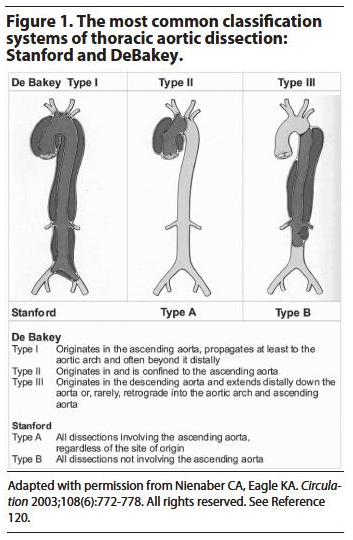
A quick glance reveals an ascending aortic aneurysm with what appears to be a dissection and a visible flap. The CT of the head was normal.  A closer look seems to reveal that the dissection extends into the brachiocephalic trunk.  My colleague discussed with the radiologist who repeatedly told him it was a type A but wouldn’t say anything more (don’t ask…). Just as a reminder, here is the current classification:

aortic dissection class

So in discussion with the family, there was obviously concern about the possible stroke (an early normal CT obviously does not rule out an ischemic infarct) and given that a palpable pulse does not exclude dissection, bedside ultrasound was the next step (also because the radiologist had not clearly pronounced himself on the scan – in all fairness he may have just done a preliminary reading – so here is what we see, with the carotid being in the lower right area of the flow box, and part of the jugular in the left upper.

As a comparison, here is the left side (normal – but inverted – jugular rt and carotid lt).

Clearly, most of the right carotid lumen is actually false lumen of the dissection, with only a small crescentic lumen between 3 and 6 o’clock. Not good.

Here are the basic cardiac views:

subxiphoid

parasternal long axis


We can see a small pericardial effusion which looks textured – likely blood, and essentially normal function.  Now here is a right-sided parasternal view, showing the dissected aneurysm, including the dissected intimal flap:

Now this isn’t a routine view, and honestly I did it after having seen the scan where one can see that the aneurysm abuts the chest wall, which would make it ultrasoundable, and i can’t really say I would have done it without that knowledge. But now I would, if a similar case would present itself. Very insensitive but quite specific.

So I thought this was an interesting case to show, as a rapidly developing clinical picture, and from the point of view of bedside ultrasound, it displays the usefulness of carotid imaging and alternate views – and how simple it is to do.  Unfortunately at her age and given state she was not deemed a surgical candidate and passed away the next day.


thanks for reading!

…to sharpen up your resuscitation and ultrasound skills, don’t forget to come to CCUS 2015, may 1-3 in Montreal, Canada!  Register at http://www.ccusinstitute.org and for more details,http://wp.me/p1avUV-aU


Philippe

Venous Hypertension: The Under-Appreciated Enemy Part 2: Discussion with Jon-Emile

So I posted about this a few weeks ago, and the discussion it brought up with Jon-Emile (www.heart-lung.org) turned out to be way better than the original post, and I just wanted to make sure everyone interested got to see it, so here we go (part 1 is here, for those who didn’t come across it: http://wp.me/p1avUV-bJ):

Jon-Emile


Jon-Emile: This is a great topic for review Philippe!

I have come across this problem, certainly on more than one occasion. I was first introduced to the idea of renal venous pressure and renal hemodynamics as a house-officer at Bellevue Hospital in New York. Dr. Jerome Lowenstein published work on this phenomenon as it pertained to ‘Minimal Change Syndrome.” He used to ‘wedge’ the renal vein and measure renal interstitial pressure in these patients and measured the response to diuresis. It was very enlightening and made me feel more comfortable given more diuretics in such patients. [Am J Med. 1981 Feb;70(2):227-33. Renal failure in minimal change nephrotic syndrome].

I am also glad that you bring up the cranial vault in this discussion, because I have often wondered if the encapsulated kidneys behave in a similar way. That is, as renal interstitial volume increases from edema, if there is some point on their compliance curve [like the cranium] where there is a very marked increase in renal interstitial pressure? I have found a few articles which loosely address this idea, but would be interested if anyone else knew of some. In such a situation, there would be a ‘vascular waterfall’ effect within the kidneys whereby the interstitial pressure supersedes the renal venous pressure [like West Zone II in the lungs]; then, renal blood flow would be driven by a gradient between MAP and renal interstitial pressure [not renal venous pressure]. I know of one paper that addresses this physiology in dogs, and finds the vascular ‘choke point’ to be in the renal venous system and not Bowman’s space.

What’s even more interesting, is that when renal interstitial pressure is elevated is that the kidney behaves in a sodium avid state [i.e. urine electrolytes will appear ‘pre-renal’] and this physiology has been known for at least a century!

Lancet. 1988 May 7;1(8593):1033-5. Raised venous pressure: a direct cause of renal sodium retention in oedema?

There is no good explanation as to why this occurs, but one I read is that the high renal interstitial pressure tends to collapse the afferent arteriole and the decrease in afferent arteriole trans-mural pressure which facilitates renin secretion [just like low blood pressure would]; but that would require a fairly high renal interstitial pressure unless the MAP was concomitantly low.

Again, what I must caution [and I’ve been personally wrong about this] is the reflex to give diuretics when seeing a ‘plump IVC’. When I was treating a woman with mild collagen-vascular-related pulmonary arterial hypertension, community-acquired pneumonia with a parapneumonic effusion and new acute renal failure, I assessed her IVC with ultrasound. It was plump an unvarying. I lobbied the nephrologist to try diruesis based on the aforementioned reasoning, but was very wrong. Her kidneys took a hit with lasix. What got her kidneys better was rehydration. In the end, what happened was her mild PAH raised her venous pressure and the hypoxemic vaso-constrction from her new pnuemonia only made that worse. Her right heart pressures, venous pressure and probably renal venous pressure were undoubtedly high. But I didn’t take into consideration her whole picture. She had a bad infection, had large insensible losses and had not been eating and drinking. She was hypovolemic, no doubt, despite her high right heart pressures. Fortunately, her pneumonia resolved and fluids brought her kidneys back to baseline.

Thanks again for another thought-provoking topic


Me: Great points as usual Jon, and your last one brings up a bit of a concern I have always had. To play devil’s advocate, one could argue that it may have been resolution of the pneumonia and its metabolic sequelae and possibly other treatment that resulted in improvement of her renal failure, rather than the fluid, no? Did her hypoxia resolution decrease PAP back to normal – with IVC dynamics restoring – and relief of renal congestion, and improvement “despite” fluid?

To me, fluid administration must – at least transiently – increase CO to have any effect on the perfusion side. To do so, my understanding is that it has to go from right to left. Because of the pericardium and interdependence, if RAP exceeds LVEDP, we will start to impair LV preload, which sets up the vicious cycle of a shrinking LV and growing RV. If we can’s increase our RT heart output, obviously our LV CO headed to the kidneys can’t increase either. Hence the assumption would have to be that somehow this additional fluid can – by increasing RV preload (without increasing RV size and further impinging LV?) – help overcome elevated PAP and increase right to left flow. To me, hard to believe without a pericardiectomy (on a short time frame, naturally). Hence I struggle with understanding how a really plump IVC with little variation (if significant pleural pressure variation is occurring) can really still need fluid.

I’d really, really like to get your comments on this. I’ve had a number of conversations about this with people – some of them pretty bright – but none satisfying. Am hoping you can point out my flawed thinking.


Jon-Emile: Philippe, you ask very good questions. Your first point is quite valid. I think we have a bias of assigning meaning to a particular intervention because we think that particular intervention will work. For the patient I treated, we administered multiple drugs [oxygen, antibiotics, bronchodilators, we may have even given a dose of steroids] and yet I assign meaning to the fluids given. I think in all patients with complex hemodynamics that there are multiple co-varying interventions that all [hopefully] push the patient in the right direction – making it quite hard to grant significance to one in particular. Yet in the patient I treated, the timing with respect to creatinine change and urine output made it very hard to argue in favor of diuresis. We were checking her creatinine fairly regularly as she was in step-down and we were concerned about the trajectory of her illness. With lasix, her creatinine jumped abruptly on the following chemistry while with fluids, creatinine dropped and her urine output really picked up.

Which brings me to Ulrich’s point. It is well-taken and I hope to have a pulmccm post on this shortly. While the CVP does not have any correlation with volume status or volume responsiveness as you point out, the physiology of the CVP can help explain confusing echocardiographic findings.

All a plump, unvarying IVC with spontaneous inspiration means [if you believe the Guyton, or Magder approach] is that the IVC transmural pressure is remaining on the flat portion of its compliance curve during inspiration.

Click to access cc11824.pdf

In other words, the IVC is at such high volume [on the flat portion] that lowering its transmural pressure [lowering the CVP, raising the intra-abdominal pressure or both] does not cause it to shrink in volume.

The question then becomes why is the IVC in this state? And a great analysis to this question is to consider the determinants of great vein volume [which really is a question of great vein/right atrial pressure or the CVP – which is related to volume by compliance].

There are two primary processes which will raise great vein volume and these flow from the Guyton Diagram 1. excessive venous return 2. poor cardiac function or a combination thereof [its really just inflow versus outflow]. Volume status plays one part of venous return, so certainly, if someone is hugely fluid overloaded, their venous return will be enhanced and this will favour a high great vein volume and high great vein pressure, BUT this will be mediated by cardiac function because if the heart can eject the large venous return it is receiving, then the great vein pressure and volume won’t change or may be low. Conversely, if cardiac function is poor, a patient could have a low venous return [e.g. be hypovolemic or euvolemic] and still have a high great vein volume and pressure – simply, because the heart can’t expel from the thorax what little venous return it receives. Importantly, poor cardiac function can mean almost anything [valve dysfunction, tachycardia with arrhythmia, high afterload, poor contractility, etc.].

To me, the above is the true value of thinking about Guyton and the CVP, so when I approach a patient, I try to think about what their venous return curve looks like [by a clinical exam] and I use a TTE to actually see what their heart function looks like [and to me this is the true power of ICU TTE]. The above also explains why CVP simply cannot be a marker of volume status.

In the patient I was treating, her history and physical really suggested poor venous return [she was clearly with a pneumonia, hadn’t been eating and was euvolemic to dry on examination] yet her great vein volume was high on TTE which meant that her cardiac function was most likely poor [on the Guyton Diagram her low venous return curve would be intersecting a very low, flattened cardiac function curve such that shifts with intra-thoracic pressure would not change right heart pressure at all].

But why was her heart function poor? Why could her right heart not eject what little inflow it was receiving? It was probably a combination of things. The pneumonia probably increased right heart afterload which caused some TR, she was tachycardic so wasn’t getting optimal filling time, she was septic with perhaps some underlying cardiomyopathy, perhaps her diastolic blood pressure was lower than normal [she was an elderly lady with likely stiff arteries] and she wasn’t perfusing her right coronary artery well and was suffering from relative ishcemia] it’s certainly is a lot of hand-waving, but all taken together perhaps plausible.

The antibiotics improved her lung function as did the bronchodilators which lowered pulmonary vascular resistance which improved right heart forward flow, maybe the inhaled beta-agonists increased her contractility, maybe the oxygen also lowered her pulmonary vascular resistance, maybe the steroids sensitized her to catechols and this raised her blood pressure and coronary perfusion pressure which improved her right heart function, but also maybe the fluids? Empirically, and in retrospect, venodilating her with lasix probably really lowered her venous return and this crashed what little cardiac reserve she had. It was improving her venous return with fluids that helped.

Sorry if this post is getting too long …

In terms of ventricular interdependence [an excellent, under-appreciated point in the ICU] I think that you have to be very careful extrapolating whether or not this effect is present from an IVC examination. In a classic paper [that caused much consternation at the time] Pinsky found that right atrial pressure was completely uncoupled from right ventricular end-diastolic volume [why the CVP is a poor indicator of volume responsiveness]. Her is a recent review of that paper by Pinsky himself.

http://www.ncbi.nlm.nih.gov/pubmed/24760121

The take home is that while right atrial volume and pressure [and by corollary great vein volume and pressure] can be high, this may not translate to a right ventricle near its elastic limit. Pinsky offers no good explanation as to why this is, but postulates that it may have to do with the complex RV geometry and how this changes during diastole. So until there is a widely accepted means of assessing RV filling with TTE [like an Ea ratio] which could pick up a restricted filling pattern, this is really hard to call on echo. As you are aware, you could look for a flattened septum or D sign during diastole, but I’m not sure how well that sign predicts a patient’s response to a fluid challenge – it certainly screams caution.

This Pinsky paper also highlights a potential disconnect between the physiology proximal to the tricuspid valve and the physiology below it which is also part of my general reluctance to use IVC volume change as a marker of fluid responsiveness, just as I have total reluctance to use CVP [or its change with respiration] as a marker of fluid responsiveness.

Unfortunately, a lot of the time it comes down to ‘guess and check’ – give fluids or give lasix and see what happens. This is why I firmly believe that determining volume status and volume responsiveness are the hands-down hardest party of ICU medicine.

If you’re still reading, I hope this helps.

One more point. I don’t think I gave a full explanation to one of your questions. Please bear with me as this is exceptionally hard to explain with words [indeed why I made heart-lung.org].

The venous return and cardiac function curves are essentially inverse of each other [that is lowering right atrial pressure increases venous inflow but decreases cardiac outflow] so they approximate the letter X [venous return is the \ and cardiac function is the / & the point at which the two lines intersect make up the CVP and defines cardiac output].

If you consider the patient I described, If we assume her venous return is low [because she is venodilated from sepsis and hypovolemic from low PO] then the venous return curve [\] is shifted leftwards. If we assume her cardiac function is poor the cardiac function curve slope [/] is shifted down and to the right.

When she takes a breath in, the lowering of intrathoracic pressure pulls the cardiac function curve leftwards [lowers its pressure relative to venous return] while the increase in in abdominal pressure with diaphragm decent tends to temporarily increase venous return by decreasing abdominal venous capacitance. This effect shifts the venous return curve in a rightward manner.

If the patient’s venous return curve initially intersects the ascending portion of the cardiac function curve [i.e. she is truly volume responsive] BUT, the intersection is very near the plateau of the cardiac function curve [i.e. the portion of the cardiac function curve that will render the patient non-volume responsive and also favour unvarying respiratory change in right atrial pressure/volume with inspiration], THEN with inspiration it is possible to see the intersection of the two curves on the flat portion of the cardiac function curve [as the cardiac function curve is pulled leftwards and the venous return curve is pushed rightwards], even though she does have some cardiac preload reserve. This would be an example of impaired specificity of IVC volume change with spontaneous inspiratory effort as a predictor of volume unresponsiveness [i.e. a false positive for a plump IVC predicting the lack of fluid responsiveness].

I address this physiology in chapter 6 parts C and D and chapter 8 part F.


Me: Very, very interesting. I think this discussion, as many, show how medicine is not a “hard science” but remains a “pseudo-science”, inherent to the fact that we are blending physics, chemistry, biology and cannot really apply simple principles of flow and pressures when dealing with elastic, muscular systems lined with microscopic coating whose compliance and resistance change from moment to moment and thru effect of neural and hormonal influence. There are simply too many unmeasurable variables to come up with single guidelines and rules.

I think, as you say, that there remains a need for some degree of trial and error, that we are hopefully narrowing with the appropriate application of technology and proper data integration.

I’ll percolate all this and see how I can tweak my mental model!

Thanks a lot Jon-Emile!

Philippe


please visit Jon-Emile at http://www.heart-lung.org

Heart-Lung


cheers!

…and don’t forget to register for CCUS 2015 at http://www.ccusinstitute.org!!!

Philippe

Bedside Ultrasound Case Debate Part 2: To lyse or not to lyse… #FOAMed, #FOAMcc, #FOAMus

If you haven’t read Part 1, get the story and the cool clips here first:  http://wp.me/p1avUV-ce


So the polls are in!  So far at least, 58% of you would blast away with full dose lytics, 26% with MOPETT-style half-dose, 10% content with heparin, and 5% would go for a PA catheter directed lysis.

So 90% would lyse this patient.  I’m glad to hear that, because in my opinion, more patients should be lysed than I see being done around me.

What did I do?  I went for the half-dose lytics, with an excellent result. Within a few hours she was much less dyspneic, BP was up to 110-120 systolic, and though RV dysfunction persisted, it was mostly resolved by the next day.  I think it is important to note that I had a long chat with her, explaining the risk of intracerebral hemorrhage, which I quoted as being less than 2%.  She opted for thrombolysis with the idea of averting cardiopulmonary limitation given her active lifestyle.

I think the physiological rationale for half-dose lytics is good, since, unlike when used for arterial lysis (coronary or cerebral) the entire dose will pass through the lungs. One could argue that the clot burden is larger,  but the resolution seen in MOPETT and in the dozen or so cases I’ve lysed (no intracerebral bleeds yet), rapid resolution of RV dysfunction supports a sufficient response.  I’ve yet to give – but am ready and willing – a “rescue” top-up 2nd half dose if the first hasn’t worked.

I think the other important point in this case is the importance of bedside ultrasound in the assessment of all shock patients. Although I have no doubt whatsoever that my competent colleague would have come to the diagnosis of PE, it may have been minutes to hours later, possibly after having to begin pressors for a lack of response to fluids.  I won’t hypothesize what might have happened in that time. Maybe nothing, maybe not.

She went home a few days later.

This is why the blind administration of fluid resuscitation is a growing pet peeve of mine.  Two litres in sepsis? Ok, probably, but not every shock is sepsis…  I think that in 2014, going on 2015, with virtually all ERs and ICUs equipped with an ultrasound, there is no place for the empiric bolus. It takes all of 5 seconds to look at an IVC, and another 15 to get an idea of cardiac function in most patients. Like a famous corporation says:

Screen Shot 2014-11-13 at 10.31.18 PM

Opinions, rants and rotten tomatoes welcome!

cheers


Philippe