Bedside Ultrasound & the patient with Acute Renal Failure – an N=1 Podcast #3, #FOAMed, #FOAMcc

Hi!

So here is a quick and dirty approach to the patient with ARF using bedside ultrasound, which enables the rapid diagnosis or ruling out of two important and time-dependant conditions with significant clinical impact: hypovolemic and post-renal/obstructive renal failure.

Let me know what you think!

Philippe Rola

http://www.ccusinstitute.org

Bedside Ultrasound Clip Quiz #3 – #FOAMed, #FOAMcc

This is what you see on the anterior chest of your patient:

What can you conclude?

scroll below for answers…


Lung sliding and B lines

The notable findings are:

a. lung sliding – this indicates that there is no pneumothorax in the area you are scanning.

b. there are B lines – this indicates that there is interstitial edema – this has no etiological information and must be coupled with the rest of the ultrasound and clinical examination to make a diagnosis. It could represent CHF, pneumonia, non-cardiogenic pulmonary edema, or any other interstitial process.

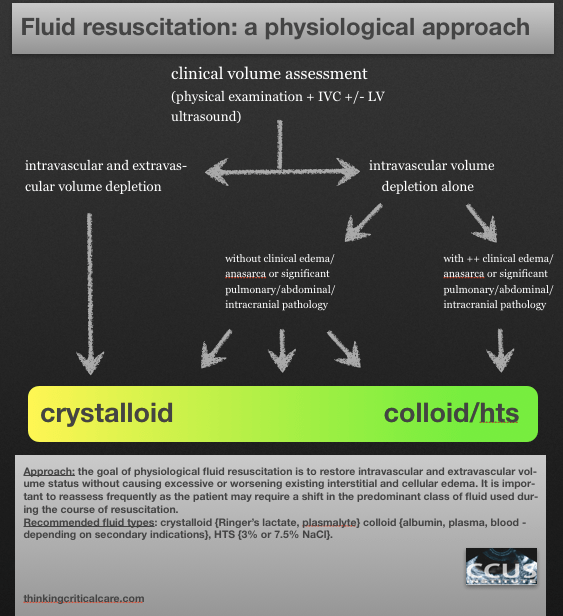
fluid resuscitation: a physiological approach – an N=1 podcast, #FOAMed, #FOAMcc

This is my approach to fluid resuscitation – sorry for the lack of precision which, to me, is actually key.  It would be against the N=1 principle to give out a recipe…but here’s a way to think about it:

Sorry the last bit cut off – my iphone can only email an 8 minute audio clip! Which I wasn’t aware of until today.  Anyway all that was lost at the end was “thanks for listening and I’d really like to hear comments and others’ practices!”

And here’s a disclaimer:  I don’t think this is the be-all and end-all. My resuscitation is a work in progress, both in terms of new fluids coming up, and in terms of identifying subgroups or individuals who would benefit from a different approach, so I’m definitely eager to hear from anyone who does things differently – but physiologically!

Please see Dr. John Myburgh’s excellent review on fluid resus in NEJM sep 26th issue!

Oh and here’s the diagram!

Physiological Fluids

thanks!

Philippe

Why do we bother checking CVP? #FOAMed, #FOAMcc

I was recently scanning the literature in preparation for our symposium, and came across what should have been a 2003 instead of a 2013 publication in the March issue of the CCM Journal, entitled “Point-of-Care Ultrasound to estimate Central Venous Pressure:  A Comparison of Three Techniques.”

I have to admit this is a pet peeve of mine, from the standpoint of a clinical physiologist, which is, as far as I’m concerned, what any physician looking after critically ill patients should be, at least some of the time.

So our real question is: is my patient fluid-responsive?  And perhaps a corollary question would be: is he fluid tolerant?

As a longtime bedside sonographer, physiology, experience and slowly growing evidence all support my using IVC sonography as a tool to assess volume responsiveness.  It isn’t perfect, and personally, I find the common M-mode, two-point measurement to be inadequate compared to a global assessment of the IVC, but it certainly is far closer to “the truth” we seek than CVP.

This then begs the question: why on earth would we be seeking to correlate one type of data to another which is clearly more removed from “the truth” we seek?

The use of CVP is largely cultural and deeply ingrained. There are some limited ways and pathologies in which it can be useful, but not as a measure of preload.  My friend Paul Marik published a piece that was both enlightening and entertaining in Chest a couple of years ago which I would have thought would have been the final nail in the coffin for the use of CVP as a preload tool, but it endures…even in the latest surviving sepsis guidelines

A testament to religion over science.

Philippe Rola

http://www.ccusinstitute.org

note that this was first posted in my buddy Matt’s awesome website pulmccmcentral (http://pulmccm.org/2013/critical-care-review/why-do-we-bother-to-check-cvp/) please check it out!

Mission Statement

Besides the grey hair, over a decade of practice certainly changes one’s perspective.  You’ve had enough time to see things come and go, you’ve had time and interest (hopefully) to dig a little deeper into certain topics and perhaps realize that not everything you were thought in training was entirely true…

There are many reasons behind this, and another perspective that some experience gets you is the appreciation for the human factor and how much is has shaped our “science.” You see, medicine is the nexus of pure sciences (chemistry, physics) and very young and growing sciences (immunology, physiology, biochemistry, etc) all intersecting in the almost-black box that is the human body. On top of this, add the infinite human variability…

Hence, medicine is inherently imperfect. It is part science, and part art. The art is being able to recognize the situations in which the science no longer exactly applies – the patient is no longer a “textbook case” – and you now have to apply your knowledge and extrapolate from the science.

My purpose in joining the online medical community is to play my little part in making our science and our art a little better, not so much by disseminating factual knowledge, but by challenging readers to think and analyze rather than simply follow recipes.

Do you believe, without a doubt that, in 2013, medicine has reached its pinnacle?  That there are no further discoveries or innovations to come?  That in a hundred years, our young colleagues’ practices will be the same as ours?

If so, well, there probably is no need for you to read on. Seems the doors, sadly, are closed.

If not, then understand that, by Hippocratic Oath or by professional conscience, you are duty-bound to challenge your own knowledge, beliefs and practices until you have written your last prescription.

What does this mean?  I’m not suggesting you forget all about guidelines and standards of care and protocols. This isn’t a call to arms against the establishment or authority or a plea to mutiny and chaos. Not at all. It’s a message to medical students, residents and physicians that the onus is on us to critically appraise everything we do from the standpoint of good evidence, physiology and experience, in order for medicine to slowly but surely evolve. It is a work in progress.

So here, I’ll be sharing my thoughts and ideas on various topics, predominantly in the area of internal medicine and critical care, since that is my field. I do hope to challenge beliefs and practices, and welcome – no, hope – for some comments and feedback, because I’m looking to learn from you, too.

Philippe Rola

http://www.ccusinstitute.org