Bedside ultrasound clip quiz 1 – #FOAMed, #FOAMcc

62 year old with weight loss, tachycardia and progressive dyspnea…what do you see?

scroll below!


This was a case of pre-tamponade/tamponade.  Here is a view a few minutes later, with the guidewire in. This was a case of malignant pericardial effusion.

Bedside Ultrasound Picture Quiz 5 – #FOAMed, #FOAMcc

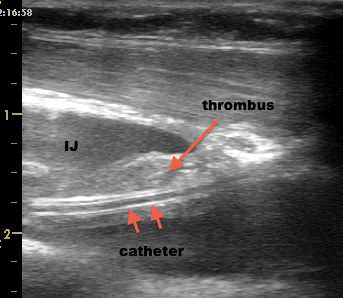
A 55 year old man admitted to the ICU for sepsis, recovering multi-organ failure with persistent culture-negative fever.

Longitudinal view of the left internal jugular vein.

What do you see?

BUPQ5-Q

scroll below for an answer!


BUPQ5-A


Thrombosed internal jugular catheter. This patient was anticoagulated. The fever disappeared within a few days and the thombosis decreased significantly.  It is difficult to be certain whether the fever was a cause but examining central lines is part of our fever workup.

Armani suits and recipe therapies…#FOAMed, #FOAMcc

Just a quick word to relate an interesting conversation I had with a colleague last evening.

I was taking over an ICU for a night’s coverage and going over the sicker patients with the current daytime attending, my friend and highly esteemed colleague Edgar Hockmann.  We were discussing a particularly challenging case of a young (40’s) patient with staph aureus sepsis and MSOF, and trying to come up with some tweaks, and ended up discussing the concept of tailored therapy to each patient’s physiology, which is right up my alley of N=1 thinking.

Now, as background, Edgar is a particularly bright guy who routinely challenges dogma, whether his own or others’, and I always learn from any conversation with him.  He has given awesome lectures in our conferences for the past several years. In this case (in addition to some fascinating microcirculation stuff I will have to digest and regurgitate at some point), he gave me a great teaching analogy:

Asking the question “what is the best treatment for disease x?”  is essentially analogous to asking “what’s the best size for a suit?”

You can debate it all you want, but ultimately, if you’re a 46 short or a 38 tall, the 42 regular on the store manikin won’t look too good on you.

And so I may be reiterating myself, but it is really key to assemble all the physiological evidence you and (physical exam, ultrasound, laboratory, etc…) and try to determine what this patient needs, not what most patients would need in a similar situation. Fluids in or fluids out? Which type of fluid? Blood pressure goals (MAP of 65 for everyone…really…)? Urine output goals?  We’ll try to go over each of these in the next weeks/months.

It’s a lot easier to follow a protocol.

…but my guess is that if you went to Savile Row, I doubt you’d see Shaquille O’Neal and Danny De Vito walking out with the same suit…the haberdashers would be fired…

Philippe

The Ideal Resuscitation Fluid – an N=1 Podcast #FOAMed, #FOAMcc

So here is the first in a series of mini-talks geared towards having us think about fluid resuscitation, which, for those in acute care of almost any type (ER, wards, ICU, anasthesia, surgery, etc…) is part of our daily routine. And that’s exactly what it shouldn’t be, routine. It should be carefully thought out and adapted to each individual clinical situation we’re facing.

So I’ve decided to approach this from a completely different angle, not looking at what we do, what’s available, and see what has been stacked up against what, etc, etc… Instead, I’ve decided to start the discussion from a completely theoretical standpoint and talking about something that doesn’t exist:  The Ideal Resuscitation Fluid.

Please, let me know your thoughts!

Philippe

http://www.ccusinstitute.org

(sorry the last 40 seconds were cut – now the “full” 5 minutes are up!  apologies, I am techno-challenged!)