
H&R2025 – The Hospitalist & The Resuscitationist, Montreal, Main conference May 22-23, pre-post courses 21 and 24, 2025. #HR25 – REGISTRATION is OPEN !!!

A few words about it…

HR2025 is about putting it all together. We’ve been talking about the venous side for a long time and it has been fantastic seeing how much it has taken off – at least in the #medtwitter #foamed and PubMed community. There’s enough data out there to show a real clinical utility of consciously examining the venous compartment. This applies to any hospitalized patients, whether in the ED, the wards or the ICU, so that’s why this year, the H and the R will spend the first day together doing all things VExUS and venous congestion, along with the corresponding workshops, again so that participants can leave with some actionable knowledge and skills. Whether you’re a beginner at this or a seasoned veteran, there should be something to learn.

On Day 2, we’ll divide into two tracks. The R side will deep-dive bedside hemodynamics and our 4-interface model of shock management. Of course there will also be some pearls and late-breakers as this is still a year away and there will undoubtedly be some really interesting things cooked up by the crew by then! 

Meanwhile on the H side, Katie and Gigi are thrilled to have put together a top-notch lineup of speakers to teach everyone how to become Inpatient Medicine Jedis. We have some big names in attendance this year, including both new and familiar faces – The Clinical Problem Solvers themselves will take us through some challenging cases; Frederik Verbrugge will drop diuretic truth-bombs; the ever-fabulous @NephroPOCUS will discuss a Bedside Approach to AKI; and Allison Bond will share the Top 10 Infectious Disease Mistakes on the ward, among many others! Day 2 Workshops will be focused on high-yield test interpretation: think EKGs, PFTs and sleep studies, urine microscopy, peripheral blood films, and more! 

https://player.vimeo.com/video/1022725950?h=825106f34a&badge=0&autopause=0&player_id=0&app_id=58479


And as always, the ethos of H&R is about putting together physiological clinicians who love to both push the envelope and share their knowledge and experience. The energy that comes out of this is really quite unique, and the sheer number of successful collaborations that have stemmed from it since 2018 is really impressive. The unplanned, unscheduled small group discussions are the true gems of this conference… Many of the usual suspects will be there, and as always some new additions to the H&R family!

Who? I can’t say enough about the H&R crew. Brilliant, open minded, eager to both learn and teach, no large fragile egos here. So expect to learn from and hang with Sara Crager, Korbin Haycock, Rory Spiegel, Matt Siuba, Eduardo Argaiz, Gigi Liu, Ross Prager, Frederic Verbrugge, Vimal Bhardwaj, Glenn Hernandez, Andre Denault, Jon-Emile Kenny, Ashley Miller, Segun Olusanya, Max Hockstein, Ben Daxon, Abhilash Koratala, as well as some new faces to the live event, very much looking forward to meeting Trina Augustin from Mayo as well as another critical care icon, Professor Jan Bakker, and I’m happy to announce the return of the true father of POCUS, Daniel Lichtenstein, and we will even have the amazing opportunity to (virtually) hear from Dr. Geoff Parkin, one of the pillars of hemodynamic physiology! There are a few more to confirm and we promise they will bring the same enthusiasm and unique experience to the event!

So the most important thing for you to do is to mark your calendars and make sure you don’t miss being a part of it! Bookmark this page as the registration link (november 1) will appear as well as developing programme information! Note that registration fees will be in USD given the international nature of the conference.

Montreal, May 21-24. Core conference May 22-23, Pre and Post-courses May 21 and 24.

Pre/Post congress preliminary courses

  1. BJJ or Self-Defense for Humans & Health Care Workers (May 21st pm)
  2. The VExUS Course (May 21st am)
  3. ArrestTEE Sim Cases (May 21st)
  4. The Great Presenter by Marco Garrone (May 21st am)
  5. Sauv Life (eCPR) by Paris’ Lionel Lamhaut! (May 24th)
  6. Bedside EEG for EDCritters? (TBA)
  7. SEVA Ventilator Course by The Cleveland Clinic’s Eduardo Mireles-Cabodevila! (May 24th)
  8. ResuscitativeTEE Workshop by Felipe Teran (May 24)

for more on these see https://thinkingcriticalcare.com/2024/10/26/hr2025-pre-and-post-courses-hr25/

if there’s a course you want, go ahead and get in touch with us! hospresusconference@gmail.com or via twitter with #HR25 tag.

Schedule 

Day 1 – May 22 

Time Talk/Workshops Faculty 
0800-0815The Concept of Fluid ToleranceRory Spiegel 
0815-0845Bedside Cheat Code – Femoral DopplerVimal Bhardwaj and Andre Denault 
0845-0915An update on the Hepatic VeinEduardo Kattan 
0915-0945Understanding Portal Vein Doppler  William Beaubien-Souligny  
0945-1015Coffee Break
1015-1045Renal Venous Doppler – RVSI and VExUS Eduardo Argaiz (virtual) 
1045-1115eCPR and Organ DonationLionel Lamhaut 
1115-1215Workshops:Mastering the IVC assessment


Hepatic and Portal vein assessments 

Intrarenal hemodynamics

Femoral vein

How I assess congestion at the bedside (Virtual workshop) 

Rory Spiegel, Juliana Kan and Audrey Lacasse Eduardo Kattan and William Beaubien-Souligny
Abhilash Koratala and Korbin Haycock 
Vimal Bhardwaj and Andre Denault 
Ross Prager 
1215-1300Lunch 
1300-1330 Keynote Lecture – The Evolution of Venous Congestion AssessmentAndre Denault 
1330-1400Pulmonary congestion: Mastering lung USDaniel Lichtenstein 
1400-1430 Practical Diastology: Will my Pt get Pulmonary Edema?Frederik Verbrugge
1430-1530Workshops:Diastology, E/e’ and LA size


CVP using Jugular POCUS  (Virtual and in person workshop) 

Lung US

RV assessment (TAPSE, S’, RVH, PASP)

Beside Cerebral Oximetry in congestion

Frederik Verbrugge and Max Hockstein

Jon Emilie Kenny and Korbin Haycock

Daniel Lichtenstein and Marco Garrone 
Matt Siuba, Andre Denault, Juliana Kan and Audrey Lacasse
Phil Rola and Masimo 
1530-1545Coffee break 
1545-1615Fluid Tolerance in the ED – Is It Pertinent? Marco Garrone 
1615-1645Minute Ventilation: Physical Exam Hack?Rory Spiegel
1645-1715Clinical Cases: CongestionAbhilash Koratala

Day 2 – May 23

Time H side talks Faculty R side talks Faculty 
0800-0830 Clinical Problem Solvers: Challenging CasesReza Manesh and Rabih Geha Intro to the circuit & interfaces Sara Crager 
0830-0900Clinical Problem Solvers: Challenging CasesReza Manesh and Rabih Geha0830-0850: What is Coupling?Jon Emilie Kenny 
0900-0930Immune Checkpoint Inhibitor Toxicity

0930-0940: Buffer 
Laura Cappelli 0850-0910: Understanding MSFP

0910-0940: Resurrecting Blood Pressure. Curious Cases of B12 for Vasoplegia
Ashley Miller and Korbin Haycock 

Ben Daxon 
0940-1040Workshops:Approach to acid-base problems (Virtual and in person workshop) 

Rory Spiegel 


Workshops:LVOT VTI 


Capillary refill time


POCUS AMA


Hemodynamic Pearls Part 1 

Sara Crager, Trina Augustin and Jeff Scott  
Glenn Hernandez and Eduardo Kattan

Jay Chatterjee, Jon Emilie Kenny and Marco Garrone
Ashley Miller
1040-1110Coffee break 
1110-1140Oncologic EmergenciesAditi Singh Interface 1: LV-VA coupling & How I Measure it Max Hockstein 


1140-1210Bedside Approach to AKIAbhilash KoratalaInterface 2: Macro-Micro Glenn Hernandez  
1210-1300Lunch 
1300-1330Keynote Lecture –  “Fill him up to his eyeballs.” Jan Bakker 
1330-1400Acute decompensated heart failureFrederik VerbruggeInterface 3: Capillary-Venular Eduardo Kattan
 
1400-1430High output heart failureEduardo Argaiz – (virtual)Interface 4: RV to PAMatt Siuba 
1430-1530Workshops: Urine electrolytes and microscopy  
POCUS AMA

Abhilash Koratala 


Daniel Lichtenstein and Sara Crager  
Workshops: POCUS RV-PA coupling
PA catheter (3 simulators)


Hemodynamic Pearls Part 2 (Virtual and in person workshop)

Matt Siuba and Korbin Haycock 
Katrina Augustin, Jeff Scott and Andre Denault
Ashley Miller 
1530-1545Coffee break
1545-1615Management of Non-Insulin medications in the hospitalized patient Elias Spanakis Can Starling and Guyton Collaborate at the Bedside? Geoff Parkin and Segun Olusanya (virtual) 
1615-1645Next level BiPAP and CPAPSegun Olysanya (virtual)Impella in Cardiogenic Shock – What Every ER and ICU Doc oughtta know!Katrina Augustin 
1645-1715Top 10 Infectious Disease Mistakes on the WardsAllison Bond Putting it All Together Rory Spiegel 

Registrationhttps://ccusinstitute.wixsite.com/ccus/events/hr2025-fluid-tolerance-all-things-vexus-shock-hemodynamics

There will be a number of different registration options so please select carefully. Please note that for online-only registrants, we will follow a fee scale using the World Bank country classification system, so click the link below if you’re not sure what applies to you (this applies to where you live/work, not your country of origin).

https://blogs.worldbank.org/en/opendata/world-bank-country-classifications-by-income-level-for-2024-2025#:~:text=Explore%20the%20updated%20World%20Bank%20country%20income%20classifications%20for%202024-2025,

Scientific Committee – Dr. Philippe St-Arnaud (Santa Cabrini Hospital, Montreal), Dr. Benjamin Daxon (Mayo Clinic, Minnesota), Dr. Rory Spiegel (Medstar Health, Washington, DC), Dr. Katie Wiskar, (University of British Columbia).

Cancellation policy: Cancellations until April 15th will be accepted and refunded minus a 5% administrative fee. Cancellations until May 1st st will receive 50% refund, and after that date no cancellations will be possible.

Hotel Information: as the hospital is in a residential area there really isn’t very much around. We suggest finding a hotel on the east side of downtown Montreal (east of University ave) or in Old Montreal, for the enjoyment of the city after the conference, especially if travelling with companions. We have found that better deals can be had using websites rather than for us to secure a conference rate (usually +30%). Priceline/expedia/booking.com are fairly reasonable. The hospital is about 20 minutes by uber/cab from these areas.

Thanks to our Sponsors!!!!!

The Resus Tracks: Medical Arrest REBOA with Zack Shinar! #FOAMed, #FOAMcc

So I’ve had the pleasure of knowing Zack for a few years now, ever since he and Joe Bellezzo (the EDECMO Team – along with Scott Weingart) came up to Montreal to teach at CCUS 2013 where they first told us about ECPR. I was instantly hooked, and after the CHEER Study came out in 2014, have been on the path to get this going in my shop, Santa Cabrini Hospital in Montreal, Canada. A tall order for a Canadian community hospital, but hey, I’m in the business of saving lives, and always felt and will feel that any patient crossing thru into a hospital I work in should get the best care that my team and I can possibly put together.

I think any invasive procedure is within the reach of any dedicated resuscitationist with reasonable procedural experience, with the proper training, and inserting ECMO cannulae, and Joe and Zack, a couple of awesome ED docs, showed this clearly. Its use is now spreading, and though there are – as always – many pundits, there is little question that this technique can save lives – the key being selection and subsequent management.

So here Zack tells me of another potential use for a tool I really like. We have recently acquired this technology and I’m looking forward to using it. REBOA is a tool used to control bleeding – a non-surgical cross-clamping of the aorta. But here, we explore how it might be used in another, more common setting… and I love the physiology of it!

Here you go – and apologize if it may be a bit choppy as we had connectivity issues, but I think Zack’s message comes out nonetheless!


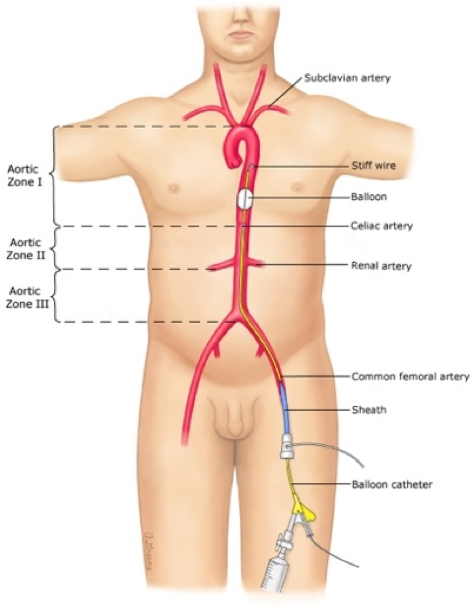
This is what a REBOA looks like:

You can see how aortic occlusion beyond the takeoff of the left subclavian will concentrate CPR-generated blood flow to coronaries, cerebral circulation and arms, none being “lost” to the viscera and lower extremities. This makes ROSC more likely by improving coronary perfusion pressure and may improve neurological outcome by improving cerebral perfusion pressure.


Oh yeah, and anyone who enjoyed this, going beyond the cutting edge, don’t miss H&R2020, whose ethos is just that. Physiology and going beyond the cutting edge. A REBOA workshop will be part of the Resus Toolbox – one of the pre-conf courses!

cheers


Philippe

The Resus Tracks: Trans-Pulmonary Dilution Catheters in the ED…myth or reality? #FOAMed, #FOAMer

So anyone who knows Korbin (@khaycock2) realizes he is a true trailblazer in the ED, essentially doing cutting edge critical care from the get go in his shock patients. In my mind this should be the goal for any critically ill patients, that they get the highest level care right at entry and for however long they may be staying in the ED until they get to the ICU.

So today, I was really happy to corner Korbin lounging somewhere in sunny California (as 6 inches of snow come down hard in Montreal) to tell me how he is using this technology in his resus patients.


So this has got me interested in using this technology. I see it as an early warning signal that your patient may be less fluid tolerant than you may think, and that the signs of pulmonary fluid intolerance I use (oxygen requirement, appearance of B lines (FALLS Protocol-style), etc…) have yet to manifest.

So I’m looking forward to hearing Korbin explain this further (during H&R2020!) and in actual cases where the change in management is clear.


cheers


Philippe


H&R2019 Lecture Series: Felipe Teran on Intra-Arrest Hemodynamics! #FOAMed, #FOAMcc

Here is an awesome lecture by Felipe Teran from this year’s H&R:


In resus, there is no one size fits all.


For anyone who missed H&R2019, you can still catch the Essentials!


But more importantly don’t forget that registration for H&R2020 is now open!


cheers!


Philippe

The Resus Tracks: A Chat with Domagoj Damjanovic! #FOAMed, #FOAMcc, #FOAMer


So I recorded a chat with Domagoj (@domagojsono in the twitterverse), an anaasthetist-resuscitationist-intensivist from Freiburg a few months ago, but with H&R2019 and its aftermath, been slow in processing a lot of stuff I’ve got stocked… Apologies!

So in this one, DOmagoj and I discuss a bunch of resus topics, from eCPR to tissue oximetry. I’m really jealous of the fact that he does prehospital work with an ECMO van!!! …and with cool gear and of course, POCUS!

Here is the chat, hope it leads to thoughts, discussion and contribution!

And here are some links:

low budget ultrasound simulation
and here’s the editorial in Resuscitation,

cheers


Philippe


RV Doppler: Resistance vs. Back Pressure. Jon-Emile Kenny & Korbin Haycock! #FOAMed #FOAMer #FOAMcc #POCUS

So I’m still trying to digest the RVOT Doppler physiology and working my hand at generating the best views and Doppler angles I can (See previous post on RVOT Doppler here). Not sure yet how this will fit in to my clinical practice but I think it’s worth shining a light into this murky pseudo-science of resuscitation. These guys are helping define its potential use… Naturally, this is bleeding-edge stuff. Use it to try to understand what’s going on with your patient’s physiology, don’t use this on board exams! My comments in bold.

Now for the big guns…


Jon-Emile Kenny (@heart_lung), pulmccm.org, heart_lung.org

Hey Guys – great discussion as always!
One thing that I find confusing on this topic, and is helpful – i think – when scrutinizing the literature, is the difference between ‘impedance’ and ‘resistance.’ Elevated vascular ‘resistance’ is often used too broadly; for example, true/pure WHO II pulmonary venous hypertension [say from acute left atrial pressure hypertension, but before chronic, compensatory pulmonary arterial changes] is actually typified by a *decrease* in resistance, but an increase in *impedance.* To make things more confusing, acute left atrial hypertension will often display a high “resistance” mathematically … even though, the true resistance can be low. What am i saying? if you imagine an acute increase in the left atrial pressure, the pulmonary venous beds and pulmonary vascular beds “recruit and dilate” backwards [why we see cephalization on the CXR] typically from the bottom to the top of the lungs up the hydrostatic gradient. Recruitment and dilation actually *increases* the cross-sectional radius/area of the vascular beds — a true decrease in resistance [Poiseuille what?]! But, as these vascular beds are engorged, they reach that infamous, hockey-stick-shaped compliance curve point [go leafs go!], where the vessels become really stiff … that is, the compliance falls such that each ejection the RV throws into this dilated circulation, the pressure rises dramatically [especially the systolic pulmonary pressure] …

This I think is a key concept to understand and keep in mind when analyzing the venous system. The physical characteristics are more akin to a floppy plastic bag or balloon, with little rise in pressure until a certain point, then a sharp one – Jon’s “hockey stick.”  It was Jon who made me realize that, with exposure to chronically elevated right atrial pressures, one could have a very big IVC (say 25-30mm, but in fact a low CVP, whereas in normal IVCs exposed to normal CVPs, that sharp rise in pressure probably occurs somewhere around 20mm. Hence, the + value we use in the PAP calculation using TR Vmax for the RAP may be very inaccurate in chronically elevated PAP… Food for thought.

Thus, the calculated pressure gradient rises and and the calculated resistance falls, but what has actually happened is that compliance has fallen, not “resistance”. More broadly, the term “impedance” is composed of compliance, resistance and something called the characteristic impedance [the Windkessels!]. Typically what abnormal RV Doppler shows you is that *impedance* has risen. At the end, you are often still left with the why? Impedance can rise when “true resistance “falls, but compliance also falls [as above] – yet the calculated RVSP/regurgitant jet will also rise. The linked papers are fantastic, but they both excluded patients with left heart disease, so you can be more confident that the RVOT abnormalities seen are related to true ‘pre-capillary’ problems. I’d be willing to bet [and if there’s data, i’d be interested to read it] that patients with pure WHO II pulmonary venous hypertension have very similar abnormalities on the right side. The key means to distinguish – as Korbin talks about – is really looking at the left heart [E/e’] and clinical context to get a better sense of what’s going on.

What would also be interesting would be to look at acutely “decompensated” true left heart disease in volume overload and correlated with RVOT morphology and great vein Doppler velocimetry. My guess is that as you decongest the pulmonary veins [increase their compliance] that the RVOT envelope “pulsatility” goes away [the RV ejection envelope appears more rounded] as does the venous pulsatility in the great veins and intra-renal veins! It’s all about energy transfer … moving away from excessive potential energy trapped in distensible structures [i.e. congestion] to kinetic energy [normal, forward blood flow]

Jon.


Korbin (@khaycock2)

Thanks for the reply Jon-Emile, as usual you bring an incredible amount of intelligent well thought out points.

As you mentioned, afterload is much better described in terms of the 3-element Windkessel model as resistance is only one component of said model (the other factors being vascular compliance and characteristic impedance). Please correct me if I’m wrong, but I believe that the most practical and easiest way to non-invasively determine arterial load is to calculate the Ea (formula: (SBP*0.9)/SV). This would include all of the factors that determine afterloading conditions instead of simply using resistance as it is only one of those factors.

Clinically speaking, I think it is important to address why afterloading conditions are abnormal when we come across undifferentiated pulmonary HTN in the acute setting. Practically in my mind, this is simply finding if the pHTN is due to post-capillary “back pressure” from elevated left atrial pressures or due to elevated pre-capillary pulmonary vascular resistance (or could be some combination of both of course). Both of these conditions can cause elevated pulmonary artery pressures, as you have pointed out, and there are a few other contributors to the afterload as well that we are ignoring (or else we’d blissfully nerd out all day and forget to take care of the patients).

I agree with this concept. This is what may direct me to use pulmonary vasodilators, whether inhaled or even the choice of milrinone or vasopressin (not a vasodilator per se but a non-pulmonary vasoconstrictor). If all the pulmonary hypertension is post-capillary, there would be little or no benefit. This important decision point is what prompts me to look into this whole right-sided Doppler thing… Let’s see what else Korbin has to add! 

So how can find out the cause(s) of the elevated PAP? Is it resistance or back pressure from the left atrium? This is essentially the topic of the post. Because PVR=(mPAP-LAP)/CO, it has been suggested that the TR gradient can be a surrogate for the mPAP-LAP and RVOT VTI be a surrogate for CO. Thus if the ratio is high, we can assume that a significant component of the pHTN is due to resistance in addition to or to the exclusion of the contribution of LAP. You have rightly questioned and very well explained why you wonder if these are valid assumptions that translate to the finding the clinical causes of pHTN.

You pointed out that the cited papers in the post excluded patients with LV failure, thus bringing into question if the TR/VTI ratio methods and their permutations are actually detecting PVR as the primary etiology of the pHTN or are corrupted by elevations in LAP. Here are 3 papers that included a significant number of patients with pHTN and elevated PCWPs as measured by RHC that show that the TR/VTI methods do seem to work to detect PVR elevations themselves even if the LAP are high:

1) Am J Cardiol. 2013 September 15; 112(6): 873–882. doi:10.1016/j.amjcard.2013.05.016.
2) J Am Soc Echocardiogr 2013;26:1170-7.
3) J Am Coll Cardiol 2003;41:1021–7.

Somewhere in my files I have a study that shows that the mid systolic notch is fairly specific for high PVR and independent of LAP as well. but apologies, I’d have to look for it.

As I might have mentioned in the audio portion of the post (I can’t remember), there is a second method to flesh out PVR from LAP causes of pHTN. First, you need to find a good estimation of the LAP. ECHO has multiple ways of various accuracies to get a number. The formulas are listed above. I don’t believe any of them are validated in acutely sick patients though. Once you have a LAP number, turn your attention to the pulmonary valve regurgitant jet which will almost always be there if there’s pHTN. The wave form is sort of down-sloping trapezoidal lasting through diastole. The velocity at end-diastole can be squared, multiplied by 4, then added to the RAP to give you the end-diastolic PAP. This is normally < 6 mmHg higher than the LAP pressure measurement, if it is a bit more higher, there likely is increased PVR. This is the same principle used in a RHC, where the inflation of the balloon stops flow and therefore eliminates resistance so that the PCWP can be measured and differentiated from the dPAP. The problem with this method is that it doesn’t work as well as the TR/VTI methods

I really enjoyed your thoughts about how Doppler waveform patterns may be affected once compliance limits have been reached, and I’m sure there is something to this that is real as well no doubt! I thought it might be helpful to provide you with the additional studies that included the patients with high LAP, and do a bit of re-explaining/restating your points to anyone new to this stuff.

Thanks again Jon!

Jon replies:

Hey Korbin – thanks for the references – I’ll dig into them. My main concern is that the mPAP-LAP will disproportionately rise (mostly because the sPAP disproportionately rises) when the left atrial pressure is high … that is when it’s actually not a “resistance” problem but rather a back pressure problem, the mathematical resistance is high. As you mention, this is why there’s a push to move away from “PVR” with RHC and more towards the dPAP-PCWP gradient which should be less than 6 mmHg. I made a cartoon describing this in an old post (https://pulmccm.org/critical-care-review/icu-physiology-1000-words-folly-pulmonary-vascular-resistance/). Thanks for these references, I’ll read them and see if they make sense from the framework I’ve adopted – which is entirely stolen from this great article

Naeije, R., et al., The transpulmonary pressure gradient for the diagnosis of pulmonary vascular disease. Eur Respir J, 2013. 41(1): p. 217-23.

Maybe Phil should do a point-counterpoint podcast where Rory comes in at the end and shakes his head because nothing really matters in the end.

“Nihilism rules…”

Jon

Korbin:

Thanks Jon, I would like to see what you think. Thanks back at you for the reference you mentioned in your reply. And you’re hilarious!

Jon replies:

I had a read of the references that you provided, thank you. I think my concerns still apply, however. My main concern is what is being used as the gold standard for ‘pulmonary vascular resistance.’ An elevated calculated pulmonary vascular resistance (e.g. in WU) doesn’t actually tell you where the pathology is. the assumption is that an elevated calculated pulmonary vascular resistance is caused by a high pre-capillary resistance in the pulmonary circulation, but this isn’t necessarily true. as i showed in that post that i linked to (https://pulmccm.org/critical-care-review/icu-physiology-1000-words-folly-pulmonary-vascular-resistance/) … if one were to acutely cross-clamp the descending aorta, below the diaphragm, the calculated pulmonary vascular resistance would rise, even though the pathology is totally outside of the thorax!! i have no doubt that the TRV / RVOT-VTI would also rise in that very same patient with the cross-clamped descending aorta such that the good correlation between the calculated ‘pulmonary vascular resistance’ and the TRV / RVOT-VTI is maintained – but the pathology is in the abdomen – not the pulmonary vascular tree! So many exclamation marks; but i’m not yelling. In a hypothetical patient with a cross-clamped descending aorta, one might be tricked into giving a pulmonary vasodilator — but that would be the absolute wrong thing to do, even though the calculated pulmonary vascular resistance is high. The treatment is to afterload reduce the struggling LV (remove the cross clamp) — which would then lower the calculated “pulmonary” vascular resistance and the TRV / RVOT-VTI.

the problem in reasoning lies in what happens with the left atrial pressure rises (as would happen if one acutely cross-clamped the descending aorta). it is assumed that as the LAP rises that the mPAP – LAP gradient stays the same or rises in proportion. but what happens when the LAP rises is that the mPAP rises disproportionately because of pulmonary vascular engorgement/stiffening (in fact, the pulmonary vascular resistance has fallen because of recruitment and dilation of the pulmonary tree). what *does* rise in proportion is the dPAP – LAP gradient [should stay below 7 mmHg]. i strongly suspect that the ability of the TTE to detect/calculate the dPAP – LAP gradient is not yet refined enough because there is a lot of supposition and inference when making dPAP and LAP measurements with pulsed wave Doppler.

alas, with either an elevated TRV / RVOT-VTI (or calculated pulmonary vascular resistance from a RHC), one still doesn’t know if it’s purely a left-sided problem (e.g. purely elevated LV afterload) – which could seriously alter management. to know that, i think that a full interrogation of the left heart and pulmonary veins must be done before knowing exactly what an elevated TRV / RVOT-VTI specifically identifies. in addition to that vascular resistance post above, i dug into some more of this in a discussion on the SIOVAC trial a while back (https://pulmccm.org/randomized-controlled-trials/choose-wisely-avoid-sildenafil-pulmonary-hypertension-corrected-left-heart-valvular-disease-siovac-trial/) – which, in my opinion, should never have passed ethics.

Jon

So this is really fascinating stuff. I must admit both Korbin and Jon make excellent points, and for now am not sure if and how to use RV Doppler in clinical decision-making, but until then will be sure to polish up these skills so that they are ready for prime time, and use them in observation of physiology in my shock patients. We’ll see what conclusions I draw.

cheers


Philippe

Exploring the Pulmonary Vasculature with Korbin Haycock: RVOT Doppler. #FOAMed, #FOAMcc, #POCUS

So some recent twitter discussions, particularly involving my friend Korbin (@khaycock2) and Lars (@LMSaxhaug) – whom I am trying to get on the podcast soon – were really fascinating in regards to RV and pulmonary hypertension assessment. So time to dig into this a little.
The basic POCUS RV assessment is RV:LV ratio and TAPSE, along with RV free wall thickness (should be below 5mm) and the D sign in parasternal SAX. This is a solid start to screen for significant RV dysfunction.
The next level should be to measure PAP using TR Vmax, in order to assess the degree of pulmonary hypertension. Thats pretty much where I’ve been at for the last few years and wasn’t sure there was really a lot more that was necessary from an acute care standpoint where your immediate questions are fluids/pressors/inotropes and some inhalational pulmonary dilators. I wasn’t convinced I needed more.
But of course Korbin and Lars are on another level, and started to talk about doing RVOT doppler and looking at TR Vmax to RVOT VTI ratios to estimate pulmonary vascular resistance. Is there any difference there? Is my PAP not enough? Well, turns out there may be some useful information there, so I will let Korbin do the talking, and my apologies for my dumb questions during this discussion!
So I will be toying with RVOT doppler and trying to see if this is something that warrants a place in acute care management. I suspect it may be something that may tip towards earlier inhaled vasodilator therapy, or else make not using them a more confident choice. I do like the waveform analysis. I think we generally overlook a lot of good info by focusing on numbers over morphology!
So far, images using the PS SAX view have been quite good:
Additionally, RVOT notching could be suggestive of an acute PE – makes sense (study link here!)
Here are a couple of excellent references:
So thanks to Korbin and Lars for forcing me to up my doppler game some more!
cheers
Philippe
Formula Fun:
Tricuspid regurgitation pressure gradient for sPAP:
sPAP=4*(TRvelocity^2) + RAP or
sPAP=TRpg +RAP
mPAP=(sPAP)*0.61 + 1.9
Acceleration time equations for sPAP and mPAP:
sPAPlog= -0.004(AT) + 2.1
mPAP=90 – (0.62*AT)
Pulmonary Regurgitation pressure gradient:
mPAP=4*(Peak initial velocity^2) +RAP
dPAP=4*(End velocity^2) + RAP
dPAP-PCWP should be about <6mmHg or else PVR is likely, see PCWP equations below
PVR equation to screen for increased PVR, or if PVR < 3 WU:
PVR=10*(TRvelocity/RVOT VTI) + 0.16. TR velocity is in m/sec, if <2 WU, no increased PVR.  This equation is accurate up to 3 WU
PVR equations for increased PVR > 3 WU.  These equations less accurate if PVR < 3 WU:
PVR=5.19*(TRvelocity^2) – 0.4, or more simplified: 5 * (TRvelocity^2). Note that the 5 * (TRvelocity^2 is almost sPAP equation (4 * TRvelocity^2)=sPAP
PVR=sPAP/RVOT VTI if no RVOT notch present
PVR=(sPAP/RVOT VTI) + 3 if RVOT notch is present
PCWP equations (for detection of group 2 pHTN to elevated sPAP), as you know, this is a whole other area, and gets a quite a bit more complicated, but to summarize:
PCWP likely elevated if E/e’>15, unlikely if E/e'<8
In NSR, PCWP=1.24 * (E/lateral e’) + 1.9
In ST, PCWP=1.5 * (E/lateral e’) + 1.5
In atrial fibrillation averaged over 5 beats, PCWP=0.8 * (E/lateral e’) +6
Using color M-mode and propagation velocity: PCWP=5.27 * (E/Vp) + 4.6

A Synopsis on Fluid Resus Parameters. #FOAMed, #FOAMcc, #POCUS

Hi, so my good friend Jeff Scott, ED/ICU doc and serious POCUSologist, asked me to summarize our current approach to fluid management, which is an amalgam of literature, physiology and bedside medicine-based evidence.

A few points to emphasize:

  1. does my patient need fluid/ will he/she benefit from fluid.
  2. is my patient fluid tolerant
  3. is my patient fluid responsive – yes, it’s the last and least important

I figure we may follow this up with a discussion – that’s often the best way to get to the real clinical decision points, and it’s always interesting to hear the questions and ideas that come up, so looking forward to it!

I figured might as well make a mini podcast of it, so here it is:

cheers


Philippe

“Volume Status” and other meanderings. #FOAMed, #FOAMcc, #FOAMer #POCUS

So the discussions go on about volume status and POCUS, and recently one in particular made me realize that it is important to reframe the way we think about “volume status.” As Segun Olusanya (better known as @iceman_ex) said, “the IVC is not a fuel tank indicator,” and indeed it is not. But even if it was, would that be useful? If somehow, an 18 mm IVC (short axis circular or average of course!) corresponded exactly to a 0.70 ml/kg blood volume, would that be of any use?

No. Of course not.

I get asked this question in consult a lot. So I could be a stickler on principle and answer, whether verbally or in a consult, that the volume status cannot be precisely ascertained using POCUS, and keep walking down the hospital hallway.

But let’s instead reconsider the true clinical question for a moment. What does “volume status” mean when requested by a colleague. The truth is that he or she is likely asking you whether there is a need to give fluid, remove fluid, or stay the course.

Ahhhh. Now POCUS, the IVC and its friends can help. A lot. A lot more that most clinical examinations and chart reviews of weights or ins and outs can. Way more. Why? Because if you are cool, with a normodynamic heart and a small IVC, you are on the low side of volume. Now you may also have a lot of B lines from your pneumonia and the lack of volume tolerance will give your answer to be very careful with fluids. If you are warm and hyperdynamic with a small IVC and totally clear lungs, no elevated ICP and a soft belly, you may just be vasodilated but, if your BP is on the low side, some fluid is a fair go, so long as you follow closely thereafter for fluid stop points. If you have a low urine output, a big IVC, a pulsatile PV and a poor LV, you probably need lasix, no matter how clear your lungs are and even if your creatinine is rising, in fact, especially since it is rising.

The permutations are myriad. But that’s why we have MDs and are supposed to be able to integrate bits and pieces of physiological data to come up with an understanding of our patients. And POCUS gives us an unprecedented bedside view into this physiology.

So if you do have legit POCUS skills, and are able to do a bit more than a long axis M mode of the IVC, then try this instead:

“Sure thing, now tell me a bit about your patient – I imagine you’re debating whether to give some fluids or diurese?”

Forget about volume status in terms of absolutes. Just think of what the clinical question is, and give your colleagues the answers they need.

I think the patients will do a lot better that way.

I’ve already put up a lot of stuff about the IVC here over the years.

cheers


Philippe

Venous Congestion from different Clinical Standpoints. #FOAMed, #FOAMcc, #FOAMus


So last week sometime we had an interesting twitter exchange which made me realize it is important to explain how some of us are using venous POCUS in different clinical scenarios, which is key, because the development of monosynaptic clinical reflexes with POCUS findings is a rabbit hole we should try not to go down. Instead, POCUS should be about asking the right question and taking that answer as a piece of the pathophysiologic puzzle facing us, which may mean intervening sometimes, and sometimes not, for the same given finding, but with different surroundings.

Here is the twitter exchange.

Thanks to those involved in that discussion – it is how we grow!

And here are some thoughts:

For those not up to speed on venous congestion POCUS I put up the chapter that Korbin Haycock, Rory Spiegel and I worked on in this earlier post.

Here are Korbin’s thoughts on this:

I’m very glad Dr. Eduardo Argaiz pointed this case out, as it brings up considerations apropos both chronic venous congestive cases as well as management of acute illness, particularly in sepsis, where we would expect patients to most likely be fluid responsive, but fluid tolerance is largely overlooked with current management strategies by the majority of clinicians.

Phil’s above audio commentary points out the difference is these two broad categories very nicely. If you didn’t listen to it–you should.

With respect to chronic venous congestive conditions, the knowledge and application of Doppler assessment to therapy will hopefully be the next advance in management at large. Already, I think there is more than adequate research available to show the value of Doppler POCUS (D’POCUS, D/POCUS, or DPOCUS?) in managing these patients. It’s only a matter of clinicians willing to commit to learning and integrate this technology into their skill set.

With respect to resuscitation of the acutely ill patient, there is by far less data, and we are probably into the realm of N=1 here, in terms of how to manage these patients. But, I personally believe–and I understand this is my opinion–that current trends in resuscitation (especially sepsis resuscitation), largely ignores the effect of over volume resuscitation and the potential downstream damage inflicted on our patients.

This theoretical damage of over aggressive fluid resuscitation is multifactorial, including glycocalyx shedding issues/endothelial dysfunction, positive fluid balance and EVLW causing increased mortality (which there is ample evidence for, I think), venous congestion leading to perfusion injuries to encapsulated organs, such as the kidney (AKI) and brain (congestive encephalopathy), and end organ edema leading to the perpetuation of a malignant inflammatory syndrome (portal HTN and gut edema).

In the case called out by Dr. Argaiz, (which can be reviewed by the previous post on this website) my patient had an IVC that whilst not plethoric, was not an IVC that one would expect to find in a patient with a typical distributive shock pattern (i.e. increased cardiac output, decreased SVR, and decreased RAP). Firstly, the complicating factor of atrial fibrillation with RVR was central to the patient’s shock state, however this was quickly addressed with rate control. However, in addition, this particular patient did exhibit additional signs of venous congestion. The portal vein was pulsatile and the intrarenal Doppler pattern was interrupted/bi-phasic in nature. Granted, a pulsatile PV Doppler could be interpreted as related to the hyper dynamic nature of septic shock (as the esteemed Dr. Denault correctly cautioned in his comments on the original post), however a less than flat IVC and the intrarenal findings gave weight to a venous congestive hypothesis as a cause the PV findings as well as a possible cause for his AKI evident on his initial labs.

With this particular case, given my personal global POCUS/FOCUS assessment of his increased LAP (high E/e’), RV dysfunction, RAP, PV, and intrarenal Doppler venous pattern, AND that fact that the RRI was insanely high with an AKI, I elected to treat my hypothetical construct of his renosarca with furosamide and his RRI with vasopressin (as the NE infusion did increase his MAP, BUT NOT decrease his RRI–which the vasopressin infusion did decrease, or so I presume as no other therapeutic interventions were given with respect to the time frame the RRI decreased).

In the end his kidneys had recovered by the next morning, which I’m sure that any intensivist will admit is the opposite of the norm, as the kidneys usually get, at least transiently worse initially-being the delicate sissies/whimps that they are. Whether this was because of the diuretic or the vasopressin, or something else, is debatable for sure, but it sure didn’t get better by 30 cc/kg of crystalloid mandated by CMS, because he got not a drop more than what was needed to push the diltiazem, the lasix, the antibiotics, and the vasopressors.

So to summarize, in the case of chronic cardiogenic venous congestion, clinician realization and adoption of Doppler assessment of this entity will likely be the next leap in improvement in the management of these patients. In the case of acute resuscitation, venous congestion may be a bit more nuanced, and a more comprehensive evaluation is in order in a case by case fashion. However, I think recognition of the issues of over aggressive volume administration will probably be the next frontier in sepsis resuscitation.


Love to hear your thoughts!

Cheers


Philippe