Epidemiology: Legends & Facts – The Publication Bias – #FOAMed, #FOAMcc

So until a few years ago I reluctantly admit I was one of those who read the title, abstract, intro and quite diagonally went thru methods and results before starting to pay attention at the discussion.  On one hand I got to read a lot more articles per unit time, but my analysis was rudimentary at best…

That was until a colleague, good friend, judoka and microbiologist extraordinaire Peter Barriga started to shine some light into my epidemiological darkness while teaching me some judo.  So while waiting for his textbook to come out, here are a few principles that I’ve found very interesting, revealing, but also somewhat frightening: in part, they explain the lack of strength and consistency found in much of the medical literature

So let’s look at the publication bias.  This refers to the likelihood that a study will be published in a major medical journal.  Not surprisingly, journals are generally more interested in positive studies than negative ones.  After all, who would be interested in reading a journal where more than half the studies concluded with “well, this didn’t work…”   It would feel like a waste of reading time.

Now, let’s look at our whole p value, a number (0.05) which we are culturally in love with. What does it really mean?  It means that there is a 1 in 20 or less likelihood of the result being purely chance. So let’s say a popular drug for sepsis is studies by 20 teams,  the same study done 20 times could yield 1 positive and 19 negative results – by chance alone.

The question then becomes, which study is picked by a big journal to be published… One of the 19 negative studies or…the positive one?

Fortunately nowadays due to the information age, a study registry exists where all studies – including negative ones – can be found, so that anyone interested enough in a particular topic can dig up all the data and have an accurate assessment, but is that the case for most physicians?  Or do most pick up the big titles of the big journals…?

Hmmm… So I think it is incumbent on all of us to examine the main things we do in our practice, and make sure we have carefully looked at the available data surrounding it, and not just blindly applied guidelines, recipes or whatever our seniors and mentors are doing or have shown us.

more to come on how to make our practice GEBM (good evidence based medicine) rather than just EBM…


Philippe

NEJM Circulatory Shock Review by Vincent & DeBacker: the sweet and the not-so sweet… #FOAMed, #FOAMcc

So if anyone hasn’t read it, here it is:

Click to access Circulatory%20Shock%20-%20NEJM%202013.pdf

I read the article by critical care icons Dr. Jean-Louis Vincent and Dr. De Backer with interest  as I am always keen to find out what the cutting edge is… So here is my take on their review.

The not-so-sweet:

The inclusion of CVP in the assessment. Ouch. No evidence whatsoever. Evidence for lack of correlation to fluid responsiveness… I wonder if they themselves were cringing a little about including it, particularly form the fact that they just put high vs low rather than commit to a value, which makes me think they realize it’s a bit of a trap. (It reminds me a bit of those night-time orders I still sometimes see which say if u/o < 30 cc/hr give a bolus if CVP under 12 or lasix if over 12.  So basically depending on whether that patient’s head is elevated, or if he’s turned on one side or the other, he may go from “needing fluids” to “needing diuretics”…).

The sweet:

First of all, they obviously did an elegant job on description of shock states, and particularly of highlighting the common-ness of mixed etiology shock.

I like that they admitted that the end-point for fluid resuscitation is “difficult to define.”  Any answer other than that would really speak to non-physiological thinking, as I’ve referred to in prior posts/podcasts.

Dopamine: good job on trying to take it off the shelf for shock. As far as I’m concerned, only useful when you’ve run out of norepinephrine, although there is the odd time when you have a septic AND bradycardic patient where it could come in handy…

Bringing some focus on the microcirculation: no recommendations, but that’s appropriate since there are none to be made yet, but this is where the money is in the future, as far as I’m concerned. Once we figure out how to manage the microcirculation (we do ok with the macro circulation) we might forge ahead. But good to point the finger in that direction.

The super-sweet!

I do (not surprisingly) really, really like the fact that they included ultrasound in their assessment protocol, and emphasizing that focused echocardiography should be done as soon as possible.  Very nice. Finally.

Hopefully, this pushes mainstream ED and critical care physicians to realize they need basic bedside ultrasound skills…


Overall, I think it is a good review, certainly worth the read for trainees. I would like to see focus on re-examining and questioning our approach, which could spur readers to embark on research with a different angle. For instance, why do we assume that we need to fill patients to the point of no longer being fluid responsive in order to avoid vasopressors? Is there any evidence for that? Not that I know of…

But, for having put an emphasis on point-of-care ultrasound, it gets a big round of applause from me!


Philippe

Steroids for cardiac arrest…really? My take on the VSE study – #FOAMed, #FOAMcc

So I’ve been asked a few times for my opinion about the VSE study in the last couple of months, so here we go.

JAMA2013;310(3):270-279. doi:10.1001/jama.2013.7832.

First of all, lets look at it from a theoretical perspective.  How would steroids contribute to ROSC (return of spontaneous circulation)?  Hard to believe they possibly could, given the ultra-short timeframe to ROSC – minutes mostly – and the much longer action of steroids.  However, it is quite possible – and in view of this study perhaps likely – that there is an effect on shock and RONF (return of neurological function).

Why?  Post arrest shock results in MSOF due to a cascade of inflammation resulting from the hypoxic insult. Remember that we are not designed to survive these events. Being designed to fight off moderate trauma and infection (eg being bitten by an animal or clubbed by another caveman) our physiological reaction often overshoots the mark resulting in more damage than good, as it does in sepsis (variably depending on our different geno/phenotypes).  So whether liver, kidney or brain damage, some component is not only related to pure hypoxia but also to an inflammatory cascade that has a prolonged effect. This is the same thing we are targeting with cooling, on top of a simple metabolic supply/demand issue, so in terms of biological plausibility, it makes some sense.

In the post-ROSC phase, there is always the possibility of relative adrenal insufficiency – after all, the adrenals have taken a hit as all the other organs did – so again there is biological plausibility.

There’s quite a bit of debate out there as to whether or not to apply this.  I’m pragmatic, not a purist, and my beliefs lie in evidence, biological plausibility and the risk/benefit ratio.  In this case, I think the decision is actually quite simple.  The way I see it, the steroids are harmless and probably helpful, so I have been giving solumedrol in the last few months.

If anything, I’m more concerned about the harm I may be doing with epinephrine/vasopressin, especially in terms of RONF.  I do hope an epi (various doses) vs placebo study is done, because it is difficult to withhold, knowing that there is greater immediate effect on ROSC… Hard decision as the clinician at the bedside, and hopefully this will become clearer in the near future.

For those unclear about the whole epi debate, the physiological issue is that the relationship between pressure and perfusion is represented by an inverted U curve – at very high pressures (from vasoconstriction) perfusion is decreased (think of the extremities on high dose pressers with a decent BP).  So although we may help coronary perfusion pressure and thus ROSC, end-organ damage is greater…and nothing matters much without a brain.


So bottom line:  I’d go ahead with the steroids, and for now the V and E, but I wouldn’t be surprised to drop or decrease those soon.

More to come on resuscitation and its future (the present for some of us…) in posts and podcasts!

Hope this helps!

Philippe


CCUS Annual Symposium 2014 – The Ultrasound-Assisted Physical Exam! stay tuned!

This year, we’re putting together a really, really interesting event.  Bedside ultrasound being a hot topic and at the brink of revolutionizing clinical examination and practice, we figured that this year, we’d go back to basics to some degree with a general ultrasound approach, but also a step further in looking at it from an integration perspective, meaning how to approach clinical problems with ultrasound as an added tool.

Talks will be clinical problem-based – e.g. the patient with dyspnea, the patient with renal failure, etc, essentially showing participants how to integrate their growing ultrasound skills into routine use.  There will be a ton of faculty led workshops to review all the basic ultrasound skills (lung, cardiac, abdominal, vascular) on live models and on advanced CAE simulators, both adult and pediatric.

Our faculty will be fantastic, including Andre Denault, Haney Mallemat (@criticalcarenow), JF and Max (@EGLS_JFandMax), Edgar Hockmann, Catherine Nix, Alberto Goffi, Massimiliano Meineri, Matt Hoffmann (www.pulmccm.org), Jeff Burzynski, Jason Fisher, Alyssa Abo and many more…

The two day core event will take place in Montreal, on may 10th and 11th, and, equally interesting will be a pre-congress set of courses on may 9th, including:

EGLS (echo-guided life support)

Focused TEE

Bedside ultrasound for nurses (vascular access, IVC volume status assessment)

Critical Care Procedures (drains, tracheostomy, central lines)


Registration is not yet open but will be in the next few weeks, so for anyone interested please visit http://www.ccusinstitute.org and join (it’s free!) and we’ll email you when its up and running.

Please forward/link this to all your forward-thinking colleagues~

thanks!


Philippe

Bedside Ultrasound & the patient with Acute Renal Failure – an N=1 Podcast #3, #FOAMed, #FOAMcc

Hi!

So here is a quick and dirty approach to the patient with ARF using bedside ultrasound, which enables the rapid diagnosis or ruling out of two important and time-dependant conditions with significant clinical impact: hypovolemic and post-renal/obstructive renal failure.

Let me know what you think!

Philippe Rola

http://www.ccusinstitute.org

CCUS 2013 Lectures – #FOAMed, #FOAMcc

This past may we had an amazing two day conference, the theme of which was challenging dogmatic practice and myths in acute care medicine.  Many of the lectures are now available to watch on our website at http://www.ccusinstitute.org/e-Store.asp?method=evideos#, you need to be a member to access – which is free, just register.


Lectures on bedside ultrasound, shock, ECMO in the ED, physiology and a lot of really, really good stuff.


We will be adding more in the next weeks!


Thanks!


PR

Bedside Ultrasound Clip Quiz #3 – #FOAMed, #FOAMcc

This is what you see on the anterior chest of your patient:

What can you conclude?

scroll below for answers…


Lung sliding and B lines

The notable findings are:

a. lung sliding – this indicates that there is no pneumothorax in the area you are scanning.

b. there are B lines – this indicates that there is interstitial edema – this has no etiological information and must be coupled with the rest of the ultrasound and clinical examination to make a diagnosis. It could represent CHF, pneumonia, non-cardiogenic pulmonary edema, or any other interstitial process.

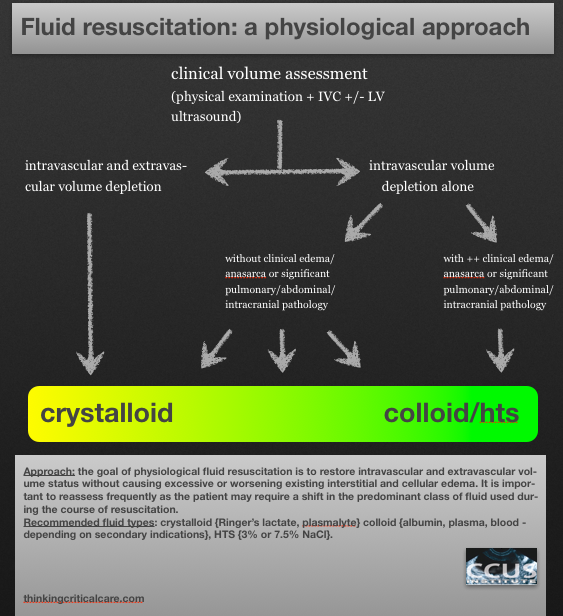
fluid resuscitation: a physiological approach – an N=1 podcast, #FOAMed, #FOAMcc

This is my approach to fluid resuscitation – sorry for the lack of precision which, to me, is actually key.  It would be against the N=1 principle to give out a recipe…but here’s a way to think about it:

Sorry the last bit cut off – my iphone can only email an 8 minute audio clip! Which I wasn’t aware of until today.  Anyway all that was lost at the end was “thanks for listening and I’d really like to hear comments and others’ practices!”

And here’s a disclaimer:  I don’t think this is the be-all and end-all. My resuscitation is a work in progress, both in terms of new fluids coming up, and in terms of identifying subgroups or individuals who would benefit from a different approach, so I’m definitely eager to hear from anyone who does things differently – but physiologically!

Please see Dr. John Myburgh’s excellent review on fluid resus in NEJM sep 26th issue!

Oh and here’s the diagram!

Physiological Fluids

thanks!

Philippe

Armani suits and recipe therapies…#FOAMed, #FOAMcc

Just a quick word to relate an interesting conversation I had with a colleague last evening.

I was taking over an ICU for a night’s coverage and going over the sicker patients with the current daytime attending, my friend and highly esteemed colleague Edgar Hockmann.  We were discussing a particularly challenging case of a young (40’s) patient with staph aureus sepsis and MSOF, and trying to come up with some tweaks, and ended up discussing the concept of tailored therapy to each patient’s physiology, which is right up my alley of N=1 thinking.

Now, as background, Edgar is a particularly bright guy who routinely challenges dogma, whether his own or others’, and I always learn from any conversation with him.  He has given awesome lectures in our conferences for the past several years. In this case (in addition to some fascinating microcirculation stuff I will have to digest and regurgitate at some point), he gave me a great teaching analogy:

Asking the question “what is the best treatment for disease x?”  is essentially analogous to asking “what’s the best size for a suit?”

You can debate it all you want, but ultimately, if you’re a 46 short or a 38 tall, the 42 regular on the store manikin won’t look too good on you.

And so I may be reiterating myself, but it is really key to assemble all the physiological evidence you and (physical exam, ultrasound, laboratory, etc…) and try to determine what this patient needs, not what most patients would need in a similar situation. Fluids in or fluids out? Which type of fluid? Blood pressure goals (MAP of 65 for everyone…really…)? Urine output goals?  We’ll try to go over each of these in the next weeks/months.

It’s a lot easier to follow a protocol.

…but my guess is that if you went to Savile Row, I doubt you’d see Shaquille O’Neal and Danny De Vito walking out with the same suit…the haberdashers would be fired…

Philippe

Bedside Ultrasound Picture Quiz 2 #FOAMed, #FOAMcc

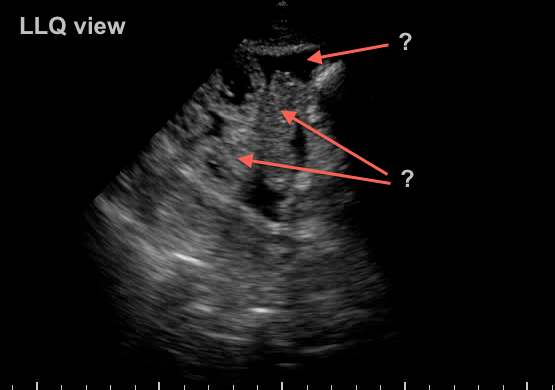
73 yr old woman recovering from septic shock with abdominal distension and difficulty tolerating enteral feeds…


what do you see?

BUPQ2


scroll below for the answer…..


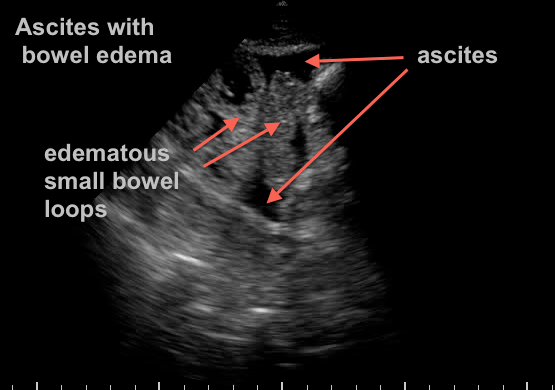
BUPQ2 Answer


Extensive third spacing from resuscitation has resulted in bowel edema and ascites.  Another “benign” effect of massive crystalloid use… A bedside 22g US guided tap confirms benign transudate.