Bedside Ultrasound: The Sluggish IVC – something to look for… #FOAMed, #FOAMcc

So take a look at this:

I’m sure most experienced bedside sonographers come across this all the time.  For those who are starting out, and until now have just been looking at size and variation, take a second to look at the flow.  You can actually see the flow stop and start, which tells you your cardiac output is bad.  It could be bad because of the RV, the LV, the pericardium, the tension pneumothorax, anything, but it’s bad.  So just in case you were only gonna look at the IVC, keep looking! You will find something abnormal downstream, perhaps that you can do something about (not fluids, though).

I have seen this disappear and clear up with – when possible – correction of the problem, back to the normally anechoic IVC we usually see.

thanks!

Philippe

ps note there is also a mirror artifact in the right lower portion of the field, making it look as though there are two beating hearts.

NEJM Circulatory Shock Review by Vincent & DeBacker: the sweet and the not-so sweet… #FOAMed, #FOAMcc

So if anyone hasn’t read it, here it is:

Click to access Circulatory%20Shock%20-%20NEJM%202013.pdf

I read the article by critical care icons Dr. Jean-Louis Vincent and Dr. De Backer with interest  as I am always keen to find out what the cutting edge is… So here is my take on their review.

The not-so-sweet:

The inclusion of CVP in the assessment. Ouch. No evidence whatsoever. Evidence for lack of correlation to fluid responsiveness… I wonder if they themselves were cringing a little about including it, particularly form the fact that they just put high vs low rather than commit to a value, which makes me think they realize it’s a bit of a trap. (It reminds me a bit of those night-time orders I still sometimes see which say if u/o < 30 cc/hr give a bolus if CVP under 12 or lasix if over 12.  So basically depending on whether that patient’s head is elevated, or if he’s turned on one side or the other, he may go from “needing fluids” to “needing diuretics”…).

The sweet:

First of all, they obviously did an elegant job on description of shock states, and particularly of highlighting the common-ness of mixed etiology shock.

I like that they admitted that the end-point for fluid resuscitation is “difficult to define.”  Any answer other than that would really speak to non-physiological thinking, as I’ve referred to in prior posts/podcasts.

Dopamine: good job on trying to take it off the shelf for shock. As far as I’m concerned, only useful when you’ve run out of norepinephrine, although there is the odd time when you have a septic AND bradycardic patient where it could come in handy…

Bringing some focus on the microcirculation: no recommendations, but that’s appropriate since there are none to be made yet, but this is where the money is in the future, as far as I’m concerned. Once we figure out how to manage the microcirculation (we do ok with the macro circulation) we might forge ahead. But good to point the finger in that direction.

The super-sweet!

I do (not surprisingly) really, really like the fact that they included ultrasound in their assessment protocol, and emphasizing that focused echocardiography should be done as soon as possible.  Very nice. Finally.

Hopefully, this pushes mainstream ED and critical care physicians to realize they need basic bedside ultrasound skills…


Overall, I think it is a good review, certainly worth the read for trainees. I would like to see focus on re-examining and questioning our approach, which could spur readers to embark on research with a different angle. For instance, why do we assume that we need to fill patients to the point of no longer being fluid responsive in order to avoid vasopressors? Is there any evidence for that? Not that I know of…

But, for having put an emphasis on point-of-care ultrasound, it gets a big round of applause from me!


Philippe

CCUS 2013 Lectures – #FOAMed, #FOAMcc

This past may we had an amazing two day conference, the theme of which was challenging dogmatic practice and myths in acute care medicine.  Many of the lectures are now available to watch on our website at http://www.ccusinstitute.org/e-Store.asp?method=evideos#, you need to be a member to access – which is free, just register.


Lectures on bedside ultrasound, shock, ECMO in the ED, physiology and a lot of really, really good stuff.


We will be adding more in the next weeks!


Thanks!


PR

Bedside Ultrasound Clip Quiz #3 – #FOAMed, #FOAMcc

This is what you see on the anterior chest of your patient:

What can you conclude?

scroll below for answers…


Lung sliding and B lines

The notable findings are:

a. lung sliding – this indicates that there is no pneumothorax in the area you are scanning.

b. there are B lines – this indicates that there is interstitial edema – this has no etiological information and must be coupled with the rest of the ultrasound and clinical examination to make a diagnosis. It could represent CHF, pneumonia, non-cardiogenic pulmonary edema, or any other interstitial process.

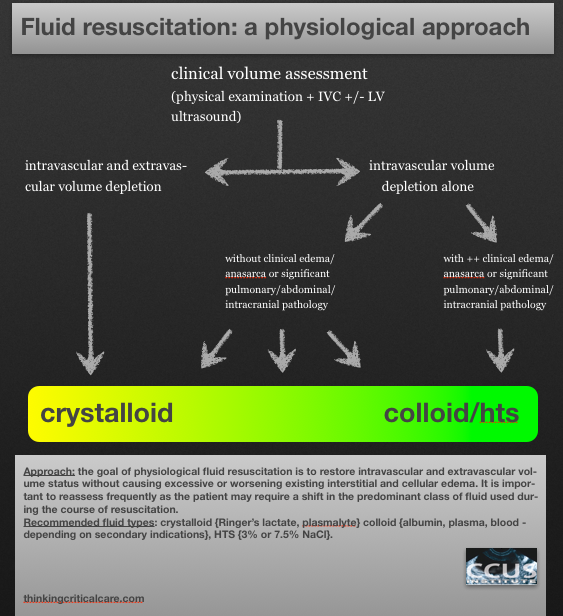
fluid resuscitation: a physiological approach – an N=1 podcast, #FOAMed, #FOAMcc

This is my approach to fluid resuscitation – sorry for the lack of precision which, to me, is actually key.  It would be against the N=1 principle to give out a recipe…but here’s a way to think about it:

Sorry the last bit cut off – my iphone can only email an 8 minute audio clip! Which I wasn’t aware of until today.  Anyway all that was lost at the end was “thanks for listening and I’d really like to hear comments and others’ practices!”

And here’s a disclaimer:  I don’t think this is the be-all and end-all. My resuscitation is a work in progress, both in terms of new fluids coming up, and in terms of identifying subgroups or individuals who would benefit from a different approach, so I’m definitely eager to hear from anyone who does things differently – but physiologically!

Please see Dr. John Myburgh’s excellent review on fluid resus in NEJM sep 26th issue!

Oh and here’s the diagram!

Physiological Fluids

thanks!

Philippe

Bedside Ultrasound Picture Quiz 2 #FOAMed, #FOAMcc

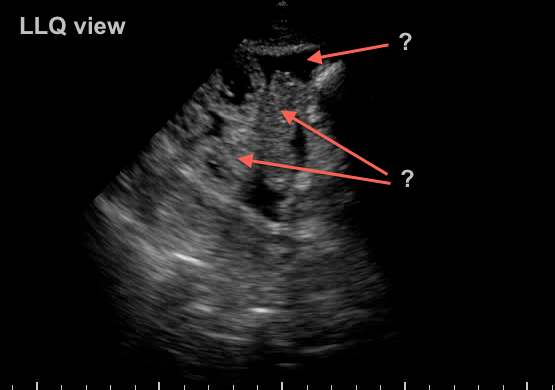
73 yr old woman recovering from septic shock with abdominal distension and difficulty tolerating enteral feeds…


what do you see?

BUPQ2


scroll below for the answer…..


BUPQ2 Answer


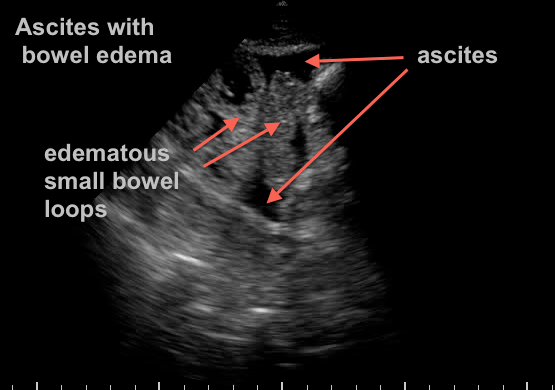
Extensive third spacing from resuscitation has resulted in bowel edema and ascites.  Another “benign” effect of massive crystalloid use… A bedside 22g US guided tap confirms benign transudate.

The Ideal Resuscitation Fluid – an N=1 Podcast #FOAMed, #FOAMcc

So here is the first in a series of mini-talks geared towards having us think about fluid resuscitation, which, for those in acute care of almost any type (ER, wards, ICU, anasthesia, surgery, etc…) is part of our daily routine. And that’s exactly what it shouldn’t be, routine. It should be carefully thought out and adapted to each individual clinical situation we’re facing.

So I’ve decided to approach this from a completely different angle, not looking at what we do, what’s available, and see what has been stacked up against what, etc, etc… Instead, I’ve decided to start the discussion from a completely theoretical standpoint and talking about something that doesn’t exist:  The Ideal Resuscitation Fluid.

Please, let me know your thoughts!

Philippe

http://www.ccusinstitute.org

(sorry the last 40 seconds were cut – now the “full” 5 minutes are up!  apologies, I am techno-challenged!)

Why do we bother checking CVP? #FOAMed, #FOAMcc

I was recently scanning the literature in preparation for our symposium, and came across what should have been a 2003 instead of a 2013 publication in the March issue of the CCM Journal, entitled “Point-of-Care Ultrasound to estimate Central Venous Pressure:  A Comparison of Three Techniques.”

I have to admit this is a pet peeve of mine, from the standpoint of a clinical physiologist, which is, as far as I’m concerned, what any physician looking after critically ill patients should be, at least some of the time.

So our real question is: is my patient fluid-responsive?  And perhaps a corollary question would be: is he fluid tolerant?

As a longtime bedside sonographer, physiology, experience and slowly growing evidence all support my using IVC sonography as a tool to assess volume responsiveness.  It isn’t perfect, and personally, I find the common M-mode, two-point measurement to be inadequate compared to a global assessment of the IVC, but it certainly is far closer to “the truth” we seek than CVP.

This then begs the question: why on earth would we be seeking to correlate one type of data to another which is clearly more removed from “the truth” we seek?

The use of CVP is largely cultural and deeply ingrained. There are some limited ways and pathologies in which it can be useful, but not as a measure of preload.  My friend Paul Marik published a piece that was both enlightening and entertaining in Chest a couple of years ago which I would have thought would have been the final nail in the coffin for the use of CVP as a preload tool, but it endures…even in the latest surviving sepsis guidelines

A testament to religion over science.

Philippe Rola

http://www.ccusinstitute.org

note that this was first posted in my buddy Matt’s awesome website pulmccmcentral (http://pulmccm.org/2013/critical-care-review/why-do-we-bother-to-check-cvp/) please check it out!