The N=1 concept. #FOAMed, #FOAMcc

First of all, happy holidays to all and happy new year!

Following a few requests, I’m gonna put up a few words about the N=1 concept, as I think it comes up in every single therapeutic and diagnostic strategy.

We do not treat a thousand, a hundred or even ten patients at a time.  As clinicians, we deal with a single patient, with a certain pathology, and his own, unique physiological pattern of response to that pathology.

In a medical utopia, we would be able to have a precise biophysiological profile of our patient – probably including parameters that either don’t yet exist, or are on the verge of being found or invented.  We would know, for instance, the degree of glycocalyx damage, the nature of this damage, the degree of subsequent capillary leak, the specific inflammatory cytokine pattern, and thus be able to use a potential combination of agonists and antagonists to favor healing, and tailor fluid therapy to the “just right” amount, avoiding both under-resuscitation and tissue edema. This would be similar to antibiotic sensitivity testing. Who, in this century so far, would deliberately not order sensitivities, instead satisfying themselves with a positive result and happy with empiric therapy?

Just in terms of biological variability, it is impossible to believe that all patients would respond best to a single goal or therapy. How can an MAP of 65 be as good for a septic hypertensive patient as it is for a young septic woman who normally walks around with an SBP of 110? Not that I don’t use that number myself most of the time, but certainly food for thought, and something to keep in mind when treating either of those “types” of patients…

And the answer to the N=1 riddle isn’t just subgroup analysis. The questions have to be answered in prospective fashion, built into the study design. Not easy work, and especially since we don’t yet even know what the key variables/questions are… But personally, as mentioned in an earlier post, I do now suspect that the ubiquitous glycocalyx holds some of those answers.

Let’s look at the whole fluid debate through the N=1 lens: it makes no sense whatsoever to debate crystalloids versus colloids. This negates thinking and only encourages near-religious fervour amidst both camps. Rather, look at your patient. Is he truly dehydrated/volume depleted or just volume responsive on the basis of vasodilation. If we want to restore the ICF and the interstitium, then crystalloids are probably better, but if we want to restore effective circulatory volume, then some measure of colloid may help avoid excessive edema, though even this can be debated. Even more important is the composition of the resuscitation fluid. Much as we adjust our TPN, we should probably design our resuscitation fluids, rather than only using Ringer’s Lactate (I say only just to drive the point that NS should not be used as a resuscitation fluid, unless repleting chloride is specifically necessary).

Now this may sound like a rant against large trials, but it isn’t. Absolutely invaluable information can be derived from these, it is just a matter of thinking how that information can benefit the one patient you have in front of you. And this isn’t easy. You have to put together your history, physical exam, bedside ultrasound exam and labwork. You can’t just say  “sepsis? 2 litres,” or any other such recipe (aka protocols).

ok, enough for a january 1st!


Love to hear what anyone thinks!


Philippe
 

A Paradigm shift: re-thinking sepsis, and maybe shock in general… #FOAMed, #FOAMcc

Thomas Kuhn, physicist and philosopher, in his groundbreaking and science changing text, The Structure of Scientific Revolutions, states that:

“Successive transition from one paradigm to another via revolution is the usual developmental pattern of a mature science.”

In other words, a science has growing pains and is bound to have a fair bit of debate and controversy, until a new paradigm becomes dominant.  I think that there is a current – in part prompted by the power of socio-professional media which has allowed minds to connect and knowledge to spread – that will see many of the things that are now “Standard of Care” out the door.

So first of all, the following are must-listens, the first a lecture by Paul Marik, whom I have had the chance to collaborate with in the last years and respect greatly, on knowledge, experience, and even more on his refusal to take anything for granted and being in a seemingly-constant quest for the improvement of medicine.

The second link is Scott Weingart’s take on it, which I think is equally awesome.

I think Paul is pushing the envelope in an essential way, and Scott does a fantastic job of seeing or putting it in perspective. Enjoy:

http://emcrit.org/podcasts/paul-marik-fluids-sepsis/

EMCrit 112 – A Response to the Marik Sepsis Fluids Lecture

My (very) humble opinion on this is a rather simple, almost philosophical one:  why are we seemingly obsessed with treating a predominantly vasodilatory pathology with large amounts of volume?  I’ve said this in previous posts and podcasts, but this, in my opinion, is largely cultural and dogmatic. “Levophed – Leave’em dead” is something I heard as a student and resident, and came to take for granted that I should give lots of fluid in hopes of avoiding pressors… But there’s no evidence at all to support this.  The common behavior of waiting until someone has clearly failed volume resuscitation before starting pressors befuddles me (think how long it takes to get two liters of fluid in most ERs…).  If I was in that bed, I’d much rather spend an hour a bit “hypertensive” (eg with a MAP above 70) than a bit hypotensive while awaiting final confirmation that I do, in fact, need pressors.

I strongly suspect that it’s just a matter of improving vascular tone, giving some volume (which may be that 3 liter mark), and ensuring that the microcirculation/glycocalyx is as undisturbed as possible. Now when I say it may be the 3 liters, I firmly believe this will not apply to everyone, and that it will be 1 liter in some, and 4 in others, and that a recipe approach will be better than nothing, but likely harm some.

I think that blind (eg no echo assessment) of shock is absurd, and for anyone to propose an algorithm that does not include point-of-care ultrasound is only acceptable if they are in the process of acquiring the skill with the intention of modifying their approach in the very near future.

The whole microcirculation/glycocalyx is absolutely fascinating stuff, and undoubtedly will come under scrutiny in the next few years, and it is definitely something I will focus on in upcoming posts & podcasts. Our resuscitation has been macro-focused, and certainly it is time to take a look at the little guys, who might turn out to have most of the answers. For instance, there is some remarkable data on HDAC inhibitors (common valproic acid) and their salutatory effects in a number of acute conditions such as hemorrhagic shock (Dr. Alam) which have nothing to do with macro-resuscitation, and everything to do with cell signaling and apoptosis. Hmmm…

please share your thoughts!

thanks

Philippe

Enough with the “Normal” Saline!!!!! #FOAMed, #FOAMcc

Enough with the “Normal” Saline!
So its been about a year since a JAMA article (http://jama.jamanetwork.com/article.aspx?articleid=1383234) finally showed that the downside of 0.9% saline isn’t just theoretical, but has some associated clinical morbidity (bad for the kidneys!).  Sadly enough, it still seems to be the routine fluid used for boluses. Whether the ER, hospitalist or intensivist, residents, students…it seems people are reluctant to let go.
Today, rounding in the ICU, I was changing an order for a bolus from another doc from NS to RL, and a nurse asked me why.  I gave her a capsule summary and she was in disbelief.  “Come on Phil, they wouldn’t call it normal saline if it wasn’t!”
I’m an internist by training, so naturally I grew up using NS, since that’s what all the attendings and residents used around me.  Ringer‘s was the stuff the surgeons used, so well, I guess it had to be wrong…no?
So forward to 2001 and John Kellum‘s lecture on acid-base I’ve previously mentioned, and my exploring Stewart’s Physicochemical Approach, and wait, I look at the back of a bag of NS, and find out, much to my dismay, that the stuff I’ve been using like holy water has a pH of 5.6.  And who have I been giving liters and liters of this stuff to?  Yup, mostly patients with acidosis. Hmmm. Interesting. So although I don’t necessarily advocate correcting metabolic acidosis for the sake of doing so (see my previous post on bicarb), I’m not a proponent of worsening acidosis either, even if by another mechanism.
I think there are a number of factors that have resulted in this situation.  For starters, there is the issue of false advertising – the “normal saline” monicker has been influencing subliminal thought for decades (think Malcolm Gladwell thin-slicing), making physicians feel they are giving and inherently “good” substance.  Then there’s the whole tribalism thing with the surgeons vs non-surgeons making all the non-surgeons polarize away from RL (not that RL is perfect, just a bit better, and certainly closer to “normal”). Finally, there’s this sad, sad factor that makes people, even (or maybe even more) smart people reluctant to accept that they have been doing something wrong (or, for those who are offended right now, not ideal) for a long time (I sure was) and prefer to fight it and rationalize it for a few more years until, eventually, the evidence becomes overwhelming or the changing of the guard has fully taken place.
I think what we should be hanging on to is not a drug or a fluid but rather what we learned in the first couple of years of med school: physiology.  Now mind you, at that point we (or most of us) didn’t have a clue how to use it for anything more that answering multiple choice questions, but at some point, we have to go back to it and realize that is what we should be basing our assessment of our therapeutic acts and decisions.
So…if I have a situation where I am low on chloride, I might want to use NS. But otherwise, let try to give something whose composition is a bit closer to our own than NS is.  So, for my students and residents, don’t let me see you prescribing boluses of NS.  If you really, really need to, wait until your next rotation please.
thanks!
Philippe
ps for a great review of the original aritcle, please see Matt’s on PulmCCM at :
Reply:  by Marco Vergano
Totally agree!
I have been struggling for years with the bad habit of some of my colleagues prescribing NS as the most harmless and physiologic replacement fluid. Here in Italy we don’t have such a clear separation between internists and surgeons about NS/RL choice: the bad habit of easily prescribing NS is ubiquitous.
Given the results you mentioned about the increased incidence of renal failure with NS, I am wondering if the ban on ALL starch solutions would have been necessary after the introduction of new balanced starch/electrolyte solutions.
What I really don’t like about RL is that it’s not only hypotonic, but also low in sodium. In our ICU we often have many ‘neuro’ patients (trauma or vascular) and sodium variations become a major issue. Also I prefer Ringer’s acetate over lactate on most of the patients who struggle to ‘manage’ their own lactate.
So my favorite solution remains our good old “Elettrolitica reidratante III” (very similar to Plasma-lyte).

Beta-blockers in Sepsis? Interesting… #FOAMed, #FOAMcc

Very interesting article in JAMA: http://jama.jamanetwork.com/article.aspx?articleID=1752246

I’m curious as to whether this has been generating interest in the cc community.  I think it is one of those articles that – at least conceptually – shines light in an area we don’t spend much time reflecting on.

I know that as an IM resident, and a CC fellow, my understanding of vasopressor therapy was pretty basic: squeeze the vessels to bring up the pressure, and hope you don’t squeeze so hard the fingers and toes fall off. In truth, no one ever really pointed out that to some degree or other, the same process killing off the fingers is probably happening to a varying degree in all organs. But maybe I just nodded off and missed it.

Since then, however, I’ve had some time to  re-examine things, and my practice has slowly been evolving.  For one thing, bedside ultrasound allows a really good assessment of inotropy, so I started to ask myself why I was giving b-agonists to patients who clearly didn’t need any help with contractility (e.g. normal, and even more so, hyperdynamic RVs and LVs).  After all, I’m putting them at risk for arrhythmias, or at least tachycardia. So whereas levophed (norepinephrine) remains my reflex pressor, I routinely shift to phenylephrine when faced with arrhythmias (most commonly fast atrial fibrillation) or tachycardia (beyond 110-120) once adequate volume resuscitation has been done.  Why 110-120?  Its an absolute guess. Somewhat educated – or I try to convince myself of that – in figuring that at some point, the increased CO via HR will be offset by decreased filling time, and with the weak but recurring data showing an association between tachycardia over 90-100 and poor outcome.

So this study – counterintuitive as it may sound to some – is really about blunting the potentially unwanted effects of b-agonists.  They randomised 336 patients to IV esmolol to a HR <95 vs a control group of standard care. They found a reduced mortality of 60%… Obviously the massive benefit should be taken with a healthy dose of skepticism, but even just the fact that they didn’t make patients worse is very, very significant.

Read the paper. They do a great job of reviewing the concept and it’s worth going over their protocol.

Physiologically, we know that catecholamines can cause stress cardiomyopathy.  The question is, when cardiomyopathy is noted, how often do we think this is related to therapy?  More often, we figure it’s the disease process – septic cardiomyopathy. At the bedside, this is impossible to differentiate.

The concept of lusitropy – active relaxation – and its contribution to cardiac output – is often overlooked, and can be affected by catecholamines. In fact it can be the most important factor related to preload, despite getting much less attention than volume loading. Remember that preload is not a pressure (especially not a CVP!!!), but a volume, and physiologically it is the degree of myocardial stretch. The ventricle is not passive, and its compliance is highly related to the active relaxation phase. Fluids will not affect this.

In addition, the decreased filling time by tachycardia can also decrease output.

Fantastic study, even if only to open the door.  I would have liked (in typical N=1 fashion and as a bedside sonographer) to see a quick echo prior to initiation, and seeing if there would have been an association with baseline RV/LV function and response/outcome to esmolol. Intuitively and physiologically, it would seem that the hyperdynamic RVs and LVs would have benefitted most, since they didn’t need beta agonism to start with – but I can also entertain that those would be unaffected and that the worse ventricles could have been worsened by stress cardiomyopathy… So a critical question in my opinion.

So…bottom line?  Is this practice-changing? It might be.  For me, I might start looking at RV/LV and opting for a quicker conversion to neosynephrine if I see a hyperdynamic state or lowering my HR threshold to do so…100? 105? – maybe just a shift rather than a change in practice. I’m not sure I’ll start esmolol infusions yet, but it will be at the back of my mind and I might, given the right set of circumstances. What I would like to see is reproducibility, and if it does happen, I would be happy to get HR’s under 95.

Love to hear what anyone else has to say!


Philippe


NEJM Circulatory Shock Review by Vincent & DeBacker: the sweet and the not-so sweet… #FOAMed, #FOAMcc

So if anyone hasn’t read it, here it is:

Click to access Circulatory%20Shock%20-%20NEJM%202013.pdf

I read the article by critical care icons Dr. Jean-Louis Vincent and Dr. De Backer with interest  as I am always keen to find out what the cutting edge is… So here is my take on their review.

The not-so-sweet:

The inclusion of CVP in the assessment. Ouch. No evidence whatsoever. Evidence for lack of correlation to fluid responsiveness… I wonder if they themselves were cringing a little about including it, particularly form the fact that they just put high vs low rather than commit to a value, which makes me think they realize it’s a bit of a trap. (It reminds me a bit of those night-time orders I still sometimes see which say if u/o < 30 cc/hr give a bolus if CVP under 12 or lasix if over 12.  So basically depending on whether that patient’s head is elevated, or if he’s turned on one side or the other, he may go from “needing fluids” to “needing diuretics”…).

The sweet:

First of all, they obviously did an elegant job on description of shock states, and particularly of highlighting the common-ness of mixed etiology shock.

I like that they admitted that the end-point for fluid resuscitation is “difficult to define.”  Any answer other than that would really speak to non-physiological thinking, as I’ve referred to in prior posts/podcasts.

Dopamine: good job on trying to take it off the shelf for shock. As far as I’m concerned, only useful when you’ve run out of norepinephrine, although there is the odd time when you have a septic AND bradycardic patient where it could come in handy…

Bringing some focus on the microcirculation: no recommendations, but that’s appropriate since there are none to be made yet, but this is where the money is in the future, as far as I’m concerned. Once we figure out how to manage the microcirculation (we do ok with the macro circulation) we might forge ahead. But good to point the finger in that direction.

The super-sweet!

I do (not surprisingly) really, really like the fact that they included ultrasound in their assessment protocol, and emphasizing that focused echocardiography should be done as soon as possible.  Very nice. Finally.

Hopefully, this pushes mainstream ED and critical care physicians to realize they need basic bedside ultrasound skills…


Overall, I think it is a good review, certainly worth the read for trainees. I would like to see focus on re-examining and questioning our approach, which could spur readers to embark on research with a different angle. For instance, why do we assume that we need to fill patients to the point of no longer being fluid responsive in order to avoid vasopressors? Is there any evidence for that? Not that I know of…

But, for having put an emphasis on point-of-care ultrasound, it gets a big round of applause from me!


Philippe

Bedside Ultrasound & the patient with Acute Renal Failure – an N=1 Podcast #3, #FOAMed, #FOAMcc

Hi!

So here is a quick and dirty approach to the patient with ARF using bedside ultrasound, which enables the rapid diagnosis or ruling out of two important and time-dependant conditions with significant clinical impact: hypovolemic and post-renal/obstructive renal failure.

Let me know what you think!

Philippe Rola

http://www.ccusinstitute.org

fluid resuscitation: a physiological approach – an N=1 podcast, #FOAMed, #FOAMcc

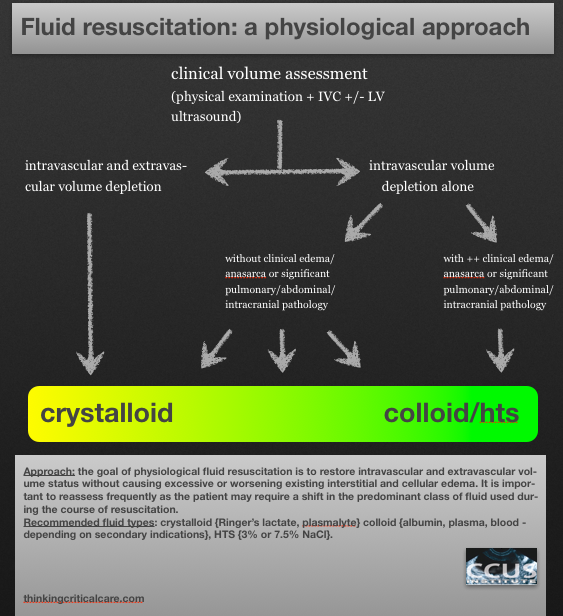
This is my approach to fluid resuscitation – sorry for the lack of precision which, to me, is actually key.  It would be against the N=1 principle to give out a recipe…but here’s a way to think about it:

Sorry the last bit cut off – my iphone can only email an 8 minute audio clip! Which I wasn’t aware of until today.  Anyway all that was lost at the end was “thanks for listening and I’d really like to hear comments and others’ practices!”

And here’s a disclaimer:  I don’t think this is the be-all and end-all. My resuscitation is a work in progress, both in terms of new fluids coming up, and in terms of identifying subgroups or individuals who would benefit from a different approach, so I’m definitely eager to hear from anyone who does things differently – but physiologically!

Please see Dr. John Myburgh’s excellent review on fluid resus in NEJM sep 26th issue!

Oh and here’s the diagram!

Physiological Fluids

thanks!

Philippe

Armani suits and recipe therapies…#FOAMed, #FOAMcc

Just a quick word to relate an interesting conversation I had with a colleague last evening.

I was taking over an ICU for a night’s coverage and going over the sicker patients with the current daytime attending, my friend and highly esteemed colleague Edgar Hockmann.  We were discussing a particularly challenging case of a young (40’s) patient with staph aureus sepsis and MSOF, and trying to come up with some tweaks, and ended up discussing the concept of tailored therapy to each patient’s physiology, which is right up my alley of N=1 thinking.

Now, as background, Edgar is a particularly bright guy who routinely challenges dogma, whether his own or others’, and I always learn from any conversation with him.  He has given awesome lectures in our conferences for the past several years. In this case (in addition to some fascinating microcirculation stuff I will have to digest and regurgitate at some point), he gave me a great teaching analogy:

Asking the question “what is the best treatment for disease x?”  is essentially analogous to asking “what’s the best size for a suit?”

You can debate it all you want, but ultimately, if you’re a 46 short or a 38 tall, the 42 regular on the store manikin won’t look too good on you.

And so I may be reiterating myself, but it is really key to assemble all the physiological evidence you and (physical exam, ultrasound, laboratory, etc…) and try to determine what this patient needs, not what most patients would need in a similar situation. Fluids in or fluids out? Which type of fluid? Blood pressure goals (MAP of 65 for everyone…really…)? Urine output goals?  We’ll try to go over each of these in the next weeks/months.

It’s a lot easier to follow a protocol.

…but my guess is that if you went to Savile Row, I doubt you’d see Shaquille O’Neal and Danny De Vito walking out with the same suit…the haberdashers would be fired…

Philippe

Bedside Ultrasound Picture Quiz 4 – #FOAMed, #FOAMcc

75 year old patient on the wards with poor urine output. Got a bolus, got some lasix. Still nothing.


what do you see?

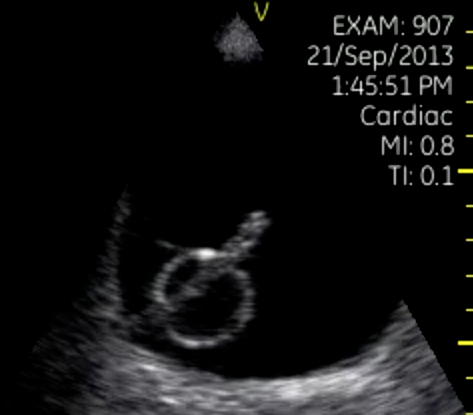
Full bladder despite foley copy


…scroll down for an answer!


…that’s a full bladder with a correctly positioned but blocked foley. Change it!

Bedside Ultrasound Picture Quiz 2 #FOAMed, #FOAMcc

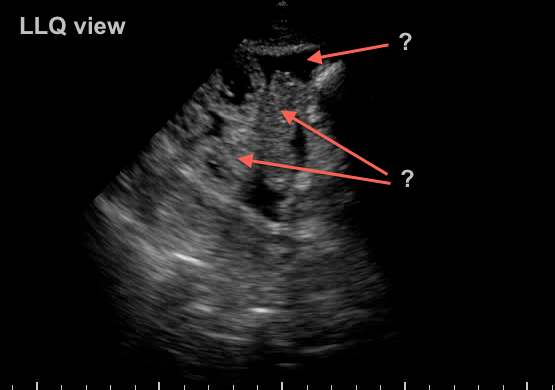
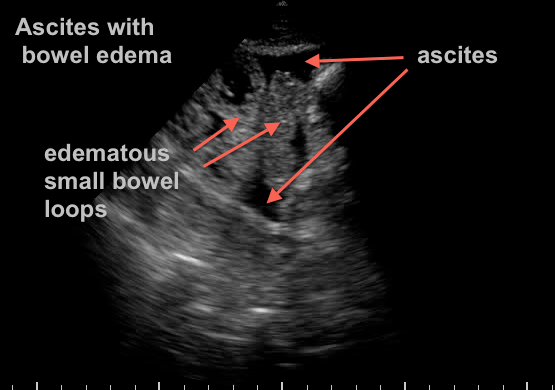
73 yr old woman recovering from septic shock with abdominal distension and difficulty tolerating enteral feeds…


what do you see?

BUPQ2


scroll below for the answer…..


BUPQ2 Answer


Extensive third spacing from resuscitation has resulted in bowel edema and ascites.  Another “benign” effect of massive crystalloid use… A bedside 22g US guided tap confirms benign transudate.