fluid resuscitation: a physiological approach – an N=1 podcast, #FOAMed, #FOAMcc

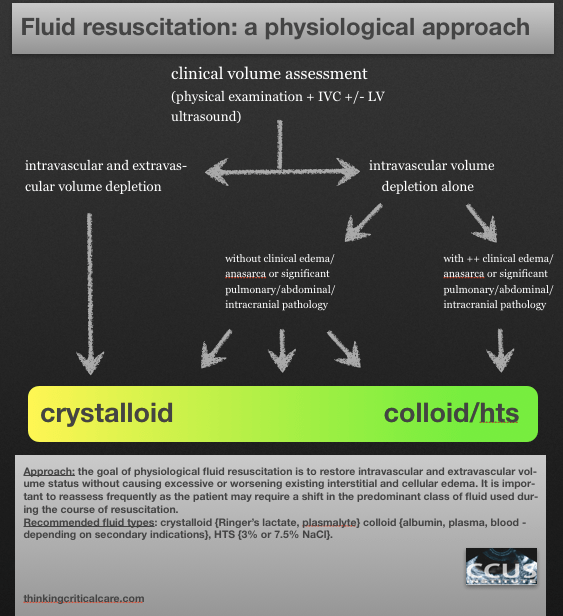
This is my approach to fluid resuscitation – sorry for the lack of precision which, to me, is actually key.  It would be against the N=1 principle to give out a recipe…but here’s a way to think about it:

Sorry the last bit cut off – my iphone can only email an 8 minute audio clip! Which I wasn’t aware of until today.  Anyway all that was lost at the end was “thanks for listening and I’d really like to hear comments and others’ practices!”

And here’s a disclaimer:  I don’t think this is the be-all and end-all. My resuscitation is a work in progress, both in terms of new fluids coming up, and in terms of identifying subgroups or individuals who would benefit from a different approach, so I’m definitely eager to hear from anyone who does things differently – but physiologically!

Please see Dr. John Myburgh’s excellent review on fluid resus in NEJM sep 26th issue!

Oh and here’s the diagram!

Physiological Fluids

thanks!

Philippe

Bedside Ultrasound Picture Quiz 5 – #FOAMed, #FOAMcc

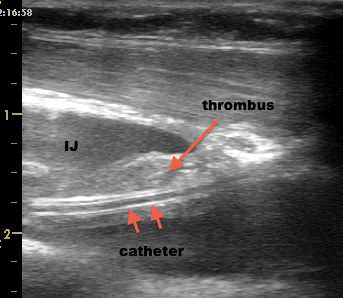
A 55 year old man admitted to the ICU for sepsis, recovering multi-organ failure with persistent culture-negative fever.

Longitudinal view of the left internal jugular vein.

What do you see?

BUPQ5-Q

scroll below for an answer!


BUPQ5-A


Thrombosed internal jugular catheter. This patient was anticoagulated. The fever disappeared within a few days and the thombosis decreased significantly.  It is difficult to be certain whether the fever was a cause but examining central lines is part of our fever workup.

Bedside Ultrasound Picture Quiz 3 #FOAMed, #FOAMcc

Post-procedure transverse view of the neck…what do you see?


IJ with catheter sax


scroll down for the answer!


…an internal jugular catheter in the jugular vein!  Note the shadow behind it.  In fact, the use of ultrasound to confirm venous position as well as eliminate pneumothorax often obviates the need for a post-procedural CXR, sparing time, resources, and the risk of turning/moving a critically ill patient (how many tubes and lines have been lost this way…).

The Ideal Resuscitation Fluid – an N=1 Podcast #FOAMed, #FOAMcc

So here is the first in a series of mini-talks geared towards having us think about fluid resuscitation, which, for those in acute care of almost any type (ER, wards, ICU, anasthesia, surgery, etc…) is part of our daily routine. And that’s exactly what it shouldn’t be, routine. It should be carefully thought out and adapted to each individual clinical situation we’re facing.

So I’ve decided to approach this from a completely different angle, not looking at what we do, what’s available, and see what has been stacked up against what, etc, etc… Instead, I’ve decided to start the discussion from a completely theoretical standpoint and talking about something that doesn’t exist:  The Ideal Resuscitation Fluid.

Please, let me know your thoughts!

Philippe

http://www.ccusinstitute.org

(sorry the last 40 seconds were cut – now the “full” 5 minutes are up!  apologies, I am techno-challenged!)

Why do we bother checking CVP? #FOAMed, #FOAMcc

I was recently scanning the literature in preparation for our symposium, and came across what should have been a 2003 instead of a 2013 publication in the March issue of the CCM Journal, entitled “Point-of-Care Ultrasound to estimate Central Venous Pressure:  A Comparison of Three Techniques.”

I have to admit this is a pet peeve of mine, from the standpoint of a clinical physiologist, which is, as far as I’m concerned, what any physician looking after critically ill patients should be, at least some of the time.

So our real question is: is my patient fluid-responsive?  And perhaps a corollary question would be: is he fluid tolerant?

As a longtime bedside sonographer, physiology, experience and slowly growing evidence all support my using IVC sonography as a tool to assess volume responsiveness.  It isn’t perfect, and personally, I find the common M-mode, two-point measurement to be inadequate compared to a global assessment of the IVC, but it certainly is far closer to “the truth” we seek than CVP.

This then begs the question: why on earth would we be seeking to correlate one type of data to another which is clearly more removed from “the truth” we seek?

The use of CVP is largely cultural and deeply ingrained. There are some limited ways and pathologies in which it can be useful, but not as a measure of preload.  My friend Paul Marik published a piece that was both enlightening and entertaining in Chest a couple of years ago which I would have thought would have been the final nail in the coffin for the use of CVP as a preload tool, but it endures…even in the latest surviving sepsis guidelines

A testament to religion over science.

Philippe Rola

http://www.ccusinstitute.org

note that this was first posted in my buddy Matt’s awesome website pulmccmcentral (http://pulmccm.org/2013/critical-care-review/why-do-we-bother-to-check-cvp/) please check it out!