CCUS 2013 Lectures – #FOAMed, #FOAMcc

This past may we had an amazing two day conference, the theme of which was challenging dogmatic practice and myths in acute care medicine.  Many of the lectures are now available to watch on our website at http://www.ccusinstitute.org/e-Store.asp?method=evideos#, you need to be a member to access – which is free, just register.


Lectures on bedside ultrasound, shock, ECMO in the ED, physiology and a lot of really, really good stuff.


We will be adding more in the next weeks!


Thanks!


PR

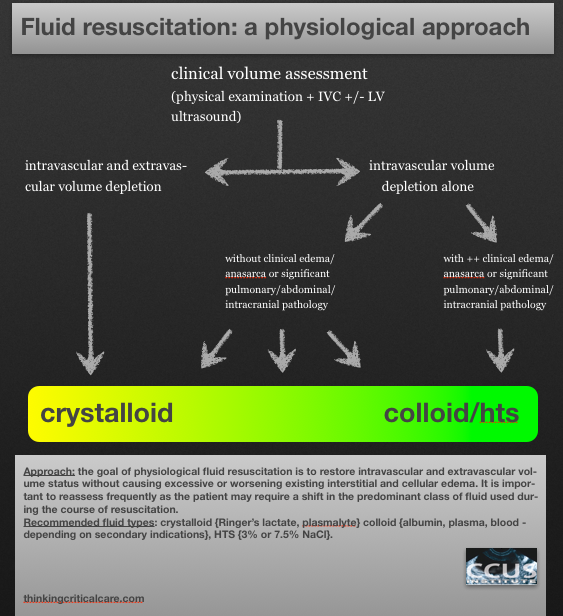
fluid resuscitation: a physiological approach – an N=1 podcast, #FOAMed, #FOAMcc

This is my approach to fluid resuscitation – sorry for the lack of precision which, to me, is actually key.  It would be against the N=1 principle to give out a recipe…but here’s a way to think about it:

Sorry the last bit cut off – my iphone can only email an 8 minute audio clip! Which I wasn’t aware of until today.  Anyway all that was lost at the end was “thanks for listening and I’d really like to hear comments and others’ practices!”

And here’s a disclaimer:  I don’t think this is the be-all and end-all. My resuscitation is a work in progress, both in terms of new fluids coming up, and in terms of identifying subgroups or individuals who would benefit from a different approach, so I’m definitely eager to hear from anyone who does things differently – but physiologically!

Please see Dr. John Myburgh’s excellent review on fluid resus in NEJM sep 26th issue!

Oh and here’s the diagram!

Physiological Fluids

thanks!

Philippe

Armani suits and recipe therapies…#FOAMed, #FOAMcc

Just a quick word to relate an interesting conversation I had with a colleague last evening.

I was taking over an ICU for a night’s coverage and going over the sicker patients with the current daytime attending, my friend and highly esteemed colleague Edgar Hockmann.  We were discussing a particularly challenging case of a young (40’s) patient with staph aureus sepsis and MSOF, and trying to come up with some tweaks, and ended up discussing the concept of tailored therapy to each patient’s physiology, which is right up my alley of N=1 thinking.

Now, as background, Edgar is a particularly bright guy who routinely challenges dogma, whether his own or others’, and I always learn from any conversation with him.  He has given awesome lectures in our conferences for the past several years. In this case (in addition to some fascinating microcirculation stuff I will have to digest and regurgitate at some point), he gave me a great teaching analogy:

Asking the question “what is the best treatment for disease x?”  is essentially analogous to asking “what’s the best size for a suit?”

You can debate it all you want, but ultimately, if you’re a 46 short or a 38 tall, the 42 regular on the store manikin won’t look too good on you.

And so I may be reiterating myself, but it is really key to assemble all the physiological evidence you and (physical exam, ultrasound, laboratory, etc…) and try to determine what this patient needs, not what most patients would need in a similar situation. Fluids in or fluids out? Which type of fluid? Blood pressure goals (MAP of 65 for everyone…really…)? Urine output goals?  We’ll try to go over each of these in the next weeks/months.

It’s a lot easier to follow a protocol.

…but my guess is that if you went to Savile Row, I doubt you’d see Shaquille O’Neal and Danny De Vito walking out with the same suit…the haberdashers would be fired…

Philippe

Bedside Ultrasound Picture Quiz 2 #FOAMed, #FOAMcc

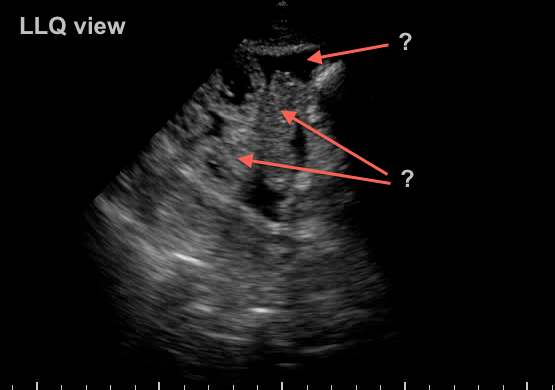
73 yr old woman recovering from septic shock with abdominal distension and difficulty tolerating enteral feeds…


what do you see?

BUPQ2


scroll below for the answer…..


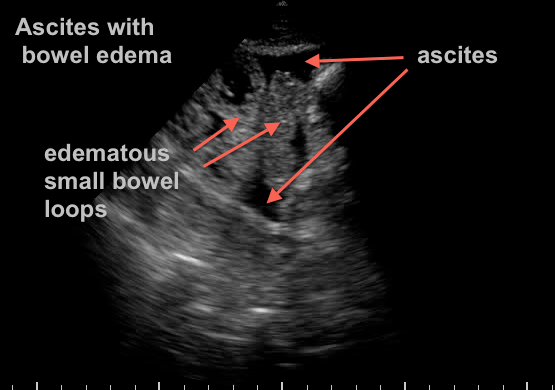
BUPQ2 Answer


Extensive third spacing from resuscitation has resulted in bowel edema and ascites.  Another “benign” effect of massive crystalloid use… A bedside 22g US guided tap confirms benign transudate.

Why do we bother checking CVP? #FOAMed, #FOAMcc

I was recently scanning the literature in preparation for our symposium, and came across what should have been a 2003 instead of a 2013 publication in the March issue of the CCM Journal, entitled “Point-of-Care Ultrasound to estimate Central Venous Pressure:  A Comparison of Three Techniques.”

I have to admit this is a pet peeve of mine, from the standpoint of a clinical physiologist, which is, as far as I’m concerned, what any physician looking after critically ill patients should be, at least some of the time.

So our real question is: is my patient fluid-responsive?  And perhaps a corollary question would be: is he fluid tolerant?

As a longtime bedside sonographer, physiology, experience and slowly growing evidence all support my using IVC sonography as a tool to assess volume responsiveness.  It isn’t perfect, and personally, I find the common M-mode, two-point measurement to be inadequate compared to a global assessment of the IVC, but it certainly is far closer to “the truth” we seek than CVP.

This then begs the question: why on earth would we be seeking to correlate one type of data to another which is clearly more removed from “the truth” we seek?

The use of CVP is largely cultural and deeply ingrained. There are some limited ways and pathologies in which it can be useful, but not as a measure of preload.  My friend Paul Marik published a piece that was both enlightening and entertaining in Chest a couple of years ago which I would have thought would have been the final nail in the coffin for the use of CVP as a preload tool, but it endures…even in the latest surviving sepsis guidelines

A testament to religion over science.

Philippe Rola

http://www.ccusinstitute.org

note that this was first posted in my buddy Matt’s awesome website pulmccmcentral (http://pulmccm.org/2013/critical-care-review/why-do-we-bother-to-check-cvp/) please check it out!

Surviving Sepsis Guidelines: useful, but patients deserve individualized care! #FOAMed, #FOAMcc

First of all, I would like to commend those involved in the Surviving Sepsis Campaign’s Guidelines. It is a tremendous endeavour that, without a doubt, has heightened awareness and their growing implementation has and will save many lives.

I would, however, also like to point out that guidelines are exactly what the term implies, and not necessarily a gold standard to  aspire to and adhere to in religious fashion.  The reason this is so is the inherent variability in human physiology and pathology.  If, out of 100 patients a treatment would help 10 but harm 1, the numbers and studies would clearly support its broad use. We’d win more than we’d lose. However, as physicians, we treat the one patient in front of us, not the hundred, so I find it difficult to believe that such blind application of a recipe would be the most Hippocratic practice to apply.

We know that our patients are widely different, and around the corner is point of care immunology that will tell us, in all likelihood, that even patients we think are similar on the surface will have widely different immune profiles and will respond to treatment differently.

There are a few recommendations which, to me, make little physiological sense, particularly in certain circumstances:

I don’t think it necessary to belabour the point about CVP. As a static measure, CVP has clearly been disproven to have any relevance in predicting volume responsiveness. Its persistence is a testament to cultural faith rather than science.

I would find it unethical to blindly bolus large amount of crystalloids (which we all know end up 70-80% extravascular) in a patient when it takes about 10 seconds to rule out a pre-existing, septic cardiomyopathy or a volume-intolerant state. Even more so when dealing with pathologies where third-spacing is a concern (pulmonary and intra-abdominal pathologies) since those leaky capillaries is where most of that fluid resuscitation will end up. Yes, I am implying that a worsening chest x-ray is not always and only due to worsening disease… Physiologically, perhaps non synthetic colloids or hypertonics may be a better option…

I would find it equally unethical to blindly put a patient on dobutamine who may have hyperdynamic ventricles and possibly still a volume-responsive state. Again, determining this takes seconds.

Yes, clearly I admit to a bedside ultrasound bias. It allows us to look inside our patients. Isn’t that what we’re always trying to do?

I can already hear voices and keyboards claiming the “lack of evidence,” and they would partly be right. That evidence is slowly but surely growing.

Unfortunately, point of care ultrasound has come of age in the era of evidence based medicine, and, as such, is required to “pass” that scrutiny whereas most of what is currently being done was “grandfathered in” and given a bye. I would be interested in seeing the compelling evidence for the use of a stethoscope.

The evolution of evidence based medicine is an interesting scientific, commercial and social development. From the positive study publishing bias to the general lack of epidemiological knowledge of our community, and without mentioning the darker side of research and publishing, it is unfortunate that almost every statement by a physician, to be taken seriously, must be backed by a hand raising a publication. And how many of those do we see torn down a month, a year or five later, thoroughly disproven? The pendulum of evidence-based medicine has perhaps swung too far…

Note that I’m not trying to discredit the countless number of truly well-designed and well-executed studies that contribute immensely to medicine – which would otherwise be reduced to little more than expert opinion – just that careful analysis of both the evidence and the case at hand is primordial.

I think that as physicians, it is our duty to look very closely at the individual patient, the care of whom we are privileged to have as a responsibility, and individualize our treatment plan to his specific problem given his specific physiology, and not blindly implement a recipe, even if it would happen to be the right one 9 out of 10 times.

Philippe Rola

http://www.ccusinstitute.org

please note that this was first posted on september 5th, 2013 on my buddy Matt’s website, pulmccm.org (http://pulmccm.org/2013/uncategorized/surviving-sepsis-guidelines-useful-patients-deserve-individualized-care/)

Go visit, its great, and you can see some fun follow up comments, too!

Glenn says:

it’s a sensitive decease in a sensitive time. Time is of the essence in treating septic shock and severe sepsis. If you wait for primary MD to individualized the care for these patients,it’s probably too late.EGDT save lives.

Thanks for commenting Glenn, and I can’t agree more. EGDT does save lives when compared to the usual care of 2001 (see my latest post on the ProCESS trial as that may no longer be the case in some institutions), but the mistake is strict adherence when you do have the capabilities to detect conditions where a protocol “violation” would be beneficial to the individual patient in front of you. Again, I’m not knocking EGDT, it was a great step, but in a set of stairs we have to keep climbing.


Philippe