
Fluids and Vasopressors in Sepsis, Wechter et al, CCM Journal: Anything Useful? #FOAMed, #FOAMcc

A couple of articles on fluid resuscitation worth mentioning. Not necessarily for their quality, but because they will be quoted and used, and critical appraisal of the content and conclusion is, without a doubt, necessary to us soldiers in the trenches.

The first one, Interaction between fluids and vasoactive agents on mortality in septic shock: a multi-center, observational study, from the october issue of the CCM Journal (2014) by Wechter et al, for the Cooperative Antimicrobial Therapy of Septic Shock Database Research Group, is a large scale effort do shed some light on one of the finer points of resuscitation, which is when to initiate vasopressors in relation to fluids in the face of ongoing shock/hypotension.

So they reviewed 2,849 patients in septic shock between 1989 and 2007, trying to note the patterns of fluid and vasopressor therapy which were associated with the best survival.  They found that survival was best when combining an early fluid loading, with pressors started somewhere in the 1-6 hour range.  I do invite you to read it for yourself, it is quite a complex analysis with a lot of permutations.

So…is it a good study?  Insofar as a retrospective study on a highly heterogeneous bunch of patients, I think so. But can I take the conclusion and generalize it to the patient I have in front of me with septic shock? I don’t think so. In all fairness, in the full text conclusion the authors concede that this study, rather than a clinical game-changer, is more of a hypothesis generator and should prompt further study. That, I think, is the fair conclusion.

In the abstract, however, the conclusion is that aggressive fluid therapy should be done, withholding vasopressors until after the first hour.  This is somewhat of a concern to me, since it isn’t uncommon for some to just read that part…

So why is this not generalizable?  First of all, I think that the very concept of generalizing is flawed.  We do not treat a hundred or a thousand patients at a time, and should not be seeking a therapeutic approach that works best for most, but for the one patient we are treating. Unfortunately, this is the inherent weakness of any large RCT and even more so in meta-analyses, unless the right subgroups have been drawn up in the study design.

Let me explain.

Patient A shows up with his septic peritonitis from his perforated cholecystitis. He’s a tough guy, been sick for days, obviously poor intake and finally crawls in. If you were to examine him properly, you’d have a hard time finding his tiny IVC, his heart would be hyperdynamic, his lungs would have clear A profiles, except maybe for a few B lines at the right base. You’d give him your version of EGDT, and he’d do pretty well. A lot better than if you loaded him with vasopressors early and worsened his perfusion. Score one for the guideline therapy.

Patient B shows up with his septic pneumonia, also a tough guy, but happens to be a diabetic with a past MI. He comes is pretty quick cuz he’s short of breath.  If you examine him properly, he has a big IVC, small pleural effusions, right basal consolidation and B lines in good quantity. He gets “EGDT” with an aggressive volume load and progressively goes into respiratory failure, which is ascribed to his severe pneumonia/ARDS, but more likely represents volume overload, as he was perhaps a little volume responsive, but not volume tolerant. An example of Paul Marik’s “salt water drowning.” (http://wp.me/p1avUV-aD) Additionally he goes into acute renal failure, ascribed to severe sepsis, but certainly not helped by the venous congestion (http://wp.me/p1avUV-2J). If he doesn’t make it, the thought process will likely be that he was just so sick, but that he got “gold standard” care. Or did he?

It may very well be that the studied group may include more Patient A types, and less B types, whose worse outcome will be hidden by the “saves” of the As. If you have a therapy that saves 15/100 but kills 5/100 you still come out 10/100 ahead… Great for those 15, not so much for the 5 outliers.

We, however, as physicians, need to apply the N=1 principle as we do not treat a hundred or a thousand patients at a time. I would not hesitate to be much more conservative in fluid resuscitating a B-type patient, regardless of the evidence.

Unfortunately, until trials include a huge number of important variables (an accurate measure of volume status, cardiac function, capillary leak, extravascular lung water, etc), it will be impossible to extrapolate results  to an individual patient.  These trials will, I suppose, eventually be done, but will be huge undertakings, and I do look forward to those results.

So, bottom line?

It’s as good a study of this type as could be done, but the inherent limitations make it of little clinical use, unless your current practice is really extreme on fluids or pressors. What it will hopefully be, however, is an onus to do the highly complex and integrative trials that need to be done to determine the right way to treat each patient we face.


thanks!


Philippe


COMMENTS:

Lawrence Lynn says:

Excellent post. This thoughtful quote should be read and understood by every sepsis trialists!!

“We do not treat a hundred or a thousand patients at a time, and should not be seeking a therapeutic approach that works best for most, but for the one patient we are treating.”

This single quote exposes the delay in progress caused by the ubiquitous oversimplification which defines present sepsis clinical trials. Bacteria (and viruses) generate “extended phenotypes” which are manifested in the host. These phenotypes combine with the phenotypic host response to produce the range of “dynamic relational hybrid phenotypes of bacterial and viral infection”. These hybrid phenotypes are also affected by the innoculum and/or the site of infection (vis-à-vis, your example of peritonitis).

Certainly Wechter et al and the Cooperative Antimicrobial Therapy of Septic Shock Database Research Group should be commended for beginning the process of moving toward the study of the dynamic relational patterns of complex rapidly evolving disease and treatment.

We are excited to see the beginning of the move of trialists toward the study of dynamic state of disease and treatment. However, before they can help us with meaningful results, trialists will need to study and define the range of “the dynamic relational phenotypes of severe infection” and then study the treatment actual phenotypes. This will not be easy as these organisms have had hundreds of thousands of years of evolution writing the complex genotypes which code for the extended of human infection. Sepsis trailists need to be encouraged by clinicians to rise to the task.

The clinicians must actively teach the trialists, (as you have in your post) that we expect trails which help to identity the therapeutic approach that works best in response to the dynamic hybrid phenotype “we are treating”.

The two linked articles below explain the present oversimplified state of the science of sepsis trails and why we clinicians must teach the trailists not to oversimplify and assure that they move quickly toward the study of the actual dynamic phenotypes of severe infection.

http://www.ncbi.nlm.nih.gov/pubmed/24834126

http://www.ncbi.nlm.nih.gov/pubmed/24383420

This is a paradigm shift so we, as clincians, must act to teach trailists this move is necessary. Otherwise we will continue to be left with hypotheses, which, while nice, are not useful at the bedside.

Lawrence Lynn


Salt water drowning…not just an environmental accident! Annals of Intensive Care 2014. #FOAMed, #FOAMcc

I’ve had the pleasure of knowing Paul for a few years as he has lectured at CCUS Symposia several times, and he is one of the few people I know who combine expertise, experience and a willingness – no, a passion – to think outside the box, challenge dogma and push the envelope of acute care.

In this month’s issue of the Annals of Intensive Care, Paul put together a great synthesis on fluid resuscitation, both the type and the quantity. It isn’t necessarily the kind of paper that gives you a cookie-cutter recipe on what to do, but rather the kind of paper that I really, really like: one that gives you a proper lens through which to see an issue, and a way to re-examine your therapeutic decisions.

SaltWaterDrowning

Tying in the type of fluid to the glycocalyx, the author leads us down the path of physiological resuscitation, which is currently not being performed.  There is certainly much, much more to come on the topic in the next few years, and we have to be ready to possibly radically change our practice. For the better.

So I think this paper should be a cornerstone for any resuscitationist, whether or not you actually agree with everything Paul says.  If you don’t, then do come up with a rationale to justify what you like to do, and perhaps teach us all something along the way. Preferably, this rationale should be physiological, and possibly evidence-based, and should not include any of the following catch parses:

“well, it’s what everyone does,” “this is what we do at (prestigious) University…” “I’ve been doing this for 20 years,” “They call it normal saline for a reason you know (dismissive chuckle),” and “there’s no randomized trial…”  and on and on.  When I hear that, time to close the discussion.

Enjoy the article!


PS for awesome talks by amazing speakers (including Paul Marik!), don’t forget to register for CCUS 2015!!! For more info: http://wp.me/p1avUV-aU and register at http://www.ccusinstitute.org!

Philippe


NEJM: The Septic Shock Issue…groundbreaking or same old same old? #FOAMed, #FOAMcc

Ok, so it was pretty cool to see an NEJM issue basically dedicated to septic shock management, I must admit. But let’s dig a little deeper, shall we?

So here is where they are: http://www.nejm.org, and fully available for now.

I won’t go through all the details and numbers, after all they are in the papers, so let’s just analyze them from two principles:

a. the N=1 principle – how was therapy individualized?

and

b. was there any integrated monitoring of the therapeutic goals?

…and we’ll conclude by looking at the potential practice-changing potential of each of these studies.

So first of all,

High vs Low BP Target in Septic Shock, by Asfar et al.

So basically a negative study except for two findings, the increased incidence of afib in the high target group and the decreased need for renal replacement therapy among chronic hypertensives in the high target group.

so N=1 is not really revealed:

“Refractoriness to fluid resuscitation was defined as a lack of response to the administration of 30 ml of normal saline per kilogram of body weight or of colloids or was determined according to a clinician’s assessment of inadequate hemodynamic results on the basis of values obtained during right-heart catheterization, pulse-pressure measurement, stroke-volume measurement, or echocardiography (although study investigators did not record the values for these variables).”

So lets just hope that the variability evens itself out between the groups, since we don’t really know. The numbers don’t really tell the tale, because the average fluids received (10 liters over 5 days) could mean one patient got 15 and one got 5 – although let’s trust they followed the French Fluid Resus protocol…

So the atrial fibrillation makes total sense – more B agonism should result in that, and the decreased renal failure also does.

As the authors note, the actual BP averages were higher than planned. For those of us practicing critical care, we know most nurses titrating prefer having a little bit of extra BP – even when I prescribe MAP 65, I usually see the 70 or so unless I make a point to tell them. Understandable. They also note the underpowered-ness of their own study, but I think it is still worth looking at their results.

So…bottom line?  I think it’s a great study for a couple of reasons.

The first is to remind us to pay a little more N=1 attention to the chronic hypertensives, and that it is probably worth aiming for slightly higher MAPs.

The second, debunking the myth of “levophed, leave’em dead” (which I heard throughout residency at McGill), and the concept of doing everything (ie juicing patient into a michelin man) in order to avoid the “dreaded and dangerous” vasopressors. So really I think an alternative way to conclude this study is that it isn’t harmful to have higher doses of vasopressors. I think this is actually a really good study on which to base assessment of more aggressive vasopressor support vs fluid resuscitation, in the right patients.

It would have been interesting to have echo data on those who developed a fib – were they patients who had normal to hyperdynamic LVs who in truth did not need B agonism at all and would have been fine with phenylephrine?  Perhaps…

Cool. I like it.

Next:

Albumin Replacement in Patients with Severe Sepsis or Septic Shock, by Caironi et al. The ALBIOS study (a Gattinoni crew)

So basically showed no difference, so pretty much a solid italian remake of the SAFE study in a sense, confirming that albumin is indeed safe overall, and may be better in those with shock.  As the authors note, mortality was low, organ failure was low, so study power a little low as well. Note the mean lactates in the 2’s at baseline. The albumin levels of the crytalloid only gorup were also not that low, low to mid 20’s, whereas I often see 15-20 range in my patients, especially if I inherit them after a few days, as I do use albumin myself a fair bit. They also used a target albumin level, not albumin as a resuscitation fluid purely.

In my mind the benefit of albumin would be greatest in those with significant capillary leak, particularly those with intra-abdominal and pulmonary pathology. It would have been nice to see a subgroup analysis where extravascular lung water was looked at (especially coming from a Gattinoni crew!).

Another interesting thing would have been to know the infusion time of the albumin, since animal data tells us that a 3hr infusion decreases extravasation and improves vascular filling vs shorter infusion times. I routinely insist on 3hr infusion per unit, which sometimes results in 9-12hr infusions, almost albumin drips!

Bottom line?

I like it. Reinforces that albumin is safe, so makes me even more comfortable in using it in the patients where my N=1 analysis tells me to be wary of third-spacing. Also the fact that they used 20% – in Canada we have 100cc bottles of 25% for the most part – is nice, since the SAFE data used 4%.

Next!

A Randomized Trial of Protocol-Based Care for Early Septic Shock – The ProCESS Trial.

So right off that bat my allergy to protocols flares up, so I’ll try to remain impartial. It just goes against the N=1 principle. The absolutely awesome thing about protocols is that it primes the team/system to react – so clearly protocols are better than no-protocol-at-all, but strict adherence would clearly not fit everyone, so that some built-in flexibility should be present.

This being said, the ProCESS study is really interesting, for a number of reasons. They have three groups, and compare basically (1) Rivers’ EGDT to (2) their own protocol (see the S2 appendix online) which gives a little more flexibility and (3) “usual care”.  Net result is that all are pretty equal, no change in mortality. As the authors note, their mortality was low, so again may not have been able to detect a difference.

So, what does this mean. To me it’s a little worrisome because I doubt that the “usual care” represents the true usual care found in EDs/ICUs all over the world, so I am concerned that many docs will use this as a reason to justify not changing their practice, similarly to many I’ve heard say they don’t need to cool anymore after the TTM trial. Human nature for some I guess.

Bottom line? You don’t have to follow EGDT if you’re conscientious and reassessing your patient frequently and have done all the other good things (abx, source control, etc). I think that’s really important because giving blood (see my post about S1P) to those with hb > 70 and giving dobutamine to patients with potentially normal or hyper dynamic LVs never made physiological sense to me, and the problem with a multi intervention study such as EGDT is that you can’t tease out the good from the bad or the neutral. Again, studies such as EGDT are pivotal in changing practice and raising awareness, so this is not a knock against a necessary study, just to highlight the point that each study is a step along the way of refining our resuscitation, and the important thing is to move on. In fact, the reason that this is a negative study is probably due to the improvement in “usual care” that EGDT brought along.

Conclusion: No new ground broken, but these studies do make me feel more confident and validated in continuing to not do certain things (strict EGDT) and  doing others (albumin and earlier use of vasopressors).

Kudos to all investigators.


let me know what you think!


P


Blood transfusion and serum S1P levels in Sepsis: a leaky proposition? (Protecting the Glycocalyx Part1) #FOAMed, #FOAMcc

So in my ongoing quest to reframe my resuscitation step-by-step, I’ve been following up on a number of leads regarding the glycocalyx, as previously stated, and John’s reference to this article in a previous comment I feel is highly relevant. So this is it:

Synergistic Effect of Anemia and Red Blood Cells Transfusion on Inflammation and Lung Injury,  Anping Dong, Manjula Sunkara, Manikandan Panchatcharam, Abdel Salous, Samy Selim, Andrew J.Morris, and Susan S. Smyth

Advances in Hematology, Volume 2012, Article ID 924042, 8 pages

http://www.hindawi.com/journals/ah/2012/924042/

S1P (sphingosine-1-phosphate) is a regulator of endothelial permeability and immune function.  Uh-oh, why had I not heard of it? Hmmm…I don’t think it was in Guyton’s or in Harrison’s…and there hasn’t been an RCT about it… Ok, that about explains it.

So here are some factoids about S1P:

–       serum levels correlate with HCT as RBCs serve as an S1P reservoir.

–       anemic patients’ S1P levels are NOT fully replenished by transfusion, especially the older the transfused blood is.

–       In fact, older RBCs may actually remove plasma S1P.

The study:

They basically took mice, and in the first group, bled them (by 20ml/kg) and looked at inflammatory markers, lung permeability and also S1P levels. That’s basically the control group, and they noted that hemorrhage significantly increased inflammatory markers (interesting in and of itself) . They then transfused these mice using wither fresh, S1P-loaded RBCs, or 14-day old RBCs, and, lo and behold, the fresh blood resulted in less inflammation, increased S1P, but most importantly, markedly decreased lung permeability. So clearly, S1P attenuates transfusion associated lung permeability.

In the next group, they injected the mice with LPS following hemorrhage, and found a synergistic effect of blood loss and LPS on inflammation and lung permeability, as could be imagined. Following the LPS, they were transfused with one of four strategies: fresh blood, old blood, fresh blood + S1P or old blood + S1P.  Well, lung permeability still increased in all groups, but least in the fresh blood + S1P, and the old blood + S1P a close second.

Note, interestingly enough, that saline alone (the “control”) also increased lung permeability, highlighting yet again that NS (and probably any crystalloid) is not innocuous…

So here we’re looking at the finer effects of transfusion, and why, against “common-sense” correcting a patient’s hemoglobin level does not seem to help in all situations.  We have understood the aging issue and loss of deformability, but it is time to take a finer look.  We are familiar – at least in concept – with transfusion-associated lung injury or TRALI, but the mechanism remains unclear.

Summary and Take-Home message:

S1P infusions in sepsis?  Maybe someday…

Yes, this is an animal study, and the results cannot be extrapolated directly to humans, but it is food for thought, as John had mentioned.  Certainly at least this should tell us to keep and ear/eye out for human work with S1P, but personally, it will make me even more comfortable in not transfusing my septic patients with hb’s in the low 70’s and maybe even high 60’s (try repeating the cbc, more often than not comes back a couple points higher and you can avoid transfusion), and for those who are a little more aggressive with transfusion, maybe this should make them think twice…

I’ll add what I can dig up on human S1P studies soon.

cheers!

Philippe

Transfusion and the Glycocalyx: John strikes again! #FOAMed, #FOAMcc

A great surprise this morning:  a comment from John. Yup, THE John. So taking a page out of Scott’s book, I thought it would be worth sharing with everyone as its own post, as opposed to just a comment. I think this is must-read material for everyone.

So without any further adue:

“I thought I might add some quirky ideas to your discussion.

We are now getting familiar with the concept of endothelial cells covered by a surface glycocalyx layer, that forms part of the barrier and mechano-sensing functions of the blood-tissue interface. We have discussed in some detail, the role of the glycocalyx in preserving endothelial integrity. I am gonna try and add a bit more spice into the whole transfusion drama.

In recent times, we have started talking a lot about a bioactive phospholipid called sphingosine-1-phosphate (S1P), as a crucial element in preserving vascular barrier integrity by ‘protecting’ the Glycolcalyx. (Most geeky papers on TRALI and other transfusion related complications do mention it).

Because albumin is one of the primary carriers of sphingosine-1-phosphate (S1P), it is possible that S1P, acting via S1P1 receptors, plays the primary role in stabilizing the endothelial glycocalyx. Infact, antagonism of S1P1 receptors have been shown to cause widespread shedding of the glycocalyx, as evidenced by increased serum concentrations of Heparan sulphate and Chondroitin sulphate. (This might probably be one of the mechanisms how albumin is glycocalyx friendly).

RBC transfusions are a double edged sword…..especially in situations of acute anemia as in post hemorrhagic situations ( major GI bleed or trauma.)….I totally agree with you in that the two are conceptually very similar.

Erythrocytes have been identified as an important buffer for sphingosine-1-phosphate . In mice, depletion of plasma S1P by genetic inactivation of S1P synthesizing enzymes (sphingosine kinases 1 and 2) elicits profound pulmonary vascular leak, which can be reversed by restoring circulating S1P via RBC transfusion.

In humans, hematocrit (Hct) predicts plasma S1P levels. There also seems to be a dynamic equlibrium between SIP levels of the plasma, and the circulating RBCs. It has been demonstrated that in anemic individuals, plasma S1P levels are not uniformly restored by RBC transfusion. Rather, the age of the RBC unit at the time of transfusion tended to negatively correlate with the ability of RBC transfusion to replenish plasma S1P. During storage, the S1P content of human RBC markedly declines, likely due to enzymatic degradation. Because erythrocytes serve as a buffer for circulating S1P, aged RBC with low S1P content may be incapable of restoring plasma S1P levels and may actually remove S1P from plasma, which in turn could contribute to increased endothelial permeability, capillary leak, and infiltration of inflammatory cells.

I hope this partly answers your question as to how the glycocalyx may be impacted by inappropriate and irresponsible transfusion triggers. I agree that these are all very novel ideas and as such, exist in the realm of experimental clinical physiology, but my gut tells me that the delicate Glycocalyx may hold the clue to a lot of answers to questions that have plagued us for a long long time!

Cheers,
John from India…”

So first of all, thank you very, very much for reading and taking the time to comment and enlighten us.

As John says, this is still in the realm of experimental physiology, but I think there are a lot of situations we are faced with, perhaps grey zone areas where we debate two potential therapeutic avenues, where we can use some of this data. We might debate giving that extra bit of fluid, or debate crystalloid vs albumin, or blood or no blood with an Hb of exactly 70, and I think we have to start weighing in some of this physiological data, even if it isn’t “evidence-based-by-RTC” to help guide these decisions.

The more I look into it the more it seems that our interventions – particularly fluid resuscitation, needs to be reassessed from the ground up both in nature, quantity and rate of infusion while measuring glycocalyx damage – e.g. biomarkers such as S1P, heparan or chondroitin sulfate, etc…

I’ve previously posted and podcasted about my general strategy for fluid resuscitation, and I am definitely in the process of revising it, still unsure what is best. I’d love to hear how John resuscitates his patients…

thanks!

Philippe

Other Comments:

Mystery John has an uncanny ability to describe complex physiology in the simplest way possible. I am very interested in digging more into his predictions of the possibility of aged erythrocytes removing S1P from circulating plasma.

Dr. John, if you’re out there, could you point us all to some of these studies you’ve mentioned? Any good S1P review papers you’d recommend to those, like me, who are S1P novices?

Thanks for your input! It was a pleasure.

Warm regards,

Derek

Thank you Derek, for the kind comments…. I think the concept of S1P is still in the process of evolving and assuming a definitive shape, so a good review might be hard to stumble across.

A good research article which cites some excellent references might be —

Synergistic Effect of Anemia and Red Blood Cells Transfusion on Inflammation and Lung Injury
— Anping Dong et al. (It is open access at http://dx.doi.org/10.1155/2012/924042).

Hope this helps……

John.

Here is the article:

924042

P

A Paradigm shift: re-thinking sepsis, and maybe shock in general… #FOAMed, #FOAMcc

Thomas Kuhn, physicist and philosopher, in his groundbreaking and science changing text, The Structure of Scientific Revolutions, states that:

“Successive transition from one paradigm to another via revolution is the usual developmental pattern of a mature science.”

In other words, a science has growing pains and is bound to have a fair bit of debate and controversy, until a new paradigm becomes dominant.  I think that there is a current – in part prompted by the power of socio-professional media which has allowed minds to connect and knowledge to spread – that will see many of the things that are now “Standard of Care” out the door.

So first of all, the following are must-listens, the first a lecture by Paul Marik, whom I have had the chance to collaborate with in the last years and respect greatly, on knowledge, experience, and even more on his refusal to take anything for granted and being in a seemingly-constant quest for the improvement of medicine.

The second link is Scott Weingart’s take on it, which I think is equally awesome.

I think Paul is pushing the envelope in an essential way, and Scott does a fantastic job of seeing or putting it in perspective. Enjoy:

http://emcrit.org/podcasts/paul-marik-fluids-sepsis/

EMCrit 112 – A Response to the Marik Sepsis Fluids Lecture

My (very) humble opinion on this is a rather simple, almost philosophical one:  why are we seemingly obsessed with treating a predominantly vasodilatory pathology with large amounts of volume?  I’ve said this in previous posts and podcasts, but this, in my opinion, is largely cultural and dogmatic. “Levophed – Leave’em dead” is something I heard as a student and resident, and came to take for granted that I should give lots of fluid in hopes of avoiding pressors… But there’s no evidence at all to support this.  The common behavior of waiting until someone has clearly failed volume resuscitation before starting pressors befuddles me (think how long it takes to get two liters of fluid in most ERs…).  If I was in that bed, I’d much rather spend an hour a bit “hypertensive” (eg with a MAP above 70) than a bit hypotensive while awaiting final confirmation that I do, in fact, need pressors.

I strongly suspect that it’s just a matter of improving vascular tone, giving some volume (which may be that 3 liter mark), and ensuring that the microcirculation/glycocalyx is as undisturbed as possible. Now when I say it may be the 3 liters, I firmly believe this will not apply to everyone, and that it will be 1 liter in some, and 4 in others, and that a recipe approach will be better than nothing, but likely harm some.

I think that blind (eg no echo assessment) of shock is absurd, and for anyone to propose an algorithm that does not include point-of-care ultrasound is only acceptable if they are in the process of acquiring the skill with the intention of modifying their approach in the very near future.

The whole microcirculation/glycocalyx is absolutely fascinating stuff, and undoubtedly will come under scrutiny in the next few years, and it is definitely something I will focus on in upcoming posts & podcasts. Our resuscitation has been macro-focused, and certainly it is time to take a look at the little guys, who might turn out to have most of the answers. For instance, there is some remarkable data on HDAC inhibitors (common valproic acid) and their salutatory effects in a number of acute conditions such as hemorrhagic shock (Dr. Alam) which have nothing to do with macro-resuscitation, and everything to do with cell signaling and apoptosis. Hmmm…

please share your thoughts!

thanks

Philippe

Beta-blockers in Sepsis? Interesting… #FOAMed, #FOAMcc

Very interesting article in JAMA: http://jama.jamanetwork.com/article.aspx?articleID=1752246

I’m curious as to whether this has been generating interest in the cc community.  I think it is one of those articles that – at least conceptually – shines light in an area we don’t spend much time reflecting on.

I know that as an IM resident, and a CC fellow, my understanding of vasopressor therapy was pretty basic: squeeze the vessels to bring up the pressure, and hope you don’t squeeze so hard the fingers and toes fall off. In truth, no one ever really pointed out that to some degree or other, the same process killing off the fingers is probably happening to a varying degree in all organs. But maybe I just nodded off and missed it.

Since then, however, I’ve had some time to  re-examine things, and my practice has slowly been evolving.  For one thing, bedside ultrasound allows a really good assessment of inotropy, so I started to ask myself why I was giving b-agonists to patients who clearly didn’t need any help with contractility (e.g. normal, and even more so, hyperdynamic RVs and LVs).  After all, I’m putting them at risk for arrhythmias, or at least tachycardia. So whereas levophed (norepinephrine) remains my reflex pressor, I routinely shift to phenylephrine when faced with arrhythmias (most commonly fast atrial fibrillation) or tachycardia (beyond 110-120) once adequate volume resuscitation has been done.  Why 110-120?  Its an absolute guess. Somewhat educated – or I try to convince myself of that – in figuring that at some point, the increased CO via HR will be offset by decreased filling time, and with the weak but recurring data showing an association between tachycardia over 90-100 and poor outcome.

So this study – counterintuitive as it may sound to some – is really about blunting the potentially unwanted effects of b-agonists.  They randomised 336 patients to IV esmolol to a HR <95 vs a control group of standard care. They found a reduced mortality of 60%… Obviously the massive benefit should be taken with a healthy dose of skepticism, but even just the fact that they didn’t make patients worse is very, very significant.

Read the paper. They do a great job of reviewing the concept and it’s worth going over their protocol.

Physiologically, we know that catecholamines can cause stress cardiomyopathy.  The question is, when cardiomyopathy is noted, how often do we think this is related to therapy?  More often, we figure it’s the disease process – septic cardiomyopathy. At the bedside, this is impossible to differentiate.

The concept of lusitropy – active relaxation – and its contribution to cardiac output – is often overlooked, and can be affected by catecholamines. In fact it can be the most important factor related to preload, despite getting much less attention than volume loading. Remember that preload is not a pressure (especially not a CVP!!!), but a volume, and physiologically it is the degree of myocardial stretch. The ventricle is not passive, and its compliance is highly related to the active relaxation phase. Fluids will not affect this.

In addition, the decreased filling time by tachycardia can also decrease output.

Fantastic study, even if only to open the door.  I would have liked (in typical N=1 fashion and as a bedside sonographer) to see a quick echo prior to initiation, and seeing if there would have been an association with baseline RV/LV function and response/outcome to esmolol. Intuitively and physiologically, it would seem that the hyperdynamic RVs and LVs would have benefitted most, since they didn’t need beta agonism to start with – but I can also entertain that those would be unaffected and that the worse ventricles could have been worsened by stress cardiomyopathy… So a critical question in my opinion.

So…bottom line?  Is this practice-changing? It might be.  For me, I might start looking at RV/LV and opting for a quicker conversion to neosynephrine if I see a hyperdynamic state or lowering my HR threshold to do so…100? 105? – maybe just a shift rather than a change in practice. I’m not sure I’ll start esmolol infusions yet, but it will be at the back of my mind and I might, given the right set of circumstances. What I would like to see is reproducibility, and if it does happen, I would be happy to get HR’s under 95.

Love to hear what anyone else has to say!


Philippe


NEJM Circulatory Shock Review by Vincent & DeBacker: the sweet and the not-so sweet… #FOAMed, #FOAMcc

So if anyone hasn’t read it, here it is:

Click to access Circulatory%20Shock%20-%20NEJM%202013.pdf

I read the article by critical care icons Dr. Jean-Louis Vincent and Dr. De Backer with interest  as I am always keen to find out what the cutting edge is… So here is my take on their review.

The not-so-sweet:

The inclusion of CVP in the assessment. Ouch. No evidence whatsoever. Evidence for lack of correlation to fluid responsiveness… I wonder if they themselves were cringing a little about including it, particularly form the fact that they just put high vs low rather than commit to a value, which makes me think they realize it’s a bit of a trap. (It reminds me a bit of those night-time orders I still sometimes see which say if u/o < 30 cc/hr give a bolus if CVP under 12 or lasix if over 12.  So basically depending on whether that patient’s head is elevated, or if he’s turned on one side or the other, he may go from “needing fluids” to “needing diuretics”…).

The sweet:

First of all, they obviously did an elegant job on description of shock states, and particularly of highlighting the common-ness of mixed etiology shock.

I like that they admitted that the end-point for fluid resuscitation is “difficult to define.”  Any answer other than that would really speak to non-physiological thinking, as I’ve referred to in prior posts/podcasts.

Dopamine: good job on trying to take it off the shelf for shock. As far as I’m concerned, only useful when you’ve run out of norepinephrine, although there is the odd time when you have a septic AND bradycardic patient where it could come in handy…

Bringing some focus on the microcirculation: no recommendations, but that’s appropriate since there are none to be made yet, but this is where the money is in the future, as far as I’m concerned. Once we figure out how to manage the microcirculation (we do ok with the macro circulation) we might forge ahead. But good to point the finger in that direction.

The super-sweet!

I do (not surprisingly) really, really like the fact that they included ultrasound in their assessment protocol, and emphasizing that focused echocardiography should be done as soon as possible.  Very nice. Finally.

Hopefully, this pushes mainstream ED and critical care physicians to realize they need basic bedside ultrasound skills…


Overall, I think it is a good review, certainly worth the read for trainees. I would like to see focus on re-examining and questioning our approach, which could spur readers to embark on research with a different angle. For instance, why do we assume that we need to fill patients to the point of no longer being fluid responsive in order to avoid vasopressors? Is there any evidence for that? Not that I know of…

But, for having put an emphasis on point-of-care ultrasound, it gets a big round of applause from me!


Philippe

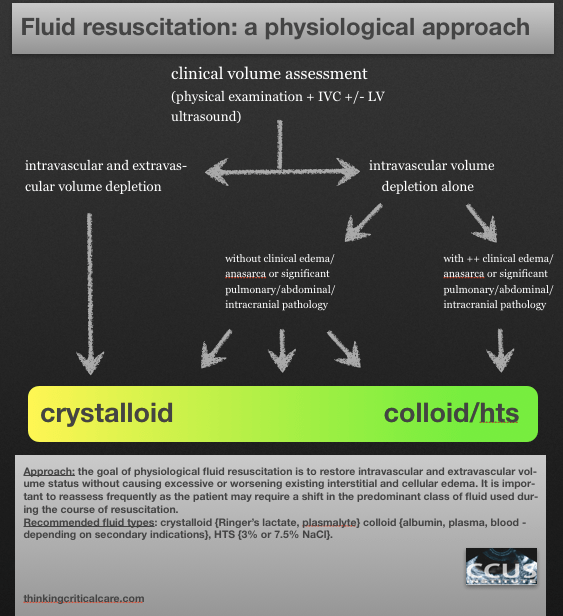
fluid resuscitation: a physiological approach – an N=1 podcast, #FOAMed, #FOAMcc

This is my approach to fluid resuscitation – sorry for the lack of precision which, to me, is actually key.  It would be against the N=1 principle to give out a recipe…but here’s a way to think about it:

Sorry the last bit cut off – my iphone can only email an 8 minute audio clip! Which I wasn’t aware of until today.  Anyway all that was lost at the end was “thanks for listening and I’d really like to hear comments and others’ practices!”

And here’s a disclaimer:  I don’t think this is the be-all and end-all. My resuscitation is a work in progress, both in terms of new fluids coming up, and in terms of identifying subgroups or individuals who would benefit from a different approach, so I’m definitely eager to hear from anyone who does things differently – but physiologically!

Please see Dr. John Myburgh’s excellent review on fluid resus in NEJM sep 26th issue!

Oh and here’s the diagram!

Physiological Fluids

thanks!

Philippe

Armani suits and recipe therapies…#FOAMed, #FOAMcc

Just a quick word to relate an interesting conversation I had with a colleague last evening.

I was taking over an ICU for a night’s coverage and going over the sicker patients with the current daytime attending, my friend and highly esteemed colleague Edgar Hockmann.  We were discussing a particularly challenging case of a young (40’s) patient with staph aureus sepsis and MSOF, and trying to come up with some tweaks, and ended up discussing the concept of tailored therapy to each patient’s physiology, which is right up my alley of N=1 thinking.

Now, as background, Edgar is a particularly bright guy who routinely challenges dogma, whether his own or others’, and I always learn from any conversation with him.  He has given awesome lectures in our conferences for the past several years. In this case (in addition to some fascinating microcirculation stuff I will have to digest and regurgitate at some point), he gave me a great teaching analogy:

Asking the question “what is the best treatment for disease x?”  is essentially analogous to asking “what’s the best size for a suit?”

You can debate it all you want, but ultimately, if you’re a 46 short or a 38 tall, the 42 regular on the store manikin won’t look too good on you.

And so I may be reiterating myself, but it is really key to assemble all the physiological evidence you and (physical exam, ultrasound, laboratory, etc…) and try to determine what this patient needs, not what most patients would need in a similar situation. Fluids in or fluids out? Which type of fluid? Blood pressure goals (MAP of 65 for everyone…really…)? Urine output goals?  We’ll try to go over each of these in the next weeks/months.

It’s a lot easier to follow a protocol.

…but my guess is that if you went to Savile Row, I doubt you’d see Shaquille O’Neal and Danny De Vito walking out with the same suit…the haberdashers would be fired…

Philippe