CCUS 2014 – all lectures coming soon! #FOAMed, #FOAMcc, #FOAMus

The 7th edition of our symposium was awesome!  We had over 130 participants from all over Canada, the USA, and even had a few europeans hop the puddle and come share in the learning and practice!  All in all, two great days.


Thanks to the entire faculty, including #FOAMites Haney – @criticalcarenow, Mike – @bedsidesono, Vicki – @nobleultrasound, Taylor – @canibagthat, Jean Francois and Maxime – @EGLS_JFandMax who really made sure each participant had a great learning experience.


In the spirit of #FOAMed, we’ll be putting up ALL the lectures on the website in the next few weeks (www.ccusinstitute.org), and eventually a system for CME might be put in place. So make sure to bookmark or come back visit, as there were some really great lectures. Select workshops will also be uploaded.


Next year is in the works, so stay tuned!


Philippe

The Effort-Variation Index – a conceptual tool for IVC ultrasound. #FOAMed, #FOAMcc, #FOAMus

I recently had a colleague ask me to put on a graph the way I like to assess the IVC, at least conceptually.  I posted about this a few weeks ago (http://wp.me/p1avUV-8E), so I tried to come up with something useful for clinicians, correlating IVC variation with respiratory effort.

A useful concept to visualize this is the Effort-Variation Index (EVI). To obtain this, start by looking at a Frank-Starling curve, and broadly categorizing patients as being on the “empty” side, the “normal” or the “full” side.

Frank-Starling:Physiological


Next, if you look at how these groups would plot on a graph correlating IVC variation to respiratory effort, which, physiologically, would be the change in pleural pressure (delta Ppl), you should conceptually see something like this:


EVI


Note that this has not been validated, nor does it contain any values. It is simply, for now, a useful mental construct to understand the physiology behind the variability, and is useful when elaborating each patient’s physiological profile in the mind of the bedside clinician. Along any horizontal line, the IVC variation would be the same. You can therefore see that, given enough respiratory effort, a “full” patient could appear “normal” or even “empty.” Hence interpreting IVC variation without understanding this would lead to potential error.


Love to hear some thoughts and comments!


Philippe

Another wicked ultrasound case! Can you see the culprit? Another reason to do bedside ultrasound… #FOAMed, #FOAMcc, #FOAMus

Reviewing some TEE cases with Max Meineiri of TGH yesterday (Max is an anaesthetist-intensivist-sonographer extraordinaire who has been kind enough to help me brush up my TEE skills recently), here is one that stood out for two reasons. Here is the story: An 84 year old woman is sent from a peripheral hospital to the cath lab for chest pain.  She arrests on the table after they found normal coronaries and the code blue is called. Max arrives on the scene, and due to CPR making TTE difficult (and also because Max walks around with a TEE probe in a hip holster by Dolce & Gabbana), in goes the TEE probe and right away they note a massively dilated and hypokinetic RV, and a small and under filled LV. Yup, sure looks like a PE in these circumstances. Not being satisfied with a presumptive diagnosis, Max gets to a short axis view of the aortic valve and pulls out the probe slightly, following the bifurcation of the main PA.  On the screen, the right PA is on the upper left field, and the left PA disappears towards the upper right (the left main stem bronchus makes it difficult to visualize).

Anything seem a little odd?   Yup, you can see the occlusive culprit a couple of centimetres into the right PA, moving with each beat.  Being in angio already, they threaded a PA cath and administered thrombolysis, but despite some visual fragmentation, she did not survive. So why is this case interesting? 1. the image is pretty cool. 2. More importantly, it highlights the importance of bedside ultrasound.  If a rapid, focused cardiac exam had been done at her presentation at the peripheral hospital, the first-line physicians most likely would have noted the severe RV dysfunction and questioned the diagnosis of coronary syndrome, possibly (hopefully) thrombolysing the patient, and very possibly averting the cardiac arrest. …I know, I know, we don’t have all the info, the ECGs, etc, and maybe this was really an ACS and she happened to have a DVT which embolized during transport, etc…do you buy that?  Ockham and his parsimonious razor don’t, and I would tend to side with them.   love to hear some thoughts!   Philippe

Bedside Ultrasound: Quite a Case! #FOAMed, #FOAMcc

So here is an awesome clip from an ICU colleague of mine, Lorraine Law.  She was managing a post arrest (elderly woman who collapsed at home and was resuscitated but remaining in profound shock) case using bedside ultrasound and came across this pathology:

video courtesy of Lorraine Law & Shirish Shantidatt

what do you think?

scroll below for my thoughts…


So the clip starts with a subxiphoid 4 chamber view that clearly shows a massively dilated RV with a hyperdynamic and underfilled LV.

[For the hemodynamic novices, remember that the ventricles are kind of like roommates who share a pericardium. Especially in acute scenarios, if one gets overloaded, the other will have to give way, until the pressure equilibrates. If the process is exceedingly slow, they can do some renovations and stretch the pericardium, but this takes likely weeks. In this case, the elevated PAP overloads the RV and the RVDP > LVDP, resulting in decreased diastolic filling, which in turn drops the stroke volume/cardiac output/MAP.]

We can see that the RV TAPSE (tricuspid valve excursion towards apex) is really minimal, supporting an acute or acute on chronic process.

The clip then shows a long axis view of the IVC with echogenic material, most likely thrombus, with a to and fro motion, going in and out of the RA. Wow. You don’t see this very often.  The only thing preventing further travel is actually the fact that the cardiac output is so low due to massive embolism so that the flow can in fact barely carry the clots forward anymore at this point, similar to the sluggish IVC clip I put up a few months ago (http://wp.me/p1avUV-5t).

The most likely diagnosis is pulmonary embolism, and thrombolysis is indicated. Unfortunately despite my colleague’s timely diagnosis, the clot burden was likely too much, and despite thrombolysis, the patient passed away of intractable shock.  One can imagine that the TPA actually has to make it to the lungs, and with such a degree of obstruction, it is likely that very little actually got to the pulmonary vasculature…

Unfortunate case, but quite impressive images.

A crazy thought, using hindsight and with the luxury of knowing the fatal prognosis: intracardiac (RV) TPA bolus? Small spinal needle?  Anyone bold enough? Food for thought if (when) I see one like this…


cheers!


Comments:

Marco says:

Really quite impressive images. A couple of weeks ago I admitted a pretty young patient after a successful resuscitation due to massive pulmonary embolism. Immediately after ROSC in emergency department, he was transported to the cath-lab where TPA bolus was administered directly through a PA cathether. In ICU we continued the infusion. In less than 24 hours we obtained a relative hemodynamic stability and discontinued all the vasopressors, but the case remains unfortunate because despite therapeutic hypothermia the post-anoxic damage was so severe that led to cerebral death declaration two days later.


Thanks Marco, very interesting.  There is a recent study on catheter directed thrombolysis in PE reviewed at PulmCCM:(http://pulmccm.org/main/2014/randomized-controlled-trials/catheter-directed-thrombolysis-submassive-pe-better-heparin-rct/)

A physiological point about PE resuscitation is the relative inefficiency of CPR, as both venous return and LV filling is severely limited, so systemic perfusion is even worse than the usually poor output during chest compressions…

Thanks for reading!

Marco replies:

Thanks, Philippe!
The point about the possible inefficiency of CPR is crucial in my opinion. The patient I brought as example had a witnessed cardiac arrest (he called EMS when in respiratory distress) and CPR without interruption from the beginning, nevertheless he resulted in brain death declaration.
I remember very clearly a 43-year-old woman that 3 years ago had a massive PE in the OR shortly after a long lumbar vertebral stabilization. We admitted her to ICU after more than 80 minutes of CPR, a bolus of rTPA and with severe hemodynamic instability. RV was extremely dilated. When she eventually regained stability I had little hope about her neurological recovery, but surprisingly she was extubated the following day and last year she returned to our 12-months post-ICU follow-up showing perfect recovery.
I think that systemic and cerebral perfusion during “obstructive” cardiac arrests such as massive PE is very difficult to asses with current technology. A couple of times I was tempted to check it with trans cranial doppler, but usually there’s too much confusion during CPR.
When I was a resident I witnessed to a iatrogenic cardiac arrest in a patient with advanced monitoring that led to an interesting publication: http://www.researchgate.net/publication/10832333_Cerebral_perfusion_pressure_and_cerebral_tissue_oxygen_tension_in_a_patient_during_cardiopulmonary_resuscitation


Wow, very interesting cases.  What fortune to have been able to record that data, as obviously getting that in during CPR would be almost impossible.  TCD, at least after ROSC, could be contributory… Another option is using NIRS, which I’ll be working with this summer.

thanks again!

Philippe

An Update on Pulmonary Embolism: NEJM’s PIETHO Study…what’s the verdict? #FOAMed, #FOAMcc

As has been discussed in a previous post (http://wp.me/p1avUV-7T), patients with sub-massive PE (hypoxic, tachycardic, some troponin rise, etc…but no hypotension) remain in a grey zone, which is, to me , a dubious situation at best – their mortality can be up to 15%, morbidity likely more.  Everyone agrees the low-risk patients don’t need thrombolysis, and everyone pretty much agrees that the patient in shock needs it.  There is data out there suggesting that some patients clearly benefit from thrombolysis despite not being in shock, in good part relating to avoiding chronic pulmonary hypertension and its consequences.

The issue for many clinicians is that they have a “stable” patient in front of them, and they are considering giving them a drug that can potentially give them a bleed in the head and leave them dead or crippled. Many shy away from this. Part of this is cultural, because the same docs probably wouldn’t hesitate giving the drug to a lateral or posterior MI, which is not likely to kill you, or even leave you a cardiac cripple (just to be clear, I’m not advocating against thrombolysis in these cases, just trying to find a parallel), but since the AHA guidelines say to do it and everyone else does it, there’s no trepidation. It is the standard of care.  For most of us acute care clinicians who do not do outpatient medicine, if the patient survives and gets discharged home, chalk one up in the win column. But, as has become clear in recent years with the post-critical illness syndromes, morbidity can be just as important as mortality, especially in the younger patients. Kline et al (Chest, 2009) showed how almost 50% of “submassive PE” patients treated with anticoagulation alone had dyspnea or exercise intolerance at 6 months. They only had a 15% improvement in their pulmonary artery pressures (mean 45 mmhg).

What are the real risks? Pooling the data together gives a value around 2% with a spread between 0.8% and 8%, more or less. This represents each patient’s inherent risk of bleeding, as well as some of the inconsistencies with post-thrombolysis anticoagulation (safest to aim for 1.5-2 x PTT baseline in the first 48h).

The MOPETT trial which, as a #FOAMite you have certainly come across, showed that a half-dose of TPA was highly effective, and they felt it might be possible to go lower. The physiological beauty in that is that, unlike other sites we thrombolyse with full dose TPA, the lungs get 100% of the TPA (coronary artery gets maybe 5%, brain gets 15%).  Mind you, of course, the culprit clot/artery obviously doesn’t get 100%, but much, much more (if we figure that you need about 50% vascular area occlusion to cause RV dysfunction) TPA per “clot” than other pathologies. One can argue that anatomically, there is a greater clot burden than coronary or arterial thrombolysis, which may offset this somewhat. However, the date was quite clear in this trial that the therapy was effective, and the bleeding was none.

Ok, so let’s get to the PIETHO. 1000 patients, TPA+heparin vs heparin alone in normotensive but intermediate risk patients. So, first question is how was that risk defined?  Patients needed to have echocardiographic/CT signs of RV dysfunction AND a positive troponin. Interestingly enough, onset of symptoms was up to 15 days before randomization…not exactly early treatment, and unfortunately there is no information about the actual time to thrombolysis or subgrouping.  The results were as one could imagine. The combined endpoint of death or hemodynamic decompensation was 2.6% in the thrombolytic group vs 5.6% in the anticoagulation.  I’m not a fan of combined endpoints. Hemorrhagic stroke was 2.0% vs 0.2%. Their conclusion? Exercise caution. Hmmm…not much of a step forward. Basically tells us what we know. It helps the hemodynamics, but you can bleed. They do re-affirm that bleeding is more likely in the over-75.


What do we REALLY need to figure out? 

1. echographic risk stratification – at least into moderate and severe RV dysfunction.

2. longer term outcomes (hopefully PIETHO has a follow-up study in the pipeline, since they had good numbers).

3. a point-of-care study – time is of the essence, and may have an impact on dosage. IMHO thrombolysis should be done within a few hours of presentation at most.

4. further dosage data – 1/2? 1/3? 1/4? small boluses q1h until RV function improves?

I wish I could do it, but community hospitals don’t have the ideal setup, nor do I have a research team that can handle something of this scale. But surely someone can!


Bottom line?

It won’t change my practice. I will continue to offer thrombolysis in select cases, especially the younger patients, who obviously have a lower risk of bleeding, and stand to benefit the most, as pulmonary hypertension  can be crippling. I know I’d take the risk of bleeding when I see 50% dyspnea/exercise intolerance two years down the road…

Finally, bedside ultrasound to anyone with dyspnea/hypoxia should be a standard of care for every acute care physician. No ifs, ands or buts, no exception. Waiting for a CT angio or formal (read daytime hours) echocardiogram is, to me, unacceptable. If you, a friend or family member were in that ER bed, would you trust a physical examination and a CXR to rule out the need for an immediate intervention? I wouldn’t, not my own, and not even Dr. Bates’, Dr. DeGowin’s or Dr. Sapira’s, or all three combined.

cheers!


Kline JA, Steuerwald MT, Marchick MR, Hernandez-Nino J, Rose GA. Prospective evaluation of right ventricular function and functional status 6 months after acute submassive pulmonary embolism: frequency of persistent or subsequent elevation in estimated pulmonary artery pressure. Chest 2009;136:1202e1210.

Guy Meyer, M.D., Eric Vicaut, M.D., Thierry Danays, M.D., Giancarlo Agnelli, M.D., Cecilia Becattini, M.D., Jan Beyer-Westendorf, M.D., Erich Bluhmki, M.D., Ph.D., Helene Bouvaist, M.D., Benjamin Brenner, M.D., Francis Couturaud, M.D., Ph.D., Claudia Dellas, M.D., Klaus Empen, M.D., Ana Franca, M.D., Nazzareno Galiè, M.D., Annette Geibel, M.D., Samuel Z. Goldhaber, M.D., David Jimenez, M.D., Ph.D., Matija Kozak, M.D., Christian Kupatt, M.D., Nils Kucher, M.D., Irene M. Lang, M.D., Mareike Lankeit, M.D., Nicolas Meneveau, M.D., Ph.D., Gerard Pacouret, M.D., Massimiliano Palazzini, M.D., Antoniu Petris, M.D., Ph.D., Piotr Pruszczyk, M.D., Matteo Rugolotto, M.D., Aldo Salvi, M.D., Sebastian Schellong, M.D., Mustapha Sebbane, M.D., Bozena Sobkowicz, M.D., Branislav S. Stefanovic, M.D., Ph.D., Holger Thiele, M.D., Adam Torbicki, M.D., Franck Verschuren, M.D., Ph.D., and Stavros V. Konstantinides, M.D., for the PEITHO Investigators*, Fibrinolysis for Patients with Intermediate- Risk Pulmonary Embolism, N Engl J Med 2014;370:1402-11.

Mohsen Sharifi, MDa,b,*, Curt Bay, PhDb, Laura Skrocki, DOa, Farnoosh Rahimi, MDa, and Mahshid Mehdipour, DMDa,b, “MOPETT” Investigators, Moderate Pulmonary Embolism Treated With Thrombolysis (from the “MOPETT” Trial), Am J Cardiol 2012

Bedside Ultrasound Clip Quiz #8. #FOAMed, #FOAMcc

So a patient presents with worsening peripheral edema and right upper quadrant discomfort. Biochemical data only reveals some mild elevation of the transaminases.

Here is what you see:

These are the right sided chambers.

And this is a hepatic vein.


What do you think is going on?  Scroll below for the answer!


This patient has severe tricuspid regurgitation. The second clip shows significant retrograde flow in the hepatic vein (red doppler signal). Hepatic congestion was the cause of pain.

Analysis of hepatic vein flow can be useful to establish the presence of right heart dysfunction when cardiac views are difficult.


cheers!


Philippe

The IVC Assessment by bedside ultrasound: Let’s apply some common sense! #FOAMed, #FOAMcc

So I have a huge issue the IVC and its ultrasound assessment. For the most part, neither the yay-sayers or the nay-sayers are applying much sound physical principles, as far as I’m concerned.

To assess a patient’s volume status, it may be practical to begin with the sub-xiphoid view of the IVC, since the decision to give fluids or not – especially in emergency situations – can then be taken within the first few seconds of examining the patient. The physiological rationale behind assessing the IVC as a marker for volume responsiveness is simple and solid. As the venous compartment fills, the size of the IVC will gradually increase until it reaches a maximal size of about 20-25mm or even 30mm, depending on physical size and chronicity.

Concomitantly, the phasic respiratory variation will decrease as the venous pressure increases and the effect of varying intrathoracic pressure is no longer felt. At this point, the flat part of the Starling curve of the right ventricle is approaching, and there is little response to volume, and little physiological rationale to support giving more.

Currently, many use a variation of about 20% or more to suggest a volume responsive state in ventilated patients or an inspiratory collapse “sniff test” of 50% or more in spontaneously breathing patients.

There remains controversy around using IVC assessment for volume responsiveness, and with good reason! There are a few important reasons why:

a. technique – First of all, there is the manner in which IVC measurement has been taught: the M-mode measurement of the antero-posterior (AP) diameter during breathing (usually of ventilated patients) about 3 cm below the diaphragm. Although highly practical and reproducible, it has many shortcomings. If we look at the physiology, what changes with cycles of respiration is the volume of blood entering the chest/right atrium. Hence the key variable we are trying to assess is the transient variation in IVC size – which is a volume, not a linear dimension (I’m getting painful flashbacks of using pressure  to determine volume!)Hence the use of a single linear measure on one point along the length of the IVC to assess this is inherently flawed. For instance, the figure to the left shows how, if this IVC were to be measured in its AP diameter, the variability may not be that great. In the short axis, however, one can clearly see the significant change in surface area, and hence volume between phases of mechanical ventilation. Also, the IVC is rarely perfectly circular, but often ovoid, and occasionally with the greatest diameter in an anteroposterior axis, making that single AP measurement even less relevant.

b. intrathoracic pressure – Secondly, the variation in intrathoracic or intrapleural pressure (Pip) must be measured, as, for instance, a young and fit patient can generate large changes, which would result in more significant IVC variation, as compared to a frail elderly patient, even if they are on the same point of their Starling curve, invalidating the IVC measurement. All “sniffs” are not created equal.

c. intra-abdominal pressure – Finally, the intra-abdominal pressure (IAP) must also be assessed, since an elevated pressure would decrease the size of the IVC and make that measure no less accurate, but less relevant in terms of representing venous filling.

So what should we do?

Instead, a more global assessment of the IVC volume, measuring short axis area measurements and variation at several points along the IVC would give a much more accurate estimate of IVC volume variation. This is currently being studied by our group.

“Eyeballing the IVC” Attempting to link evidence and physiology, some bedside sonographers’ approach is to take a global look at the IVC in both long and short axis during respiration, while clinically assessing the respiratory effort and the abdominal pressure. This approach is analogous to the “eyeballing” of LV function – versus more formal measurements such as Simpson’s disk method, etc – which has been proven just as accurate with sufficient clinical experience.

The figure below shows an IVC that is about 10-12mm along most of its intrahepatic segment on expiration, and collapses almost completely on inspiration. If this belongs to a patient breathing with little effort and with a soft abdomen to palpation, it is physiologically quite clear that this patient would be fluid responsive. It also shows how impressive the collapse is in the short axis.

IVC insp dual

For instance, let’s say Patient A is in respiratory distress and using accessory muscles and presents to the ER with a respiratory rate of 35 and a systolic BP of 80. His IVC measures approximately 21 mm in diameter at several points along its axis, and has a brief collapse to about 10 mm with strong inspiratory efforts. His abdomen is soft during inspiration but firm during a prolonged expiratory phase.

Patient B is brought to the ER somnolent with a respiratory rate of 10 and a systolic BP of 80. His IVC measures 15 mm with minimal respiratory variation. His respirations are shallow and his abdomen soft. These two patients show how the IVC assessment needs to be taken in clinical context.

Patient A has some 50% inspiratory collapse of a large IVC in the context of large variations in Pip, whereas Patient B has little variation of a mid-sized IVC in the context of very small variations in Pip. In all likelihood, Patient A is not very volume responsive, while Patient B probably is.

Volume Responsiveness vs. Volume Tolerance – it is critically important to distinguish the difference between these two concepts as they are often misused interchangeably: Volume responsiveness refers to an increase in cardiac output (CO) to a fluid challenge. This is a purely hemodynamic concept. Volume Tolerance refers to whether or not a patient can tolerate volume without clinically significant side effects. This is a complex clinical assessment that should include: -the patient’s plasma oncotic pressure (serum albumin) and level of capillary leak, if present, -the patient’s pathology – is there risk of capillary leak in critical tissues such as lung, brain, abdomen? -the type of fluid being considered (isotonic crystalloid vs hypertonics or colloids/blood products). It is important to distinguish that not all patients who are volume responsive are necessarily volume tolerant.

Volume assessment summary – this issue remains a difficult one, even with the use of bedside ultrasound, because the optimal point for any one patient to be on his or her Starling curve at any one time in different clinical conditions remains elusive. Despite considerable study and several proposed management algorithms, there is no means by which to determine exactly how much of any given fluid is enough, without being too much.

In my opinion… – no direct evidence – keeping an IVC below 20mm and probably below 15mm with significant respiratory variation, if hemodynamics allow, is probably ideal. However, bedside ultrasound allows to clearly identify the cases where fluid is clearly needed and those where fluid is unlikely to benefit. Both of these scenarios are easily and routinely missed by traditional examination. Additionally, when the IVC assessment is done in conjunction with lung ultrasound, it becomes possible to detect early development of pulmonary edema and halt aggressive fluid resuscitation (FALLS Protocol, Daniel Lichtenstein).


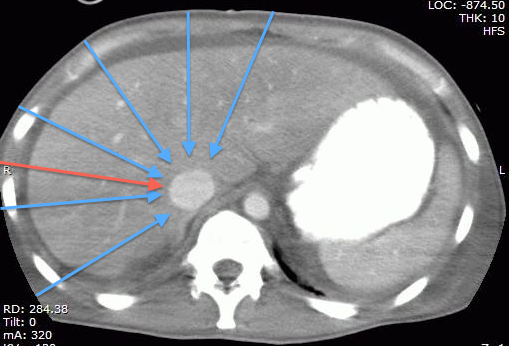
Technical Pearl: the part of the IVC we generally assess being the intrahepatic segment, it is possible to find it almost by scanning through any part of the liver, which happens to provide a great acoustic window. This may be particularly useful when the epigastric area is difficult to access (incision/bandage, drains, in the OR, etc…) or when there is bowel gas in the epigastrium. The figures below show the same IVC, first in a “traditional” epigastric view, then in a view approximately along the plane of the red arrow on the CT scan.

2 views IVC std:liver

CT liver IVC views


Bottom line?

When assessing volume status, it is absolutely essential to keep the clinical question in mind. It is a great minority of patients who are volume responsive who actually need volume. Normal, healthy humans are very much fluid responsive and fluid tolerant but certainly not in need of any. Much of the current studies and literature focus on assessing volume responsiveness in the setting of shock, which, although arguably the most important, is not the only type of information that can be obtained from the IVC. For instance, as will be discussed in the chapter on congestive heart failure, knowing that your patient is very “full” should prompt further diuresis. If you are dealing with managing severe anasarca, knowing that a patient’s intravascular volume is low may prompt the use of albumin or hypertonics prior to further diuresis to help resorb some of the interstitial fluid. Another critical question to which there is currently no answer is just how much fluid to give to patients in shock. There are many opinions but no certainty. It is common practice to fill a patient in shock until they are no longer fluid responsive, in an effort to avoid or minimize the use or dose of vasopressor medications. There is no study to date that compares a “moderate fluid/early vasopressors” vs “aggressive fluid/avoid-vasopressors-if-possible” approach.

Hopefully this will be answered soon. In light of the clear evidence linking positive fluid balance and mortality, it would seem wise to fill to a “moderate fullness” where some respiratory variation remains, rather than to the point of no longer being fluid responsive. After all, physiologically, the only time humans are really full (>20mm IVC with little or no variation) is in pathological states of congestive heart failure or obstructive shock. So again, when assessing an IVC, keep in mind what your clinical question is and interpret the sonographic data accordingly.


cheers!


Comments:

Marco says:

Thanks Philippe, very interesting post.
Using your great categorization, I think that the worst scenario is represented by a patient who is volume responsive but poorly volume tolerant. In that case, it is important to have clear in mind which is our target: cerebral perfusion, oxygenation and lung extravascular fluid, ventilatory weaning, renal function, avoiding vasopressors or mechanical ventilation, etc…
Very often, maintaining a brain dead heart beating donor, every organ would require a different volemic status, and if all of them are suitable for transplantation you have to compromise.
Just a last thought: as well as “all sniffs are not created equal”, also tidal volumes are very variable. Assessing respiratory variations during protective (low TV) ventilation requires a thoughtful interpretation of the results.


Absolutely. Interpretation of the findings in each individual case is key. 

Philippe

Bedside Ultrasound Clip Quiz: What’s the Rhythm? #FOAMed, #FOAMcc, #FOAMer

Just a clip.

What’s the dx?


scroll below!


sinus tachycardia with 3rd degree HB – taken on a call on the ward before the tech brought the EKG machine.

thought it was neat.


Philippe

NEJM: The Septic Shock Issue…groundbreaking or same old same old? #FOAMed, #FOAMcc

Ok, so it was pretty cool to see an NEJM issue basically dedicated to septic shock management, I must admit. But let’s dig a little deeper, shall we?

So here is where they are: http://www.nejm.org, and fully available for now.

I won’t go through all the details and numbers, after all they are in the papers, so let’s just analyze them from two principles:

a. the N=1 principle – how was therapy individualized?

and

b. was there any integrated monitoring of the therapeutic goals?

…and we’ll conclude by looking at the potential practice-changing potential of each of these studies.

So first of all,

High vs Low BP Target in Septic Shock, by Asfar et al.

So basically a negative study except for two findings, the increased incidence of afib in the high target group and the decreased need for renal replacement therapy among chronic hypertensives in the high target group.

so N=1 is not really revealed:

“Refractoriness to fluid resuscitation was defined as a lack of response to the administration of 30 ml of normal saline per kilogram of body weight or of colloids or was determined according to a clinician’s assessment of inadequate hemodynamic results on the basis of values obtained during right-heart catheterization, pulse-pressure measurement, stroke-volume measurement, or echocardiography (although study investigators did not record the values for these variables).”

So lets just hope that the variability evens itself out between the groups, since we don’t really know. The numbers don’t really tell the tale, because the average fluids received (10 liters over 5 days) could mean one patient got 15 and one got 5 – although let’s trust they followed the French Fluid Resus protocol…

So the atrial fibrillation makes total sense – more B agonism should result in that, and the decreased renal failure also does.

As the authors note, the actual BP averages were higher than planned. For those of us practicing critical care, we know most nurses titrating prefer having a little bit of extra BP – even when I prescribe MAP 65, I usually see the 70 or so unless I make a point to tell them. Understandable. They also note the underpowered-ness of their own study, but I think it is still worth looking at their results.

So…bottom line?  I think it’s a great study for a couple of reasons.

The first is to remind us to pay a little more N=1 attention to the chronic hypertensives, and that it is probably worth aiming for slightly higher MAPs.

The second, debunking the myth of “levophed, leave’em dead” (which I heard throughout residency at McGill), and the concept of doing everything (ie juicing patient into a michelin man) in order to avoid the “dreaded and dangerous” vasopressors. So really I think an alternative way to conclude this study is that it isn’t harmful to have higher doses of vasopressors. I think this is actually a really good study on which to base assessment of more aggressive vasopressor support vs fluid resuscitation, in the right patients.

It would have been interesting to have echo data on those who developed a fib – were they patients who had normal to hyperdynamic LVs who in truth did not need B agonism at all and would have been fine with phenylephrine?  Perhaps…

Cool. I like it.

Next:

Albumin Replacement in Patients with Severe Sepsis or Septic Shock, by Caironi et al. The ALBIOS study (a Gattinoni crew)

So basically showed no difference, so pretty much a solid italian remake of the SAFE study in a sense, confirming that albumin is indeed safe overall, and may be better in those with shock.  As the authors note, mortality was low, organ failure was low, so study power a little low as well. Note the mean lactates in the 2’s at baseline. The albumin levels of the crytalloid only gorup were also not that low, low to mid 20’s, whereas I often see 15-20 range in my patients, especially if I inherit them after a few days, as I do use albumin myself a fair bit. They also used a target albumin level, not albumin as a resuscitation fluid purely.

In my mind the benefit of albumin would be greatest in those with significant capillary leak, particularly those with intra-abdominal and pulmonary pathology. It would have been nice to see a subgroup analysis where extravascular lung water was looked at (especially coming from a Gattinoni crew!).

Another interesting thing would have been to know the infusion time of the albumin, since animal data tells us that a 3hr infusion decreases extravasation and improves vascular filling vs shorter infusion times. I routinely insist on 3hr infusion per unit, which sometimes results in 9-12hr infusions, almost albumin drips!

Bottom line?

I like it. Reinforces that albumin is safe, so makes me even more comfortable in using it in the patients where my N=1 analysis tells me to be wary of third-spacing. Also the fact that they used 20% – in Canada we have 100cc bottles of 25% for the most part – is nice, since the SAFE data used 4%.

Next!

A Randomized Trial of Protocol-Based Care for Early Septic Shock – The ProCESS Trial.

So right off that bat my allergy to protocols flares up, so I’ll try to remain impartial. It just goes against the N=1 principle. The absolutely awesome thing about protocols is that it primes the team/system to react – so clearly protocols are better than no-protocol-at-all, but strict adherence would clearly not fit everyone, so that some built-in flexibility should be present.

This being said, the ProCESS study is really interesting, for a number of reasons. They have three groups, and compare basically (1) Rivers’ EGDT to (2) their own protocol (see the S2 appendix online) which gives a little more flexibility and (3) “usual care”.  Net result is that all are pretty equal, no change in mortality. As the authors note, their mortality was low, so again may not have been able to detect a difference.

So, what does this mean. To me it’s a little worrisome because I doubt that the “usual care” represents the true usual care found in EDs/ICUs all over the world, so I am concerned that many docs will use this as a reason to justify not changing their practice, similarly to many I’ve heard say they don’t need to cool anymore after the TTM trial. Human nature for some I guess.

Bottom line? You don’t have to follow EGDT if you’re conscientious and reassessing your patient frequently and have done all the other good things (abx, source control, etc). I think that’s really important because giving blood (see my post about S1P) to those with hb > 70 and giving dobutamine to patients with potentially normal or hyper dynamic LVs never made physiological sense to me, and the problem with a multi intervention study such as EGDT is that you can’t tease out the good from the bad or the neutral. Again, studies such as EGDT are pivotal in changing practice and raising awareness, so this is not a knock against a necessary study, just to highlight the point that each study is a step along the way of refining our resuscitation, and the important thing is to move on. In fact, the reason that this is a negative study is probably due to the improvement in “usual care” that EGDT brought along.

Conclusion: No new ground broken, but these studies do make me feel more confident and validated in continuing to not do certain things (strict EGDT) and  doing others (albumin and earlier use of vasopressors).

Kudos to all investigators.


let me know what you think!


P


Bedside Ultrasound and PEA: CPR or no CPR…? #FOAMed, #FOAMcc

The usefulness of bedside ultrasound in cardiac arrest is clear, giving the clinician instant information on the hemodynamic process resulting in arrest. My arrest sequence is generally done as follows:

Step 1: IVC assessment

Step 2: Subxiphoid cardiac views

Step 3: Lung views if pneumothorax suspected.

Step 4: remaining views if possible (eg abdominal views to find source of bleeding, etc…)

The important part (as per current recommendations) is to have minimal interference on chest compressions. The IVC view, albeit jumpy, can generally be obtained during CPR.  The subxiphoid view should be “prepared” during CPR, meaning that the sonographer warns the team member doing CPR not to stop compressions until he is told to do so (unless the team are already used to ultrasound in cardiac arrest), the probe positioned optimally, then instruction given to stop for five seconds while a look +/- loop is acquired. This should be enough to look for pericardial effusion, RV/LV ratio and LV contractility. In fact, experienced sonographers can usually get this while CPR is going on in many cases. Then CPR should be restarted. Hence for now, minimal interruptions in CPR (until the concept of “stutter CPR” really emerges!!!).

Here are a couple of views with active CPR:

In this case there is  a clear RV overload with a dynamic but underfilled LV.

From the information obtained in those 5 seconds, one should be able to consider the need for volume (hypovolemia), thrombolytics  (pulmonary embolism suspected) or drainage of fluid (tamponade) or air (pneumothorax). The possibility of an acute myocardial infarction must be considered as it is one of the most common causes but is difficult to confirm by ultrasound.

Pulseless Electrical Activity

This may be the most exciting area in which ultrasound will change management.  In the absence of ultrasound, all PEA is more or less alike: there is organized electrical activity, but no pulse. Physiologically however, the range of diagnoses is very wide, with on one end, a perfectly good heart that is empty (hypovolemic shock in extremis), and on the other, cardiac standstill despite electrical activity. An astute physician does not need a randomized clinical trial to know that the management and prognoses of those two extremes are very different. Without bedside ultrasound, however, these would appear identical: “PEA.”

 The heart rate cannot be relied on since it will largely depend on the phase (both would begin as tachycardic, then eventually bradycardic until asystole occurs).

Notwithstanding guidelines,  the information obtained should be considered strongly. If we start by looking at the first end of the spectrum, there would be no physiological rationale for performing chest compressions or an empty and hyperdynamic ventricle: rapid infusers and vasopressors (to recruit venous unstressed volume) should be used instead. At the other end, the heart in standstill definitely needs compressions. Of course, there is then the whole range of varying RV and LV pathologies, tamponade, etc, all of which need to be dealt with individually. It is really a huge grey zone…

CPR or no CPR?

A very important question is whether CPR should or should not be performed in certain cases of PEA.  Certainly ACLS protocol dictates so. However, ACLS has not yet truly integrated bedside ultrasound into management, only suggests in a very loose way – understandably since the protocols must be applied by all, and still only few use it regularly.

I have to credit Dr. Sue, an ER doc from Atlanta, who asked me the question about CPR in extreme hypotension, and I had to rewind in my mind the cases in which I had used physiological information to overrule the ACLS protocol in one direction or another and try to formulate an answer.

It is an excellent question and made me realize that there is no clear answer for two reasons:

One: PEA is not a diagnosis but a clinical syndrome. It relies on manual pulse check (unless the arrest occurs in a patient with an arterial line), hence the line between severe hypotension and true PEA is difficult to determine. Technically and physiologically speaking, if the LV contraction is sufficient to open the aortic valve, there is a “pulse.” Now how far along the arterial circuit this pulse travels is not known…unless it is monitored.

Two: The key question then becomes the following: at what level of endogenous blood pressure is the perfusion better than with “good” CPR?  We do not yet have that answer. The coronary perfusion pressure (diastolic pressure – wedge pressure) data often quotes a minimal range of 15-25 mmhg, which – if we arbitrarily choose a high-ish wedge – would suggest we need a diastolic pressure in the 40’s (also note that that data is imperfect). Hence the arterial line. Perhaps there could be a role for tissue saturation/near-infrared spectroscopy or other microvascular flow indices in the future…

Now what about the huge spectrum of cases in between?  Let us exclude the cases with immediately reversible causes such as tamponade and pneumothorax, where the initial management is clear, and instead focus on differing levels of RV and LV dysfunction resulting in the absence of a palpable pulse.

Predominant RV failure – although PE should be strongly suspected and thrombolysis considered, the question remains about management if you see a hyperdynamic but underfilled LV.  CPR would appear reasonable in an effort to try to get some RV to LA flow. Endotracheal milrinone, sometimes used in cardiac anasthesia, can be an option as it provides inotropy and pulmonary vasodilation.

Predominant LV or biventricular failure – if cardiac activity is present, it seems imperative to start an infusion of vasopressors, and traditionally, do CPR until there is a measurable blood pressure. I have used CPR with progressing bradycardic rhythms for a few seconds to circulate the epinephrine, with at least short-term success.

Here is a typical LV “PEA” from the subxiphoid view:

Ideally, an arterial line would be very useful in these patients, and may help to decide on an individual basis when CPR should be used. Remember that CPR on a beating heart will likely worsen cardiac output as asynchronicity and increased mean intrathoracic pressure will impair filling.

Additionally, the arterial line also allows us to notice small trends during resuscitation, such as seeing that a few seconds of CPR may help circulate a bolus of vasopressor and enable it to take effect – progressive BP increase, or that the BP may be trending downwards despite vasopressor infusion – CPR may be useful until enough vasopressor/inotropes have infused.

Bottom Line:

1. if possible, put in an arterial line

2. bedside ultrasound is mandatory if you don’t want to miss anything reversible

3. if you don’t have a palpable pulse and your diastolic pressure (arterial line) is less than 40, consider some CPR until vasopressors/inotropes have had effect.

4. if you are lucky enough to have ECMO (shout out to Joe and Zack at http://www.edecmo.org)  or other mechanical support, it would be the time to consider!

I think this is actually a really interesting area to develop, and I’d really, really like to hear what other sonographer-resuscitationists are doing, or what anyone else might think!


Philippe


Joe Bellezzo – yes, THE Joe, says:

Phil, I agree with all your points here. Great post! As you know, Shinar, Weingart and I recently published a rant on PEA (over at http://www.edecmo.org/13) and Weingart threw out two possible new monikers: PRE-M (Pulseless Rythm with Echocardiographic – Motion) and PRE-S (Pulseless Rythm with Echocardiographic – Standstill). I don’t disagree with any of those concepts but I think its simpler than that.

PRE-S (standstill) = asystole and you start compressions.
PRE-M (organized cardiac activity) = profound shock. In this setting I like the recent Littmann paper that gives a simplified approach (http://edecmo.org/wp-content/uploads/2014/08/A-Simplified-and-Structured-Teaching-Tool-for-the-Evaluation-and-Management-of-Pulseless-Electrical-Activity.pdf).

As you pointed out above, the real big question is at what point do you start compressions when you have cardiac motion? Your points above are spot on. The problem with compressions on a beating heart is that you don’t know what your end-point is. You lose the ability to do minute-minute diagnostics and doing any procedures with ongoing compressions is tough. And it seems to be a knee-jerk reaction for the RN or pharmacist to have an amp of epi ready to blast away at this point. NO!

I wait. I do stuff first. Step 1 is ECHO. If PRE-M (aka profound shock): EKG and arterial line NOW. Step 2: Stop, think and decide what you think is your top probable etiology of this profound shock and fix that. Step 3: reassess = repeat echo, EKG, and see what your art line pressures are doing. I try to do all that before I start compressions.

Example: “PEA” hits your door. Echo shows a wall motion abnormality and hypokinesis. EKG suggests ischemia but is not obvious STEMI. art line goes in simultaneously. I think this is MI. This heart does NOT NEED epi 1 mg! This is cardiogenic shock and I need to fix some stuff before I start pushing on the chest and blasting superhuman doses of epi! I usually start with a push dose epi (10-20 mics or so) while a pressor drip is prepped. Calcium bolus is given. I likely start dobutamine here (or milrenone if beta blocked). If that fixes your problem, then the pt goes to the cath lab. If it doesn’t, I cannulate and put the pt on VA-ECMO.

And what if I were wrong? what if this were a big PE? massive beta blocker OD? the protocol above is works in those cases too.

An aside, since you already placed a femoral venous line….and you popped in the Art line immediately, you have nice conduits to upsize to ECMO cannulas.

Great post Phil!


Thanks for sharing your approach!  As you know and clearly show, a sensical physiological approach is absolutely needed in a day and age when we can (bedside ultrasound) see what’s really going on, and we can (ECMO) give these patients a fighting chance!  See you at BMBTL in a couple of weeks!

Philippe


PS Joe (and Zack and Scott) will be talking about all this and more at CCUS 2015! http://www.ccusinstitute.org to register soon!