Bedside Ultrasound Clip Quiz #4 – #FOAMed, #FOAMcc

So you’ve been doing ACLS for a few minutes in the ED on an elderly male who collapsed at a bus stop and shocked out of VF on the scene by EMS, and when you do a 3 second pause to assess the heart, just after an epi got flushed, this is what you see in the subxiphoid view:


Is this a case of tamponade?

Scroll below!


Nope!  There’s no pericardial effusion, and the atria are huge!  What you do see is microbubbles from the flushed IV medication in the RA and RV, and severe LV dysfunction.   The severe LA dilation suggests at least a component of chronic overload (also supported by significant leg edema in this case). Note that you can have severe LV dysfunction (post-resuscitation myocardial dysfunction or PRMD) after cardiac arrest of ANY etiology and does not necessarily imply pre-existing LV dysfunction or predict eventual LV function.


Is it still cool to cool in cardiac arrest? The new TTM Hypothermia trial! #FOAMed, #FOAMcc

So the other dayI read the TTM trial (http://www.nejm.org/doi/full/10.1056/NEJMoa1310519?query=featured_home#t=article) with great interest, as cardiac arrest and the post-resuscitation phase have always been among my pet topics.

First of all this is a big trial.  Bigger that the previous ones that established hypothermia as a standard of care. Does it obviate those previous results?  Absolutely not. Those trials were not 32/33 vs 36 but 32/33 vs “whatever happens.”

Hypothermia makes a lot of sense physiologically, but of course that doesn’t mean that it might not have some harmful side effects that have not yet been clearly delineated (besides the current known hemodynamic ones and relatively benign electrolyte and renal alterations).

However, it is pretty clear that, compared to 33 degrees, 36 does just as well, which leans towards saying that all we have to do is avoid fever, or stay in a very mild hypothermia.

Avoiding secondary injury in brain pathology is key (no desat, no hypotension, and no fever), and in anoxic encephalopathy, it is no different.  The key thing is that in this trial, the temperature was controlled – ie it would not be acceptable to do no cooling, and just chase the fever (which is very common) with acetaminophen, which would invariably result in significant time spent above 36 (oops, tylenol didn’t really work, ok lets put the blanket, etc …this is gonna be hours).

So is this the end of aggressive cooling?  Not necessarily.

For anyone interested in the topic, I suggest reviewing Peter Safar‘s data on dogs and cold aortic flushes – it is absolutely unbelievable to see dogs who  had an arrest, got the cold aortic flush (brain temp below 10 degrees), are left stone cold dead for 45 minutes, then resuscitated and are then able to go around a few days later and do doggie things like run and bark and eat…  So I don’t think that cooler isn’t necessarily better, but that we haven’t yet delineated what are the pros and cons of each temperature range or how to get there practically and safely.

So what should we do?  Well, it would seem reasonable to do either at this point, and accepting a temp between 32-36 (I have usually preferred 33-34 as they rarely drift down into the 20’s as I’ve seen the 32’s do) as being adequate. This may make hemodynamics a bit easier to manage in certain cases.
Also check out Scott’s take at:
 http://emcrit.org/podcasts/emcrit-wee-targeted-temperature-trial-changes-everything/#comment-58635
And the RAGE Podcast addresses this topic at about 25 minutes:
…and of course, keep abreast of further data and subgrouping that may become available on this, and further trials. But for now, its definitely still cool to cool, maybe just a little less…

A Paradigm shift: re-thinking sepsis, and maybe shock in general… #FOAMed, #FOAMcc

Thomas Kuhn, physicist and philosopher, in his groundbreaking and science changing text, The Structure of Scientific Revolutions, states that:

“Successive transition from one paradigm to another via revolution is the usual developmental pattern of a mature science.”

In other words, a science has growing pains and is bound to have a fair bit of debate and controversy, until a new paradigm becomes dominant.  I think that there is a current – in part prompted by the power of socio-professional media which has allowed minds to connect and knowledge to spread – that will see many of the things that are now “Standard of Care” out the door.

So first of all, the following are must-listens, the first a lecture by Paul Marik, whom I have had the chance to collaborate with in the last years and respect greatly, on knowledge, experience, and even more on his refusal to take anything for granted and being in a seemingly-constant quest for the improvement of medicine.

The second link is Scott Weingart’s take on it, which I think is equally awesome.

I think Paul is pushing the envelope in an essential way, and Scott does a fantastic job of seeing or putting it in perspective. Enjoy:

http://emcrit.org/podcasts/paul-marik-fluids-sepsis/

EMCrit 112 – A Response to the Marik Sepsis Fluids Lecture

My (very) humble opinion on this is a rather simple, almost philosophical one:  why are we seemingly obsessed with treating a predominantly vasodilatory pathology with large amounts of volume?  I’ve said this in previous posts and podcasts, but this, in my opinion, is largely cultural and dogmatic. “Levophed – Leave’em dead” is something I heard as a student and resident, and came to take for granted that I should give lots of fluid in hopes of avoiding pressors… But there’s no evidence at all to support this.  The common behavior of waiting until someone has clearly failed volume resuscitation before starting pressors befuddles me (think how long it takes to get two liters of fluid in most ERs…).  If I was in that bed, I’d much rather spend an hour a bit “hypertensive” (eg with a MAP above 70) than a bit hypotensive while awaiting final confirmation that I do, in fact, need pressors.

I strongly suspect that it’s just a matter of improving vascular tone, giving some volume (which may be that 3 liter mark), and ensuring that the microcirculation/glycocalyx is as undisturbed as possible. Now when I say it may be the 3 liters, I firmly believe this will not apply to everyone, and that it will be 1 liter in some, and 4 in others, and that a recipe approach will be better than nothing, but likely harm some.

I think that blind (eg no echo assessment) of shock is absurd, and for anyone to propose an algorithm that does not include point-of-care ultrasound is only acceptable if they are in the process of acquiring the skill with the intention of modifying their approach in the very near future.

The whole microcirculation/glycocalyx is absolutely fascinating stuff, and undoubtedly will come under scrutiny in the next few years, and it is definitely something I will focus on in upcoming posts & podcasts. Our resuscitation has been macro-focused, and certainly it is time to take a look at the little guys, who might turn out to have most of the answers. For instance, there is some remarkable data on HDAC inhibitors (common valproic acid) and their salutatory effects in a number of acute conditions such as hemorrhagic shock (Dr. Alam) which have nothing to do with macro-resuscitation, and everything to do with cell signaling and apoptosis. Hmmm…

please share your thoughts!

thanks

Philippe

Bedside Ultrasound: The Sluggish IVC – something to look for… #FOAMed, #FOAMcc

So take a look at this:

I’m sure most experienced bedside sonographers come across this all the time.  For those who are starting out, and until now have just been looking at size and variation, take a second to look at the flow.  You can actually see the flow stop and start, which tells you your cardiac output is bad.  It could be bad because of the RV, the LV, the pericardium, the tension pneumothorax, anything, but it’s bad.  So just in case you were only gonna look at the IVC, keep looking! You will find something abnormal downstream, perhaps that you can do something about (not fluids, though).

I have seen this disappear and clear up with – when possible – correction of the problem, back to the normally anechoic IVC we usually see.

thanks!

Philippe

ps note there is also a mirror artifact in the right lower portion of the field, making it look as though there are two beating hearts.

NEJM Circulatory Shock Review by Vincent & DeBacker: the sweet and the not-so sweet… #FOAMed, #FOAMcc

So if anyone hasn’t read it, here it is:

Click to access Circulatory%20Shock%20-%20NEJM%202013.pdf

I read the article by critical care icons Dr. Jean-Louis Vincent and Dr. De Backer with interest  as I am always keen to find out what the cutting edge is… So here is my take on their review.

The not-so-sweet:

The inclusion of CVP in the assessment. Ouch. No evidence whatsoever. Evidence for lack of correlation to fluid responsiveness… I wonder if they themselves were cringing a little about including it, particularly form the fact that they just put high vs low rather than commit to a value, which makes me think they realize it’s a bit of a trap. (It reminds me a bit of those night-time orders I still sometimes see which say if u/o < 30 cc/hr give a bolus if CVP under 12 or lasix if over 12.  So basically depending on whether that patient’s head is elevated, or if he’s turned on one side or the other, he may go from “needing fluids” to “needing diuretics”…).

The sweet:

First of all, they obviously did an elegant job on description of shock states, and particularly of highlighting the common-ness of mixed etiology shock.

I like that they admitted that the end-point for fluid resuscitation is “difficult to define.”  Any answer other than that would really speak to non-physiological thinking, as I’ve referred to in prior posts/podcasts.

Dopamine: good job on trying to take it off the shelf for shock. As far as I’m concerned, only useful when you’ve run out of norepinephrine, although there is the odd time when you have a septic AND bradycardic patient where it could come in handy…

Bringing some focus on the microcirculation: no recommendations, but that’s appropriate since there are none to be made yet, but this is where the money is in the future, as far as I’m concerned. Once we figure out how to manage the microcirculation (we do ok with the macro circulation) we might forge ahead. But good to point the finger in that direction.

The super-sweet!

I do (not surprisingly) really, really like the fact that they included ultrasound in their assessment protocol, and emphasizing that focused echocardiography should be done as soon as possible.  Very nice. Finally.

Hopefully, this pushes mainstream ED and critical care physicians to realize they need basic bedside ultrasound skills…


Overall, I think it is a good review, certainly worth the read for trainees. I would like to see focus on re-examining and questioning our approach, which could spur readers to embark on research with a different angle. For instance, why do we assume that we need to fill patients to the point of no longer being fluid responsive in order to avoid vasopressors? Is there any evidence for that? Not that I know of…

But, for having put an emphasis on point-of-care ultrasound, it gets a big round of applause from me!


Philippe

Steroids for cardiac arrest…really? My take on the VSE study – #FOAMed, #FOAMcc

So I’ve been asked a few times for my opinion about the VSE study in the last couple of months, so here we go.

JAMA. 2013;310(3):270-279. doi:10.1001/jama.2013.7832.

First of all, lets look at it from a theoretical perspective.  How would steroids contribute to ROSC (return of spontaneous circulation)?  Hard to believe they possibly could, given the ultra-short timeframe to ROSC – minutes mostly – and the much longer action of steroids.  However, it is quite possible – and in view of this study perhaps likely – that there is an effect on shock and RONF (return of neurological function).

Why?  Post arrest shock results in MSOF due to a cascade of inflammation resulting from the hypoxic insult. Remember that we are not designed to survive these events. Being designed to fight off moderate trauma and infection (eg being bitten by an animal or clubbed by another caveman) our physiological reaction often overshoots the mark resulting in more damage than good, as it does in sepsis (variably depending on our different geno/phenotypes).  So whether liver, kidney or brain damage, some component is not only related to pure hypoxia but also to an inflammatory cascade that has a prolonged effect. This is the same thing we are targeting with cooling, on top of a simple metabolic supply/demand issue, so in terms of biological plausibility, it makes some sense.

In the post-ROSC phase, there is always the possibility of relative adrenal insufficiency – after all, the adrenals have taken a hit as all the other organs did – so again there is biological plausibility.

There’s quite a bit of debate out there as to whether or not to apply this.  I’m pragmatic, not a purist, and my beliefs lie in evidence, biological plausibility and the risk/benefit ratio.  In this case, I think the decision is actually quite simple.  The way I see it, the steroids are harmless and probably helpful, so I have been giving solumedrol in the last few months.

If anything, I’m more concerned about the harm I may be doing with epinephrine/vasopressin, especially in terms of RONF.  I do hope an epi (various doses) vs placebo study is done, because it is difficult to withhold, knowing that there is greater immediate effect on ROSC… Hard decision as the clinician at the bedside, and hopefully this will become clearer in the near future.

For those unclear about the whole epi debate, the physiological issue is that the relationship between pressure and perfusion is represented by an inverted U curve – at very high pressures (from vasoconstriction) perfusion is decreased (think of the extremities on high dose pressers with a decent BP).  So although we may help coronary perfusion pressure and thus ROSC, end-organ damage is greater…and nothing matters much without a brain.


So bottom line:  I’d go ahead with the steroids, and for now the V and E, but I wouldn’t be surprised to drop or decrease those soon.

More to come on resuscitation and its future (the present for some of us…) in posts and podcasts!

Hope this helps!

Philippe


CCUS Annual Symposium 2014 – The Ultrasound-Assisted Physical Exam! stay tuned!

This year, we’re putting together a really, really interesting event.  Bedside ultrasound being a hot topic and at the brink of revolutionizing clinical examination and practice, we figured that this year, we’d go back to basics to some degree with a general ultrasound approach, but also a step further in looking at it from an integration perspective, meaning how to approach clinical problems with ultrasound as an added tool.

Talks will be clinical problem-based – e.g. the patient with dyspnea, the patient with renal failure, etc, essentially showing participants how to integrate their growing ultrasound skills into routine use.  There will be a ton of faculty led workshops to review all the basic ultrasound skills (lung, cardiac, abdominal, vascular) on live models and on advanced CAE simulators, both adult and pediatric.

Our faculty will be fantastic, including Andre Denault, Haney Mallemat (@criticalcarenow), JF and Max (@EGLS_JFandMax), Edgar Hockmann, Catherine Nix, Alberto Goffi, Massimiliano Meineri, Matt Hoffmann (www.pulmccm.org), Jeff Burzynski, Jason Fisher, Alyssa Abo and many more…

The two day core event will take place in Montreal, on may 10th and 11th, and, equally interesting will be a pre-congress set of courses on may 9th, including:

EGLS (echo-guided life support)

Focused TEE

Bedside ultrasound for nurses (vascular access, IVC volume status assessment)

Critical Care Procedures (drains, tracheostomy, central lines)


Registration is not yet open but will be in the next few weeks, so for anyone interested please visit http://www.ccusinstitute.org and join (it’s free!) and we’ll email you when its up and running.

Please forward/link this to all your forward-thinking colleagues~

thanks!


Philippe

CCUS 2013 Lectures – #FOAMed, #FOAMcc

This past may we had an amazing two day conference, the theme of which was challenging dogmatic practice and myths in acute care medicine.  Many of the lectures are now available to watch on our website at http://www.ccusinstitute.org/e-Store.asp?method=evideos#, you need to be a member to access – which is free, just register.


Lectures on bedside ultrasound, shock, ECMO in the ED, physiology and a lot of really, really good stuff.


We will be adding more in the next weeks!


Thanks!


PR

Bedside ultrasound clip quiz 1 – #FOAMed, #FOAMcc

62 year old with weight loss, tachycardia and progressive dyspnea…what do you see?

scroll below!


This was a case of pre-tamponade/tamponade.  Here is a view a few minutes later, with the guidewire in. This was a case of malignant pericardial effusion.

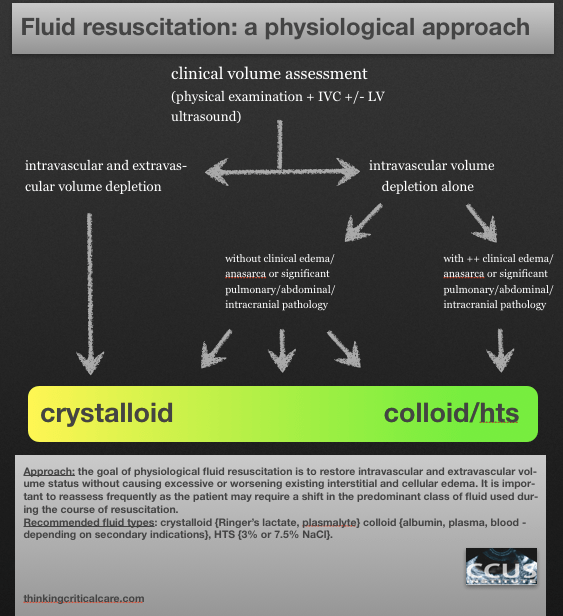
fluid resuscitation: a physiological approach – an N=1 podcast, #FOAMed, #FOAMcc

This is my approach to fluid resuscitation – sorry for the lack of precision which, to me, is actually key.  It would be against the N=1 principle to give out a recipe…but here’s a way to think about it:

Sorry the last bit cut off – my iphone can only email an 8 minute audio clip! Which I wasn’t aware of until today.  Anyway all that was lost at the end was “thanks for listening and I’d really like to hear comments and others’ practices!”

And here’s a disclaimer:  I don’t think this is the be-all and end-all. My resuscitation is a work in progress, both in terms of new fluids coming up, and in terms of identifying subgroups or individuals who would benefit from a different approach, so I’m definitely eager to hear from anyone who does things differently – but physiologically!

Please see Dr. John Myburgh’s excellent review on fluid resus in NEJM sep 26th issue!

Oh and here’s the diagram!

Physiological Fluids

thanks!

Philippe