
The IVC Assessment by bedside ultrasound: Let’s apply some common sense! #FOAMed, #FOAMcc

So I have a huge issue the IVC and its ultrasound assessment. For the most part, neither the yay-sayers or the nay-sayers are applying much sound physical principles, as far as I’m concerned.

To assess a patient’s volume status, it may be practical to begin with the sub-xiphoid view of the IVC, since the decision to give fluids or not – especially in emergency situations – can then be taken within the first few seconds of examining the patient. The physiological rationale behind assessing the IVC as a marker for volume responsiveness is simple and solid. As the venous compartment fills, the size of the IVC will gradually increase until it reaches a maximal size of about 20-25mm or even 30mm, depending on physical size and chronicity.

Concomitantly, the phasic respiratory variation will decrease as the venous pressure increases and the effect of varying intrathoracic pressure is no longer felt. At this point, the flat part of the Starling curve of the right ventricle is approaching, and there is little response to volume, and little physiological rationale to support giving more.

Currently, many use a variation of about 20% or more to suggest a volume responsive state in ventilated patients or an inspiratory collapse “sniff test” of 50% or more in spontaneously breathing patients.

There remains controversy around using IVC assessment for volume responsiveness, and with good reason! There are a few important reasons why:

a. technique – First of all, there is the manner in which IVC measurement has been taught: the M-mode measurement of the antero-posterior (AP) diameter during breathing (usually of ventilated patients) about 3 cm below the diaphragm. Although highly practical and reproducible, it has many shortcomings. If we look at the physiology, what changes with cycles of respiration is the volume of blood entering the chest/right atrium. Hence the key variable we are trying to assess is the transient variation in IVC size – which is a volume, not a linear dimension (I’m getting painful flashbacks of using pressure  to determine volume!)Hence the use of a single linear measure on one point along the length of the IVC to assess this is inherently flawed. For instance, the figure to the left shows how, if this IVC were to be measured in its AP diameter, the variability may not be that great. In the short axis, however, one can clearly see the significant change in surface area, and hence volume between phases of mechanical ventilation. Also, the IVC is rarely perfectly circular, but often ovoid, and occasionally with the greatest diameter in an anteroposterior axis, making that single AP measurement even less relevant.

b. intrathoracic pressure – Secondly, the variation in intrathoracic or intrapleural pressure (Pip) must be measured, as, for instance, a young and fit patient can generate large changes, which would result in more significant IVC variation, as compared to a frail elderly patient, even if they are on the same point of their Starling curve, invalidating the IVC measurement. All “sniffs” are not created equal.

c. intra-abdominal pressure – Finally, the intra-abdominal pressure (IAP) must also be assessed, since an elevated pressure would decrease the size of the IVC and make that measure no less accurate, but less relevant in terms of representing venous filling.

So what should we do?

Instead, a more global assessment of the IVC volume, measuring short axis area measurements and variation at several points along the IVC would give a much more accurate estimate of IVC volume variation. This is currently being studied by our group.

“Eyeballing the IVC” Attempting to link evidence and physiology, some bedside sonographers’ approach is to take a global look at the IVC in both long and short axis during respiration, while clinically assessing the respiratory effort and the abdominal pressure. This approach is analogous to the “eyeballing” of LV function – versus more formal measurements such as Simpson’s disk method, etc – which has been proven just as accurate with sufficient clinical experience.

The figure below shows an IVC that is about 10-12mm along most of its intrahepatic segment on expiration, and collapses almost completely on inspiration. If this belongs to a patient breathing with little effort and with a soft abdomen to palpation, it is physiologically quite clear that this patient would be fluid responsive. It also shows how impressive the collapse is in the short axis.

IVC insp dual

For instance, let’s say Patient A is in respiratory distress and using accessory muscles and presents to the ER with a respiratory rate of 35 and a systolic BP of 80. His IVC measures approximately 21 mm in diameter at several points along its axis, and has a brief collapse to about 10 mm with strong inspiratory efforts. His abdomen is soft during inspiration but firm during a prolonged expiratory phase.

Patient B is brought to the ER somnolent with a respiratory rate of 10 and a systolic BP of 80. His IVC measures 15 mm with minimal respiratory variation. His respirations are shallow and his abdomen soft. These two patients show how the IVC assessment needs to be taken in clinical context.

Patient A has some 50% inspiratory collapse of a large IVC in the context of large variations in Pip, whereas Patient B has little variation of a mid-sized IVC in the context of very small variations in Pip. In all likelihood, Patient A is not very volume responsive, while Patient B probably is.

Volume Responsiveness vs. Volume Tolerance – it is critically important to distinguish the difference between these two concepts as they are often misused interchangeably: Volume responsiveness refers to an increase in cardiac output (CO) to a fluid challenge. This is a purely hemodynamic concept. Volume Tolerance refers to whether or not a patient can tolerate volume without clinically significant side effects. This is a complex clinical assessment that should include: -the patient’s plasma oncotic pressure (serum albumin) and level of capillary leak, if present, -the patient’s pathology – is there risk of capillary leak in critical tissues such as lung, brain, abdomen? -the type of fluid being considered (isotonic crystalloid vs hypertonics or colloids/blood products). It is important to distinguish that not all patients who are volume responsive are necessarily volume tolerant.

Volume assessment summary – this issue remains a difficult one, even with the use of bedside ultrasound, because the optimal point for any one patient to be on his or her Starling curve at any one time in different clinical conditions remains elusive. Despite considerable study and several proposed management algorithms, there is no means by which to determine exactly how much of any given fluid is enough, without being too much.

In my opinion… – no direct evidence – keeping an IVC below 20mm and probably below 15mm with significant respiratory variation, if hemodynamics allow, is probably ideal. However, bedside ultrasound allows to clearly identify the cases where fluid is clearly needed and those where fluid is unlikely to benefit. Both of these scenarios are easily and routinely missed by traditional examination. Additionally, when the IVC assessment is done in conjunction with lung ultrasound, it becomes possible to detect early development of pulmonary edema and halt aggressive fluid resuscitation (FALLS Protocol, Daniel Lichtenstein).


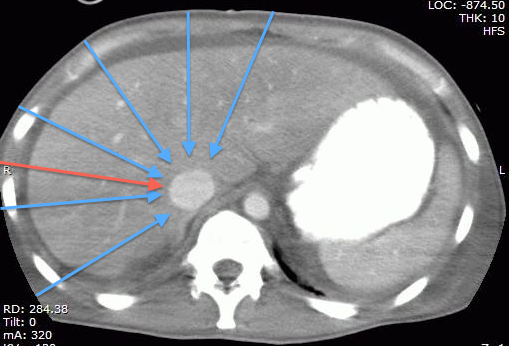
Technical Pearl: the part of the IVC we generally assess being the intrahepatic segment, it is possible to find it almost by scanning through any part of the liver, which happens to provide a great acoustic window. This may be particularly useful when the epigastric area is difficult to access (incision/bandage, drains, in the OR, etc…) or when there is bowel gas in the epigastrium. The figures below show the same IVC, first in a “traditional” epigastric view, then in a view approximately along the plane of the red arrow on the CT scan.

2 views IVC std:liver

CT liver IVC views


Bottom line?

When assessing volume status, it is absolutely essential to keep the clinical question in mind. It is a great minority of patients who are volume responsive who actually need volume. Normal, healthy humans are very much fluid responsive and fluid tolerant but certainly not in need of any. Much of the current studies and literature focus on assessing volume responsiveness in the setting of shock, which, although arguably the most important, is not the only type of information that can be obtained from the IVC. For instance, as will be discussed in the chapter on congestive heart failure, knowing that your patient is very “full” should prompt further diuresis. If you are dealing with managing severe anasarca, knowing that a patient’s intravascular volume is low may prompt the use of albumin or hypertonics prior to further diuresis to help resorb some of the interstitial fluid. Another critical question to which there is currently no answer is just how much fluid to give to patients in shock. There are many opinions but no certainty. It is common practice to fill a patient in shock until they are no longer fluid responsive, in an effort to avoid or minimize the use or dose of vasopressor medications. There is no study to date that compares a “moderate fluid/early vasopressors” vs “aggressive fluid/avoid-vasopressors-if-possible” approach.

Hopefully this will be answered soon. In light of the clear evidence linking positive fluid balance and mortality, it would seem wise to fill to a “moderate fullness” where some respiratory variation remains, rather than to the point of no longer being fluid responsive. After all, physiologically, the only time humans are really full (>20mm IVC with little or no variation) is in pathological states of congestive heart failure or obstructive shock. So again, when assessing an IVC, keep in mind what your clinical question is and interpret the sonographic data accordingly.


cheers!


Comments:

Marco says:

Thanks Philippe, very interesting post.
Using your great categorization, I think that the worst scenario is represented by a patient who is volume responsive but poorly volume tolerant. In that case, it is important to have clear in mind which is our target: cerebral perfusion, oxygenation and lung extravascular fluid, ventilatory weaning, renal function, avoiding vasopressors or mechanical ventilation, etc…
Very often, maintaining a brain dead heart beating donor, every organ would require a different volemic status, and if all of them are suitable for transplantation you have to compromise.
Just a last thought: as well as “all sniffs are not created equal”, also tidal volumes are very variable. Assessing respiratory variations during protective (low TV) ventilation requires a thoughtful interpretation of the results.


Absolutely. Interpretation of the findings in each individual case is key. 

Philippe

NEJM: The Septic Shock Issue…groundbreaking or same old same old? #FOAMed, #FOAMcc

Ok, so it was pretty cool to see an NEJM issue basically dedicated to septic shock management, I must admit. But let’s dig a little deeper, shall we?

So here is where they are: http://www.nejm.org, and fully available for now.

I won’t go through all the details and numbers, after all they are in the papers, so let’s just analyze them from two principles:

a. the N=1 principle – how was therapy individualized?

and

b. was there any integrated monitoring of the therapeutic goals?

…and we’ll conclude by looking at the potential practice-changing potential of each of these studies.

So first of all,

High vs Low BP Target in Septic Shock, by Asfar et al.

So basically a negative study except for two findings, the increased incidence of afib in the high target group and the decreased need for renal replacement therapy among chronic hypertensives in the high target group.

so N=1 is not really revealed:

“Refractoriness to fluid resuscitation was defined as a lack of response to the administration of 30 ml of normal saline per kilogram of body weight or of colloids or was determined according to a clinician’s assessment of inadequate hemodynamic results on the basis of values obtained during right-heart catheterization, pulse-pressure measurement, stroke-volume measurement, or echocardiography (although study investigators did not record the values for these variables).”

So lets just hope that the variability evens itself out between the groups, since we don’t really know. The numbers don’t really tell the tale, because the average fluids received (10 liters over 5 days) could mean one patient got 15 and one got 5 – although let’s trust they followed the French Fluid Resus protocol…

So the atrial fibrillation makes total sense – more B agonism should result in that, and the decreased renal failure also does.

As the authors note, the actual BP averages were higher than planned. For those of us practicing critical care, we know most nurses titrating prefer having a little bit of extra BP – even when I prescribe MAP 65, I usually see the 70 or so unless I make a point to tell them. Understandable. They also note the underpowered-ness of their own study, but I think it is still worth looking at their results.

So…bottom line?  I think it’s a great study for a couple of reasons.

The first is to remind us to pay a little more N=1 attention to the chronic hypertensives, and that it is probably worth aiming for slightly higher MAPs.

The second, debunking the myth of “levophed, leave’em dead” (which I heard throughout residency at McGill), and the concept of doing everything (ie juicing patient into a michelin man) in order to avoid the “dreaded and dangerous” vasopressors. So really I think an alternative way to conclude this study is that it isn’t harmful to have higher doses of vasopressors. I think this is actually a really good study on which to base assessment of more aggressive vasopressor support vs fluid resuscitation, in the right patients.

It would have been interesting to have echo data on those who developed a fib – were they patients who had normal to hyperdynamic LVs who in truth did not need B agonism at all and would have been fine with phenylephrine?  Perhaps…

Cool. I like it.

Next:

Albumin Replacement in Patients with Severe Sepsis or Septic Shock, by Caironi et al. The ALBIOS study (a Gattinoni crew)

So basically showed no difference, so pretty much a solid italian remake of the SAFE study in a sense, confirming that albumin is indeed safe overall, and may be better in those with shock.  As the authors note, mortality was low, organ failure was low, so study power a little low as well. Note the mean lactates in the 2’s at baseline. The albumin levels of the crytalloid only gorup were also not that low, low to mid 20’s, whereas I often see 15-20 range in my patients, especially if I inherit them after a few days, as I do use albumin myself a fair bit. They also used a target albumin level, not albumin as a resuscitation fluid purely.

In my mind the benefit of albumin would be greatest in those with significant capillary leak, particularly those with intra-abdominal and pulmonary pathology. It would have been nice to see a subgroup analysis where extravascular lung water was looked at (especially coming from a Gattinoni crew!).

Another interesting thing would have been to know the infusion time of the albumin, since animal data tells us that a 3hr infusion decreases extravasation and improves vascular filling vs shorter infusion times. I routinely insist on 3hr infusion per unit, which sometimes results in 9-12hr infusions, almost albumin drips!

Bottom line?

I like it. Reinforces that albumin is safe, so makes me even more comfortable in using it in the patients where my N=1 analysis tells me to be wary of third-spacing. Also the fact that they used 20% – in Canada we have 100cc bottles of 25% for the most part – is nice, since the SAFE data used 4%.

Next!

A Randomized Trial of Protocol-Based Care for Early Septic Shock – The ProCESS Trial.

So right off that bat my allergy to protocols flares up, so I’ll try to remain impartial. It just goes against the N=1 principle. The absolutely awesome thing about protocols is that it primes the team/system to react – so clearly protocols are better than no-protocol-at-all, but strict adherence would clearly not fit everyone, so that some built-in flexibility should be present.

This being said, the ProCESS study is really interesting, for a number of reasons. They have three groups, and compare basically (1) Rivers’ EGDT to (2) their own protocol (see the S2 appendix online) which gives a little more flexibility and (3) “usual care”.  Net result is that all are pretty equal, no change in mortality. As the authors note, their mortality was low, so again may not have been able to detect a difference.

So, what does this mean. To me it’s a little worrisome because I doubt that the “usual care” represents the true usual care found in EDs/ICUs all over the world, so I am concerned that many docs will use this as a reason to justify not changing their practice, similarly to many I’ve heard say they don’t need to cool anymore after the TTM trial. Human nature for some I guess.

Bottom line? You don’t have to follow EGDT if you’re conscientious and reassessing your patient frequently and have done all the other good things (abx, source control, etc). I think that’s really important because giving blood (see my post about S1P) to those with hb > 70 and giving dobutamine to patients with potentially normal or hyper dynamic LVs never made physiological sense to me, and the problem with a multi intervention study such as EGDT is that you can’t tease out the good from the bad or the neutral. Again, studies such as EGDT are pivotal in changing practice and raising awareness, so this is not a knock against a necessary study, just to highlight the point that each study is a step along the way of refining our resuscitation, and the important thing is to move on. In fact, the reason that this is a negative study is probably due to the improvement in “usual care” that EGDT brought along.

Conclusion: No new ground broken, but these studies do make me feel more confident and validated in continuing to not do certain things (strict EGDT) and  doing others (albumin and earlier use of vasopressors).

Kudos to all investigators.


let me know what you think!


P


Transfusion and the Glycocalyx: John strikes again! #FOAMed, #FOAMcc

A great surprise this morning:  a comment from John. Yup, THE John. So taking a page out of Scott’s book, I thought it would be worth sharing with everyone as its own post, as opposed to just a comment. I think this is must-read material for everyone.

So without any further adue:

“I thought I might add some quirky ideas to your discussion.

We are now getting familiar with the concept of endothelial cells covered by a surface glycocalyx layer, that forms part of the barrier and mechano-sensing functions of the blood-tissue interface. We have discussed in some detail, the role of the glycocalyx in preserving endothelial integrity. I am gonna try and add a bit more spice into the whole transfusion drama.

In recent times, we have started talking a lot about a bioactive phospholipid called sphingosine-1-phosphate (S1P), as a crucial element in preserving vascular barrier integrity by ‘protecting’ the Glycolcalyx. (Most geeky papers on TRALI and other transfusion related complications do mention it).

Because albumin is one of the primary carriers of sphingosine-1-phosphate (S1P), it is possible that S1P, acting via S1P1 receptors, plays the primary role in stabilizing the endothelial glycocalyx. Infact, antagonism of S1P1 receptors have been shown to cause widespread shedding of the glycocalyx, as evidenced by increased serum concentrations of Heparan sulphate and Chondroitin sulphate. (This might probably be one of the mechanisms how albumin is glycocalyx friendly).

RBC transfusions are a double edged sword…..especially in situations of acute anemia as in post hemorrhagic situations ( major GI bleed or trauma.)….I totally agree with you in that the two are conceptually very similar.

Erythrocytes have been identified as an important buffer for sphingosine-1-phosphate . In mice, depletion of plasma S1P by genetic inactivation of S1P synthesizing enzymes (sphingosine kinases 1 and 2) elicits profound pulmonary vascular leak, which can be reversed by restoring circulating S1P via RBC transfusion.

In humans, hematocrit (Hct) predicts plasma S1P levels. There also seems to be a dynamic equlibrium between SIP levels of the plasma, and the circulating RBCs. It has been demonstrated that in anemic individuals, plasma S1P levels are not uniformly restored by RBC transfusion. Rather, the age of the RBC unit at the time of transfusion tended to negatively correlate with the ability of RBC transfusion to replenish plasma S1P. During storage, the S1P content of human RBC markedly declines, likely due to enzymatic degradation. Because erythrocytes serve as a buffer for circulating S1P, aged RBC with low S1P content may be incapable of restoring plasma S1P levels and may actually remove S1P from plasma, which in turn could contribute to increased endothelial permeability, capillary leak, and infiltration of inflammatory cells.

I hope this partly answers your question as to how the glycocalyx may be impacted by inappropriate and irresponsible transfusion triggers. I agree that these are all very novel ideas and as such, exist in the realm of experimental clinical physiology, but my gut tells me that the delicate Glycocalyx may hold the clue to a lot of answers to questions that have plagued us for a long long time!

Cheers,
John from India…”

So first of all, thank you very, very much for reading and taking the time to comment and enlighten us.

As John says, this is still in the realm of experimental physiology, but I think there are a lot of situations we are faced with, perhaps grey zone areas where we debate two potential therapeutic avenues, where we can use some of this data. We might debate giving that extra bit of fluid, or debate crystalloid vs albumin, or blood or no blood with an Hb of exactly 70, and I think we have to start weighing in some of this physiological data, even if it isn’t “evidence-based-by-RTC” to help guide these decisions.

The more I look into it the more it seems that our interventions – particularly fluid resuscitation, needs to be reassessed from the ground up both in nature, quantity and rate of infusion while measuring glycocalyx damage – e.g. biomarkers such as S1P, heparan or chondroitin sulfate, etc…

I’ve previously posted and podcasted about my general strategy for fluid resuscitation, and I am definitely in the process of revising it, still unsure what is best. I’d love to hear how John resuscitates his patients…

thanks!

Philippe

Other Comments:

Mystery John has an uncanny ability to describe complex physiology in the simplest way possible. I am very interested in digging more into his predictions of the possibility of aged erythrocytes removing S1P from circulating plasma.

Dr. John, if you’re out there, could you point us all to some of these studies you’ve mentioned? Any good S1P review papers you’d recommend to those, like me, who are S1P novices?

Thanks for your input! It was a pleasure.

Warm regards,

Derek

Thank you Derek, for the kind comments…. I think the concept of S1P is still in the process of evolving and assuming a definitive shape, so a good review might be hard to stumble across.

A good research article which cites some excellent references might be —

Synergistic Effect of Anemia and Red Blood Cells Transfusion on Inflammation and Lung Injury
— Anping Dong et al. (It is open access at http://dx.doi.org/10.1155/2012/924042).

Hope this helps……

John.

Here is the article:

924042

P

The N=1 concept. #FOAMed, #FOAMcc

First of all, happy holidays to all and happy new year!

Following a few requests, I’m gonna put up a few words about the N=1 concept, as I think it comes up in every single therapeutic and diagnostic strategy.

We do not treat a thousand, a hundred or even ten patients at a time.  As clinicians, we deal with a single patient, with a certain pathology, and his own, unique physiological pattern of response to that pathology.

In a medical utopia, we would be able to have a precise biophysiological profile of our patient – probably including parameters that either don’t yet exist, or are on the verge of being found or invented.  We would know, for instance, the degree of glycocalyx damage, the nature of this damage, the degree of subsequent capillary leak, the specific inflammatory cytokine pattern, and thus be able to use a potential combination of agonists and antagonists to favor healing, and tailor fluid therapy to the “just right” amount, avoiding both under-resuscitation and tissue edema. This would be similar to antibiotic sensitivity testing. Who, in this century so far, would deliberately not order sensitivities, instead satisfying themselves with a positive result and happy with empiric therapy?

Just in terms of biological variability, it is impossible to believe that all patients would respond best to a single goal or therapy. How can an MAP of 65 be as good for a septic hypertensive patient as it is for a young septic woman who normally walks around with an SBP of 110? Not that I don’t use that number myself most of the time, but certainly food for thought, and something to keep in mind when treating either of those “types” of patients…

And the answer to the N=1 riddle isn’t just subgroup analysis. The questions have to be answered in prospective fashion, built into the study design. Not easy work, and especially since we don’t yet even know what the key variables/questions are… But personally, as mentioned in an earlier post, I do now suspect that the ubiquitous glycocalyx holds some of those answers.

Let’s look at the whole fluid debate through the N=1 lens: it makes no sense whatsoever to debate crystalloids versus colloids. This negates thinking and only encourages near-religious fervour amidst both camps. Rather, look at your patient. Is he truly dehydrated/volume depleted or just volume responsive on the basis of vasodilation. If we want to restore the ICF and the interstitium, then crystalloids are probably better, but if we want to restore effective circulatory volume, then some measure of colloid may help avoid excessive edema, though even this can be debated. Even more important is the composition of the resuscitation fluid. Much as we adjust our TPN, we should probably design our resuscitation fluids, rather than only using Ringer’s Lactate (I say only just to drive the point that NS should not be used as a resuscitation fluid, unless repleting chloride is specifically necessary).

Now this may sound like a rant against large trials, but it isn’t. Absolutely invaluable information can be derived from these, it is just a matter of thinking how that information can benefit the one patient you have in front of you. And this isn’t easy. You have to put together your history, physical exam, bedside ultrasound exam and labwork. You can’t just say  “sepsis? 2 litres,” or any other such recipe (aka protocols).

ok, enough for a january 1st!


Love to hear what anyone thinks!


Philippe


The Glycocalyx: an overview for the clinician. #FOAMed, #FOAMcc

Ok, so I’d had a couple of glimpses at articles in the past few years which referred to the glycocalyx, but, in truth, I tend to read most of the “bench” studies a little, well…quickly.  So basically, when I listened to Paul’s (Marik) recent lecture at Scott’s (Weingart, emcrit.org) New York Sepsis Collaborative, I started to dig a little…and whoa! And then of course, then now-famous expose by John (Doe?) on EmCrit continued to convince me that this is definitely something I need to pay attention to! Its not like there hasn’t already been a high level of scrutiny of the glycocalyx in the field of sepsis.  Google it. Its like a whole new world. It just hasn’t yet translated into an effective therapy, but nor has it seemed to spread into general awareness, and it seems like it’s high time it does, since it is the interface between the blood and the body – a “blood-body barrier” of sorts.

So here we go, a crash course on the glycocalyx for the clinician in the trenches…

The existence of an acellular layer lining the endothelium was described by Luft some 40 years ago (1), and in the last decade has come under scrutiny for its role in various pathophysiological states, which seems to be quite exhaustive. This has not yet translated into diagnostic or therapeutic interventions, but it seems its properties, or at least those we are currently aware of, should be kept in mind when we are faced with therapeutic choices given that some of these may have an effect on the glycocalyx.

Its existence was deduced due to the lower capillary hematocrit – meaning that the hematocrit in the capillaries, adjusted for the luminal volume, is lower than that of the large or medium vessels, implying an area where there are no red cells. This was confirmed by electron microscopy and found to be a gel-like epithelial lining which acts as an interface between the blood and the endothelial cells, of a thickness of about 0.5 um at the level of tha capillaries, and thicker in the larger vessels.

So what is it made of? Its is essentially a meshwork of glycoproteins and proteoglycans, anchored to the epithelial cells, in which many soluble molecules are enmeshed. It is important to note that there is a dynamic equilibrium between this layer and the adjacent flowing blood, which will affect the thickness and composition of the glycocalyx. The layer seems to be vulnerable to both enzymatic degradation as well as to shear forces, in variable degrees. Enzymatic removal of components seems to radically alter properties, pointing to a strong synergistic effect of the various components. It is a constantly shedding and regenerating structure.

glycocalyx em pic

EM view of the glycocalyx (reproduced with authors’ permission from Reitsma et al.)

glycocalix pic2

(reproduced with authors’ permission from Reitsma et al.)

Major components:

– Proteoglycans (protein core with chains of glycosaminoglycans) are the “backbone” of the glycocalyx, and consist of syndecans, glipicans, mimecan, perlecans and biglycans.

– Glycosaminoglycans (linear disaccharide polymers of a uronic acid and a hexosamine) are predominantly heparan sulfate (50-90%), then dermatan sulfate, chondroitin sulfate, keratan sulfate and hyaluronan (or hyaluronic acid).

– Glycoproteins are also part of the “backbone” structure and the main types are the endothelial cell adhesion molecules ( -cams, which are selectins, integrins and immunoglobulins) and components of the fibrin/coagulation system.  E- and P-selectins as well as others are involved in leukocyte-endothelial interaction and diapedesis, an important aspect of local inflammation.

– Soluble components are also embedded in the glycocalyx such as proteins and soluble proteoglycans and are important in preserving the charge of the layer and play critical roles in functionality.

Function of the glycocalyx (as far as we know…)

a. gatekeeper

It is a key determinant of vascular permeability. Partial enzymatic removal without damage to the endothelial cells themselves result in a radical change in permeability in aminal models. Charge, size and steric hindrance affect permeability. The glycocalyx has a highly net negative charge towards the bloodstream – neutralizing this induces an increase in cellular albumin uptake.

Weinbaum introduced a new model integrating the glycocalyx in the classical (but now outdated and disproven) Starling model of microvascular fluid exchange. The revised Starling principle stresses the importance of an intact glycocalyx.

Its role with cellular elements is interesting, as it contains key elements for interaction (-CAMs) but at the same time physically prevents direct interaction between cells (WBC, RBC, plt) and the endothelium. This clearly points to a pivotal role in controlling the interaction. Damage by various methods consistently shows increased neutrophil-endothelial interaction (often termed “leukocyte rolling”). It isn’t much of a stretch to see how the glycocalyx will thus be involved in the control of local inflammation.

b. mechanotransduction

The glycocalyx provides mechanical protection from shear stress to the endothelium.  Increased shear leads to upregulation of synthesis, and correspondingly, thicker glycocalyx is found in high shear areas.

c. microenvironment

Receptor binding, local growth and repair, and vasculoprotection. For instance, ATIII is bound to the glycocalyx (inhibits procoagulants), as well as superoxide dismutase, key in reducing oxidative stress and maintaining MO availability.

Clinical implications…

Now this is the real question.  I think that the first step is acknowledging the presence and importance of the glycocalyx, and trying to discern which of our interventions may have an impact.  It is quite clear that enzymes, cytokines and ischemia/reperfusion all damage the glycocalyx and result in increased cellular interaction and permeability. In a way this can explain the entire “SIRS” spectrum with diffuse damage resulting from an insult that may or may not be infectious in origin. Obviously, we know to avoid anything that might cause the above.

I think we can divide our interventions into two types:

a. those that inherently disrupt the glycocalyx –

b. those that secondarily disrupt it via another mediator – eg over-resuscitation and ANP/BNP (John’s “evil twins”) elevation causing breakdown.

Here are some interesting facts, in no particular order of importance:

a. in acute hyperglycemia and in type I diabetes, there is significant loss of glycocalyx volume.

Nieuwdorp M, van Haeften TW, Gouverneur MC, Mooij HL, van Lieshout MH, Levi M, Meijers JC, Holleman F, Hoekstra JB, Vink H, Kastelein JJ, Stroes ES (2006) Loss of endothelial glycocalyx during acute hyperglycemia coincides with endothelial dysfunction and coagulation activation in vivo. Diabetes 55:480–486.

Nieuwdorp M, Mooij HL, Kroon J, Atasever B, Spaan JA, Ince C, Holleman F, Diamant M, Heine RJ, Hoekstra JB, Kastelein JJ, Stroes ES, Vink H (2006) Endothelial glycocalyx damage coincides with microalbuminuria in type 1 diabetes. Diabetes 55:1127–1132

b. high fat/high cholesterol diet and high LDL levels disrupt the glycocalyx. The co-infusion of superoxide dysmutase and catalase with ox-LDL abolishes the glycocalyx shedding found with ox-LDL infusion only. (not exactly a big surprise, but certainly brings up a therapeutic possibility in acute coronary events, especially NSTEMIs…)

Vink H, Constantinescu AA, Spaan JA (2000) Oxidized lipoproteins degrade the endothelial surface layer: implications for platelet–endothelial cell adhesion. Circulation 101:1500–1502

van den Berg BM, Spaan JA, Rolf TM, Vink H (2006) Atherogenic region and diet diminish glycocalyx dimension and increase intima-to-media ratios at murine carotid artery bifurcation. Am J Physiol Heart Circ Physiol 290:H915–H920

c. hydrocortisone and antithrombin prevent TNF-a induced shedding of the glycocalyx. (we never really knew how steroids help in sepsis; ATIII trials failed, but were they designed with glycocalyx-sparing in mind…?)

Daniel Chappell MD, Klaus Hofmann-Kiefer, Matthias Jacob, Markus Rehm, Josef Briegel, Ulrich Welsch, Peter Conzen, Bernhard F. Becker TNF-α induced shedding of the endothelial glycocalyx is prevented by hydrocortisone and antithrombin Basic Research in Cardiology, January 2009, Volume 104, Issue 1, pp 78-89

 d. endotoxemia damages the pulmonary vascular endothelium and results in ALI (now the neutrophils can attach and activate inflammation…)

Eric P Schmidt, Yimu Yang, William J Janssen, Aneta Gandjeva, Mario J Perez, Lea Barthel, Rachel L Zemans, Joel C Bowman, Dan E Koyanagi, Zulma X Yunt, Lynelle P Smith, Sara S Cheng, Katherine H Overdier, Kathy R Thompson, Mark W Geraci, Ivor S Douglas, David B Pearse & Rubin M Tuder The pulmonary endothelial glycocalyx regulates neutrophil adhesion and lung injury during experimental sepsis, Nature Medicine 18,1217–1223 (2012)

e. sepsis and major abdominal surgery damage the glycocalyx (a good example of common pathway pathophysiology…)

Jochen Steppan, M.D., Stefan Hofer, M.D., Benjamin Funke, M.D., Thorsten Brenner, M.D., Michael Henrich, M.D., Ph.D., Eike Martin, M.D.,Jürgen Weitz, M.D., Ursula Hofmann, M.D., Markus A. Weigand, M.D.Sepsis and Major Abdominal Surgery Lead to Flaking of the Endothelial Glycocalix Journal of Surgical Research Volume 165, Issue 1 ,Pages 136-141, January 2011

f. molecules (eg Slit2N,  good old aPC) that enhance or preserve barrier function have shown some success in animal models. (the key might be to using a bunch of them at once, not one of them vs placebo)

N. R. London, W. Zhu, F. A. Bozza, M. C. Smith, D. M. Greif, L. K. Sorensen, L. Chen, Y. Kaminoh, A. C. Chan, S. F. Passi, C. W. Day, D. L. Barnard, G. A. Zimmerman, M. A. Krasnow, D. Y. Li, Targeting Robo4-dependent Slit signaling to survive the cytokine storm in sepsis and infl uenza. Sci. Transl. Med. 2, 23ra19 (2010).

…and this is just the tip of the iceberg. Seriously, google it…

Conclusion:

For now, it is difficult to make any hard recommendations, but it has certainly made me pause to regroup and re-strategize. I think the critical thing is to reframe our thinking and redesign our approach to be a glycocalyx-sparing therapy.

In sepsis therapy, so many molecules have failed, but little emphasis so far has been on targeting the glycocalyx, and in all likelihood, the key is not in finding the “magic bullet” but rather using multiple interventions to bolster it. One could think of this as the sepsis “chain-of-survival”, and now that we can see the complexity of the glycocalyx, it is easy to understand how no one therapy, even if it did do its job, would succeed in preventing the degradation of the other links in the chain, and fail.  In all likelihood, a successful strategy will probably involve the following:

1. fancy molecules to prevent glycocalyx damage.

2. fluid choices which are glycocalyx-friendly.

3. fluid in just the right amount (not by macro/volume-responsiveness but by micro/glycocalyx management).

4. rapid diagnosis/abx/source control, etc, all the good stuff we know about.

5. preventing hyperglycemia.

A trial like that would be a monumental undertaking. I can only hope someone does it.

My next step, as a guy in the bedside trenches and not at the bench, after gaining a modicum of understanding on the topic, will be to delve deeper into the effects of currently available fluids on the glycocalyx.  Look for a post on that in the next weeks.  As a starter, everyone should review Woodcock & Woodcock’s excellent clinical review.

And if anyone has any amazing information to share, please do!!! That’s what #FOAMed is for!!!

Suggested viewing/reading:

Woodcock and Woodcock, BJA 2012,  http://bja.oxfordjournals.org/content/early/2012/01/29/bja.aer515.full.pdf+html

Broken Barriers: A New Take on Sepsis Pathogenesis Neil M. Goldenberg,1* Benjamin E. Steinberg,1* Arthur S. Slutsky,2,3,4 Warren L. Lee2,4 Science Translational Medicine, 22 June 2011 Vol 3 Issue 88 88ps25

Click to access Science_Translational_Medicine_2011_Pathogenesis_of_Sepsis.pdf

a great article on understanding the glycocalyx in sepsis by a U of T gang!

emcrit:

http://emcrit.org/blogpost/best-fluids-comment-ever/

http://emcrit.org/podcasts/fluids-severe-sepsis/

http://emcrit.org/podcasts/paul-marik-fluids-sepsis/

all must-listen/watch material!

other refs.

Luft JH (1966) Fine structures of capillary and endocapillary layer as revealed by ruthenium red. Fed Proc 25:1773-1783

Reitsma et al, The endothelial glycocalyx: composition, functions, and visualization, Eur J Physiol (2007) 454:345–359

Zhang X, Adamson RH, Curry FR, Weinbaum S (2006) A 1-D model to explore the effects of tissue loading and tissue concentration gradients in the revised Starling principle. Am J Physiol Heart Circ Physiol 291:H2950–H2964

A Paradigm shift: re-thinking sepsis, and maybe shock in general… #FOAMed, #FOAMcc

Thomas Kuhn, physicist and philosopher, in his groundbreaking and science changing text, The Structure of Scientific Revolutions, states that:

“Successive transition from one paradigm to another via revolution is the usual developmental pattern of a mature science.”

In other words, a science has growing pains and is bound to have a fair bit of debate and controversy, until a new paradigm becomes dominant.  I think that there is a current – in part prompted by the power of socio-professional media which has allowed minds to connect and knowledge to spread – that will see many of the things that are now “Standard of Care” out the door.

So first of all, the following are must-listens, the first a lecture by Paul Marik, whom I have had the chance to collaborate with in the last years and respect greatly, on knowledge, experience, and even more on his refusal to take anything for granted and being in a seemingly-constant quest for the improvement of medicine.

The second link is Scott Weingart’s take on it, which I think is equally awesome.

I think Paul is pushing the envelope in an essential way, and Scott does a fantastic job of seeing or putting it in perspective. Enjoy:

http://emcrit.org/podcasts/paul-marik-fluids-sepsis/

EMCrit 112 – A Response to the Marik Sepsis Fluids Lecture

My (very) humble opinion on this is a rather simple, almost philosophical one:  why are we seemingly obsessed with treating a predominantly vasodilatory pathology with large amounts of volume?  I’ve said this in previous posts and podcasts, but this, in my opinion, is largely cultural and dogmatic. “Levophed – Leave’em dead” is something I heard as a student and resident, and came to take for granted that I should give lots of fluid in hopes of avoiding pressors… But there’s no evidence at all to support this.  The common behavior of waiting until someone has clearly failed volume resuscitation before starting pressors befuddles me (think how long it takes to get two liters of fluid in most ERs…).  If I was in that bed, I’d much rather spend an hour a bit “hypertensive” (eg with a MAP above 70) than a bit hypotensive while awaiting final confirmation that I do, in fact, need pressors.

I strongly suspect that it’s just a matter of improving vascular tone, giving some volume (which may be that 3 liter mark), and ensuring that the microcirculation/glycocalyx is as undisturbed as possible. Now when I say it may be the 3 liters, I firmly believe this will not apply to everyone, and that it will be 1 liter in some, and 4 in others, and that a recipe approach will be better than nothing, but likely harm some.

I think that blind (eg no echo assessment) of shock is absurd, and for anyone to propose an algorithm that does not include point-of-care ultrasound is only acceptable if they are in the process of acquiring the skill with the intention of modifying their approach in the very near future.

The whole microcirculation/glycocalyx is absolutely fascinating stuff, and undoubtedly will come under scrutiny in the next few years, and it is definitely something I will focus on in upcoming posts & podcasts. Our resuscitation has been macro-focused, and certainly it is time to take a look at the little guys, who might turn out to have most of the answers. For instance, there is some remarkable data on HDAC inhibitors (common valproic acid) and their salutatory effects in a number of acute conditions such as hemorrhagic shock (Dr. Alam) which have nothing to do with macro-resuscitation, and everything to do with cell signaling and apoptosis. Hmmm…

please share your thoughts!

thanks

Philippe

Enough with the “Normal” Saline!!!!! #FOAMed, #FOAMcc

Enough with the “Normal” Saline!
So its been about a year since a JAMA article (http://jama.jamanetwork.com/article.aspx?articleid=1383234) finally showed that the downside of 0.9% saline isn’t just theoretical, but has some associated clinical morbidity (bad for the kidneys!).  Sadly enough, it still seems to be the routine fluid used for boluses. Whether the ER, hospitalist or intensivist, residents, students…it seems people are reluctant to let go.
Today, rounding in the ICU, I was changing an order for a bolus from another doc from NS to RL, and a nurse asked me why.  I gave her a capsule summary and she was in disbelief.  “Come on Phil, they wouldn’t call it normal saline if it wasn’t!”
I’m an internist by training, so naturally I grew up using NS, since that’s what all the attendings and residents used around me.  Ringer‘s was the stuff the surgeons used, so well, I guess it had to be wrong…no?
So forward to 2001 and John Kellum‘s lecture on acid-base I’ve previously mentioned, and my exploring Stewart’s Physicochemical Approach, and wait, I look at the back of a bag of NS, and find out, much to my dismay, that the stuff I’ve been using like holy water has a pH of 5.6.  And who have I been giving liters and liters of this stuff to?  Yup, mostly patients with acidosis. Hmmm. Interesting. So although I don’t necessarily advocate correcting metabolic acidosis for the sake of doing so (see my previous post on bicarb), I’m not a proponent of worsening acidosis either, even if by another mechanism.
I think there are a number of factors that have resulted in this situation.  For starters, there is the issue of false advertising – the “normal saline” monicker has been influencing subliminal thought for decades (think Malcolm Gladwell thin-slicing), making physicians feel they are giving and inherently “good” substance.  Then there’s the whole tribalism thing with the surgeons vs non-surgeons making all the non-surgeons polarize away from RL (not that RL is perfect, just a bit better, and certainly closer to “normal”). Finally, there’s this sad, sad factor that makes people, even (or maybe even more) smart people reluctant to accept that they have been doing something wrong (or, for those who are offended right now, not ideal) for a long time (I sure was) and prefer to fight it and rationalize it for a few more years until, eventually, the evidence becomes overwhelming or the changing of the guard has fully taken place.
I think what we should be hanging on to is not a drug or a fluid but rather what we learned in the first couple of years of med school: physiology.  Now mind you, at that point we (or most of us) didn’t have a clue how to use it for anything more that answering multiple choice questions, but at some point, we have to go back to it and realize that is what we should be basing our assessment of our therapeutic acts and decisions.
So…if I have a situation where I am low on chloride, I might want to use NS. But otherwise, let try to give something whose composition is a bit closer to our own than NS is.  So, for my students and residents, don’t let me see you prescribing boluses of NS.  If you really, really need to, wait until your next rotation please.
thanks!
Philippe
ps for a great review of the original aritcle, please see Matt’s on PulmCCM at :
Reply:  by Marco Vergano
Totally agree!
I have been struggling for years with the bad habit of some of my colleagues prescribing NS as the most harmless and physiologic replacement fluid. Here in Italy we don’t have such a clear separation between internists and surgeons about NS/RL choice: the bad habit of easily prescribing NS is ubiquitous.
Given the results you mentioned about the increased incidence of renal failure with NS, I am wondering if the ban on ALL starch solutions would have been necessary after the introduction of new balanced starch/electrolyte solutions.
What I really don’t like about RL is that it’s not only hypotonic, but also low in sodium. In our ICU we often have many ‘neuro’ patients (trauma or vascular) and sodium variations become a major issue. Also I prefer Ringer’s acetate over lactate on most of the patients who struggle to ‘manage’ their own lactate.
So my favorite solution remains our good old “Elettrolitica reidratante III” (very similar to Plasma-lyte).

Bedside Ultrasound: The Sluggish IVC – something to look for… #FOAMed, #FOAMcc

So take a look at this:

I’m sure most experienced bedside sonographers come across this all the time.  For those who are starting out, and until now have just been looking at size and variation, take a second to look at the flow.  You can actually see the flow stop and start, which tells you your cardiac output is bad.  It could be bad because of the RV, the LV, the pericardium, the tension pneumothorax, anything, but it’s bad.  So just in case you were only gonna look at the IVC, keep looking! You will find something abnormal downstream, perhaps that you can do something about (not fluids, though).

I have seen this disappear and clear up with – when possible – correction of the problem, back to the normally anechoic IVC we usually see.

thanks!

Philippe

ps note there is also a mirror artifact in the right lower portion of the field, making it look as though there are two beating hearts.

Beta-blockers in Sepsis? Interesting… #FOAMed, #FOAMcc

Very interesting article in JAMA: http://jama.jamanetwork.com/article.aspx?articleID=1752246

I’m curious as to whether this has been generating interest in the cc community.  I think it is one of those articles that – at least conceptually – shines light in an area we don’t spend much time reflecting on.

I know that as an IM resident, and a CC fellow, my understanding of vasopressor therapy was pretty basic: squeeze the vessels to bring up the pressure, and hope you don’t squeeze so hard the fingers and toes fall off. In truth, no one ever really pointed out that to some degree or other, the same process killing off the fingers is probably happening to a varying degree in all organs. But maybe I just nodded off and missed it.

Since then, however, I’ve had some time to  re-examine things, and my practice has slowly been evolving.  For one thing, bedside ultrasound allows a really good assessment of inotropy, so I started to ask myself why I was giving b-agonists to patients who clearly didn’t need any help with contractility (e.g. normal, and even more so, hyperdynamic RVs and LVs).  After all, I’m putting them at risk for arrhythmias, or at least tachycardia. So whereas levophed (norepinephrine) remains my reflex pressor, I routinely shift to phenylephrine when faced with arrhythmias (most commonly fast atrial fibrillation) or tachycardia (beyond 110-120) once adequate volume resuscitation has been done.  Why 110-120?  Its an absolute guess. Somewhat educated – or I try to convince myself of that – in figuring that at some point, the increased CO via HR will be offset by decreased filling time, and with the weak but recurring data showing an association between tachycardia over 90-100 and poor outcome.

So this study – counterintuitive as it may sound to some – is really about blunting the potentially unwanted effects of b-agonists.  They randomised 336 patients to IV esmolol to a HR <95 vs a control group of standard care. They found a reduced mortality of 60%… Obviously the massive benefit should be taken with a healthy dose of skepticism, but even just the fact that they didn’t make patients worse is very, very significant.

Read the paper. They do a great job of reviewing the concept and it’s worth going over their protocol.

Physiologically, we know that catecholamines can cause stress cardiomyopathy.  The question is, when cardiomyopathy is noted, how often do we think this is related to therapy?  More often, we figure it’s the disease process – septic cardiomyopathy. At the bedside, this is impossible to differentiate.

The concept of lusitropy – active relaxation – and its contribution to cardiac output – is often overlooked, and can be affected by catecholamines. In fact it can be the most important factor related to preload, despite getting much less attention than volume loading. Remember that preload is not a pressure (especially not a CVP!!!), but a volume, and physiologically it is the degree of myocardial stretch. The ventricle is not passive, and its compliance is highly related to the active relaxation phase. Fluids will not affect this.

In addition, the decreased filling time by tachycardia can also decrease output.

Fantastic study, even if only to open the door.  I would have liked (in typical N=1 fashion and as a bedside sonographer) to see a quick echo prior to initiation, and seeing if there would have been an association with baseline RV/LV function and response/outcome to esmolol. Intuitively and physiologically, it would seem that the hyperdynamic RVs and LVs would have benefitted most, since they didn’t need beta agonism to start with – but I can also entertain that those would be unaffected and that the worse ventricles could have been worsened by stress cardiomyopathy… So a critical question in my opinion.

So…bottom line?  Is this practice-changing? It might be.  For me, I might start looking at RV/LV and opting for a quicker conversion to neosynephrine if I see a hyperdynamic state or lowering my HR threshold to do so…100? 105? – maybe just a shift rather than a change in practice. I’m not sure I’ll start esmolol infusions yet, but it will be at the back of my mind and I might, given the right set of circumstances. What I would like to see is reproducibility, and if it does happen, I would be happy to get HR’s under 95.

Love to hear what anyone else has to say!


Philippe


NEJM Circulatory Shock Review by Vincent & DeBacker: the sweet and the not-so sweet… #FOAMed, #FOAMcc

So if anyone hasn’t read it, here it is:

Click to access Circulatory%20Shock%20-%20NEJM%202013.pdf

I read the article by critical care icons Dr. Jean-Louis Vincent and Dr. De Backer with interest  as I am always keen to find out what the cutting edge is… So here is my take on their review.

The not-so-sweet:

The inclusion of CVP in the assessment. Ouch. No evidence whatsoever. Evidence for lack of correlation to fluid responsiveness… I wonder if they themselves were cringing a little about including it, particularly form the fact that they just put high vs low rather than commit to a value, which makes me think they realize it’s a bit of a trap. (It reminds me a bit of those night-time orders I still sometimes see which say if u/o < 30 cc/hr give a bolus if CVP under 12 or lasix if over 12.  So basically depending on whether that patient’s head is elevated, or if he’s turned on one side or the other, he may go from “needing fluids” to “needing diuretics”…).

The sweet:

First of all, they obviously did an elegant job on description of shock states, and particularly of highlighting the common-ness of mixed etiology shock.

I like that they admitted that the end-point for fluid resuscitation is “difficult to define.”  Any answer other than that would really speak to non-physiological thinking, as I’ve referred to in prior posts/podcasts.

Dopamine: good job on trying to take it off the shelf for shock. As far as I’m concerned, only useful when you’ve run out of norepinephrine, although there is the odd time when you have a septic AND bradycardic patient where it could come in handy…

Bringing some focus on the microcirculation: no recommendations, but that’s appropriate since there are none to be made yet, but this is where the money is in the future, as far as I’m concerned. Once we figure out how to manage the microcirculation (we do ok with the macro circulation) we might forge ahead. But good to point the finger in that direction.

The super-sweet!

I do (not surprisingly) really, really like the fact that they included ultrasound in their assessment protocol, and emphasizing that focused echocardiography should be done as soon as possible.  Very nice. Finally.

Hopefully, this pushes mainstream ED and critical care physicians to realize they need basic bedside ultrasound skills…


Overall, I think it is a good review, certainly worth the read for trainees. I would like to see focus on re-examining and questioning our approach, which could spur readers to embark on research with a different angle. For instance, why do we assume that we need to fill patients to the point of no longer being fluid responsive in order to avoid vasopressors? Is there any evidence for that? Not that I know of…

But, for having put an emphasis on point-of-care ultrasound, it gets a big round of applause from me!


Philippe