Portal Vein POCUS: A Reader’s Case and a Follow-Up to the Denault Discussion

So I’ve been meaning to post a follow up and discussion about portal vein POCUS and how I am integrating it so far, and a few days ago I got a really interesting comment from Dr. Korbin Haycock, and I think it’s got some awesome elements to discuss.

Before we get into it, I would invite anyone reading this to go listen to the original Denault Track here, without which this discussion would be missing some elements.

What we are looking at here is the physiological assessment of venous congestion, and how doppler interrogation of the portal vein may help us. So here is Korbin’s case, and I will interject (in bold) where I think a point can be made, or at least my thoughts on it.

“Awesome post. Awesome website. I had never heard about portal vein pulsatility until reading your blog. I have previously been looking at the renal resistive index and renal vein Doppler pattern in my hypotensive/shock patients (along with doing a bedside ECHO and POCUS pulmonary exam) to guide when to stop fluid resuscitiation.

Very impressive. I have only ever heard of a handful of resuscitationists looking at this (including Andre, and consequently myself) so I’m gonna have to have a chat with this fellow soon! For those who have not tried or are not familiar, some basic info can be found here. I’ll have to review this, but I think one issue with RI is that there is an associated ddx, so that without knowledge of baseline, I would not be certain how to use it. Renal vein doppler seems very interesting to me, as that venous path is the one of the cardiorenal syndrome (forget about all that “low flow” nonsense in CHF – not in shock – patients), and there is clearly bad prognosis associated with abnormal (discontinuous) flow patterns. Here is a really good study (Iida et al)  and its editorial (Tang).

Iida Doppler_CHF Heart Failure JACCHF 2016

Tang Editorial JACCHF 2016

I had a case last night that I think illustrates that fluid administration can be the wrong thing to do in some septic shock patients. Plus, I got to try something new and look at the portal vein for pulsatility.

My case was a gentleman in his late 60’s with a history of HTN, atrial fibrillation and HFrEF who presented with three days for a productive cough and fever. POC lactate was 2.7. His HR was 130-140’s, in atrial fibrillation, febrile, MAP was 50, and he looked a bit shocky and was diaphoretic. The resident had started antibiotics and a fluid bolus of LR, of which not much had gone in (maybe 200cc) when I came to start a night shift and evaluated the patient. I asked that the fluids be stopped until we could have a look at him.

His IVC was about 1.5-2 cm with >50% collapsibility.

So I’m gonna hit the pause button right there for a couple of comments. That’s not a hypovolemic IVC. The RAP may be raised by some of the  It may very well be volume responsive, but I think the first thing to go for is correcting that tachycardia. The antibiotics are definitely the right call, but the fluids should, in my opinion, be held until assessment for volume tolerance is done.

His LV looked to have some mildly decreased EF and was going very fast. RV looked normal. His average SV was 45, CO was 6.1, E/e’ ratio indicated a slightly elevated left atrial pressure. His estimated/calculated SVR by the ECHO numbers was about 550. Lungs were dry anteriorly, without B-lines, but PLAPS view was c/w bilateral lower lobe PNA. Renal vein Doppler was biphasic and the resistive index was very high. I looked at his portal vein and it was pulsatile.

Excellent. So there is pulmonary pathology, which makes fluid tolerance already of concern. The CO is certainly adequate and SVR is low, suggesting a vasodilatory shock etiology. 

In the past, based on the IVC and the way the RV looked, I would have done a straight leg raise or given a given some crystalloid to see if his SV and BP improved, and if it did, give some IVF. Instead, I told the staff to given no more fluids and I gave him 20 mg of diltiazem.

His heart rate decreased from 130-140’s to 90. His averaged SV increased to 65 (probably due to increased LV filling time and better diastolic perfusion time), CO was 5.9, estimated SVR was 570. The renal and portal vein Doppler were unchanged. The MAP didn’t bulge and stayed low at 50-55. At this point I ordered furosemide and but him on a norepinephrine infusion to increase the SVR, first at 5 mcg/min, then 7 mcg/min.

Totally awesome to see. It isn’t unusual for me to diurese patients in vasopressor-dependant shock, as more and more data is emerging on how venous congestion has deleterious effects on the gut and may even contribute to the SIRS-type state. And once a patient is in a euvolemic to hypervolemic state, the only fluid they get from me is the one containing norepinephrine. Maintenance fluid is not for critically ill patients IMO.

The NE gtt increased his MAP to 75 mmHg. His SV was 80, CO 7.1 (I was a little surprised it didn’t go down a bit), estimated SVR was 700. I had his labs back at this point and his creatinine was 1.8 and the last creatinine we had was 1.1 a few months ago. His renal vein pattern was still biphasic and his renal resistive index was also still quite high at 0.89, which would probably predict a significant kidney injury in 2-3 days.

Even though his MAP and hemodynamics looked great, I was worried about the renal resistive index. I ordered a little more furosemide and started him on a little bit of a vasopressin infusion. After things settled down, MAP was 75-80, his average SV was 80, CO 7.3, estimated SVR was about 800, and his renal resistive index (RRI) was 0.75. He looked much better too. The second lactate was 1.3.

Very interesting to see the drop in RRI.  Great case to show how you don’t need to chase lactate with fluids. That is an antiquated knee-jerk reflex hinging on the concept that hyperlactatemia is primarily due to tissue hypoperfusion, which we have learned is not the main cause. 

This morning his creatinine had improved to 1.3 and he is doing well.

South of your border, CMS considers me a bad doctor for not giving 30 cc/kg crystalloid as a knee jerk reaction and instead giving a diuretic and early vasopressors as we did in this patient. Just looking at his IVC would indicate that IVF would be a reasonable strategy. If I had done a SLR or fluid challenge and found him fluid responsive, in the past, I would be temped to chase every bit of fluid response with pushing more fluids, but the renal and portal vein Doppler made me stop fluids in this patient this time. I think this example illustrates the importance of looking at each of your patients on a case by case basis and looking at the whole picture (heart, lungs, kidneys, now portal system too for me!), rather than following protocols.

Kudos. 


So then, Andre decides to chime in as well:

Very interesting but be careful about the interpretation of portal pulsatility because it can be falsely positive particularly in hyperdynamic young patient, which was may be not the case. We published an algorithm in order to identify the true portal pulsatility associated with right heart failure and fluid overload and a normal portal vein with pulsatility:

Tremblay Portal pulsatility Flolan Mil AACR 2017

(Tremblay 2017 A&A care report) A & A Case Reports. 9(8):219–223, OCT 2017 DOI: 10.1213/XAA.0000000000000572 , PMID: 28604468)

The latter will be associated with normal RV even hyperdynamic, normal hepatic venous and renal flow, normal IVC. We still need to explore the significance of portal hypertension outside the area of cardiac surgery where we are finalizing our studies.

Always tell my residents and fellow, treat the patient and not the number or the image. That being said, the patient got better so cannot argue with success.

So I think this is a really important point, that it can become dangerous in POCUS to look for a simple, single-factor “recipe” with which to manage the patient, when in fact you can have many factors which, integrated, can give you a much better understanding about your patient’s pathophysiology.

My take on portal vein POCUS so far is that it is a marker of critical venous congestion, beyond simply a plethoric IVC. I think it is wise to stop fluids before the plethoric IVC, but a plethoric IVC with a pulsatile PV should bring fluids to a screeching halt and some decongestive therapy started. The data for this?  Andre is cooking it up, but in the meantime, there is plenty of evidence that congestion is plenty bad, and NO evidence that maximizing CO works at all, so I am very comfortable in witholding fluids and diuresing these patients. 

For fun, here is a little figure from Tang et al about the doppler patterns discussed.

Love to hear everyone’s thoughts!

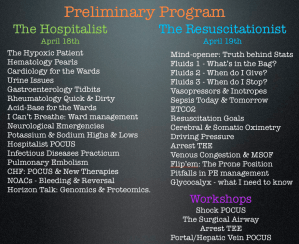
and for those interested, there will be a workshop run by Andre and myself on this at :

more to come on this soon…

cheers


Philippe

The Resuscitation Tracks 1: Portal Vein POCUS with Dr. Andre Denault. #FOAMed, #FOAMcc, #FOAMus

So this is one of the key discussions I wanted to have in my process of synthesizing my resuscitation algorithm. Dr. Denault is the one guy I’d call a mentor, and I think one of the rare and true clinician-scholar, who is just as comfortable being the anaesthetist/intensivist at the bedside of the crashing patient as he is being the keynote speaker in major conferences, or writing the textbooks that lead the field in acute care/perioperative TEE and critical care POCUS.

So to put some perspective to this discussion, back in 2014 I organized a resuscitation afternoon for internists with Andre and another awesome guy you probably all know, Haney Mallemat (@criticalcarenow). In a quick 15 minute discussion between talks, he shared with me the most recent of his discoveries, portal vein POCUS as a marker of right-sided failure/volume overload in his post-op cardiac patients, and how aggressively managing these resulted in much improved post-operative courses in terms of weaning, vasopressors and even delirium.

Interesting stuff.

So here you are:

So I’ll let you all ponder that and I would really like to hear comments and ideas. Sometime in the next few weeks I’ll be finalizing my resus algorithm – which will not be a recipe approach, as you might suspect if you have been following this blog, and will rely heavily on POCUS and the clinical exam.

cheers and thanks for reading and listening!

Don’t miss Andre running a POCUS workshop on PV/HV at  next april!

Philippe


Emergency Pericardiocentesis post-arrest (Part 1). #FOAMed, #FOAMus, #FOAMer

So a few nights ago I got pulled out of slumber to rush to the ER for an elderly patient who had arrested in hospital shortly after having been brought in for chest pain. The sharp ER doc had diagnosed a tamponade on a presumed aortic dissection, managed to get a needle in, aspirated some fluid and managed to get ROSC.

So when I got there we had a patient post-ROSC in rapid atrial fibrillation with a thready but palpable pulse. POCUS showed a large pericardial effusion with minimal LV filling. So here is what we did:

With the catheter in, we were able to drain. Note a couple of POCUS teaching points, always make sure to (1) visualize your guidewire in the right space, and (2) second, when using a dilator, you can note the disappearance of the proximal part of the guidewire as it is covered by the dilator. This tells you you have adequately dilated into the target structure – pericardium in this case, because it is possible (personal experience) to advance a dilator fairly deep, but not go through a perhaps fibrotic pericardium, and then result in pigtail mis-placement just outside of the target.

In part 2 you can also see the aspiration of the effusion and improved LV filling. The patient’s BP instantly rose to 140’s systolic.

More case details and POCUS teaching points to come in part 2.

cheers,

ps – a sterile probe cover was unavailable immediately in the ER. By the time it showed up the pigtail was in. We didn’t feel we could wait. We doused it in alcohol.

Philippe


Twittercase: Fouled urine and #POCUS discussion. #FOAMed, #FOAMcc, #FOAMer

So I admitted a patient to the ICU yesterday from the ED.  He’s an 80-something gentleman from a nursing home with an indwelling catheter, and presented with stupor, hypotension, fever, leukocytosis and clearly infected urine.  His labwork showed a lactate of 5.3, a double-normal creatinine and, after 3 liters or so of crystalloid, he was started on norpeinephrine and hence came to the ICU. His extremities were fairly warm, and his cerebral saturation was 62%.

Before seeing the POCUS info, however, consider a clearly septic patient with AKI and elevated lactate. He did get 3 liters of fluids, but i’ve seen these patients get more fluids, whether for hemodynamics, lactate, AKI or any combination of the aforementioned.

Below is the clip, a quick POCUS sequence going from IVC (with hepatic vein flows), subxiphoid cardiac views, both lung views.

So here, we see a plethoric and fixed IVC (sorry I didn’t include the short axis but it was round and full, so in this case the LAX is reliable) with biphasic hepatic flow. Cardiac views show normal ratios and a poor LV function. Chest views show bilateral effusions and consolidations.

So what did I do?

  1. stopped fluids (I do not believe in routine maintenance fluids any more than in maintenance antibiotics or vasopressors).
  2. gave lasix (given that he is on the flat part of FS curve, I was unconcerned with some diuresis decreasing his preload, vasopressors and lactate notwithstanding, and with the goal to decongest his kidneys, likely suffering from congestive insult on top of the septic one).
  3. did not try to chase his lactate with increasing cardiac output (lactate being a great alarm bell and prognosticator, but little else, and because he was worm and with a decent cerebral saturation, I did not feel that there was a major cardiogenic component to his shock).

So what happened?

This morning, after a negative balance of 1,500 cc in 24 hours, his levophed dose has dropped by half, his lactate is normal and his creatinine is decreasing. A decade ago, I would have chased down the last ounce of volume responsiveness with fluids, aggressively trying to drive down the lactate and creatinine, and maybe, 24 hours later, he would have developed “ARDS” because he was “so sick.”  😉

cheers


Philippe


Bedside Ultrasound Quiz Part 2: A 50 yr old man with dyspnea, acidosis, hepatitis and leg edema. #FOAMed, #FOAMer, #FOAMus

So I was glad to see some great answers on twitter about this case, so let me fill you guys in on the management and the details.

So my diagnosis was of a (likely viral) myocarditis as a subacute process over the last weeks, with a superimposed pneumonia causing the acute deterioration and presentation to ED.  I didn’t think that his elevated lactate represented shock, but rather a reflection of adrenergic activation and reduced hepatic clearance due to congestive hepatitis.  He also had congestive renal failure. Of course, the LV had a 4 x 2 cm apical thrombus, which is likely secondary to the dilated cardiomyopathy.

So the management was diuretics, antibiotics, and anticoagulation, which resulted in a gradual improvement of the respiratory status and renal/hepatic dysfunction. He had a coronary angiogram the day following admission which showed two 50% stenoses deemed to be innocent bystanders.

Bottom Line:

I think the learning point in this case is that, without POCUS, this could easily have been treated as severe sepsis with multiple organ failure (potentially rationalizing away the BP of 140 as a “relatively low” BP due to untreated hypertension), and as such, may have received fluids… Especially south of the border where they are mandated to give 30 cc/kg to anything deemed “septic.”  This would have been the polar opposite of the necessary treatment.

The scarier thought is that he may have then progressed to “ARDS,” been intubated and then the debate between keeping him dry and giving fluids for the kidneys may have ensued.  Though a formal echo likely would have been done, it may not have happened in the first 24-48 hours… If MSOF progressed and he succumbed, the rational may have been that he was “so sick,” and died despite “best care…”

The reality is that he is not yet out of the woods today, with an EF of 15% and afib, but he is off O2 and sitting up in a chair. Fingers crossed he falls in the group of those with myocarditis who improve…

Love to hear anyone’s thoughts!


Cheers

Philippe

Bedside Ultrasound Clip Quiz! A 72 year old man with fever, weight loss and tachycardia. #FOAMed, #FOAMcc, #FOAMer

So a 72 year old man is brought to the ER after collapsing at home. His family had noted weight loss in the last months, and recently some fever and general weakness.  His HR is 108, T 38.8, BP 80/40, GCS 14 – somnolent – he is in lactic acidosis (4.5) and renal failure (cr 180 – baseline 120), with some vague abdominal pain, a clear chest and warm extremities.

POCUS shows a normal IVC, normal RV/LV, A profile lungs, no ascites, and this on the left flank:


What is the main diagnosis?

Scroll below for the answer:


So the clip shows fairly severe hydronephrosis, the “bear paw” with very dilated calyces.  The patient was suffering from obstructed pyelonephritis due to massive retroperitoneal adenopathy later found to be lymphoma.  A couple of hours later he got a nephrostomy tube to take care of the septic source (double J could not pass) and his sepsis resolved within a few days, and he headed off to chemo for the NHL.

The advantage of POCUS here is. once again, the speed of diagnosis. He went straight from CT to the readied urologists and source control happened within a couple of hours. His relatively benign abdomen may not have prompted a rapid CT otherwise.

See here for more POCUS!

cheers!


Philippe

Wicked Clinical Case: POCUS & Prone save the day! #FOAMed, #FOAMcc, #FOAMer

So I get a call from a colleague in the ED at about 2am, telling me about a 39 yr old woman post-arrest. So I start putting on my boots and warming up the car (it’s January in Montreal folks).  Apparently she had presented earlier in severe acidosis, the diagnosis is unclear, but she apparently got 2 units for an Hb of 49, then went into respiratory failure and got intubated. She arrested about 30 minutes later, cause unknown.

I tell the ICU to prepare a bed but I want to see her in the ED first. Twenty minutes later I put probe to patient and see a full IVC with spontaneous echo contrast. On that I tell the nurse to hold the fluids – there was a bag and tubing and a pump with 100ml/hr on it – and turn into a subxiphoid view to see a normal RV and a hypokinetic LV with some WMAs. She has marked consolidations  in both posterior lung fields and B lines laterally, with small effusions and dynamic air bronchograms (indicating patent airways). At this point she has a HR of about 120, but there is neither perceptible BP (by NIBP) nor saturation. She’s on levophed at 20mcg. She’s about an hour post arrest which was witnessed and brief (<10min to ROSC).

The theories about the arrest are possible hyperkalemia: she was intubated with succinylcholine before the K of 6.1 was back from the lab, and her pre-intubation pH was 7.0, and post-intubation she was only ventilated at 400 x 18, possibly precipitating a drop in pH and a rise in K. Her EKG had some nonspecific signs at this point, but also a poor anterior R wave.

So we head to the ICU, as instrumentation was needed. Cerebral saturation (SctO2) is 42% and ETCO2 is 20mmhg, which reassures me that the BP is probably in the measurable range (normal SctO2 is >60% and varies, but 47% is certainly viable)…  A jugular CVC with continuous ScVo2 and a femoral arterial line goes in:

screen-shot-2017-01-05-at-10-44-50-pm

So with a BP of 59/44 (ignore the 100/46, not sure whose arm that was on!) I start epinephrine, as the POCUS is similar, as I want some added beta-agonism. ScVO2 matches SctO2 in the 40’s. We get the BP up the the 90-1oo range, the ETCO2 goes to 30, the SctO2 and ScVo2 go up into the high 40’s, which is very reassuring, because with this I know that my epi drip is improving perfusion and NOT over-vasoconstricting. Without looking at a real-time tissue perfusion index of some sort or other, it is nearly impossible to know rapidly whether your therapy is helping or harming (will discuss tissue saturation & resuscitation monitoring in more detail in another post sometime soon).

screen-shot-2017-01-05-at-10-46-31-pm

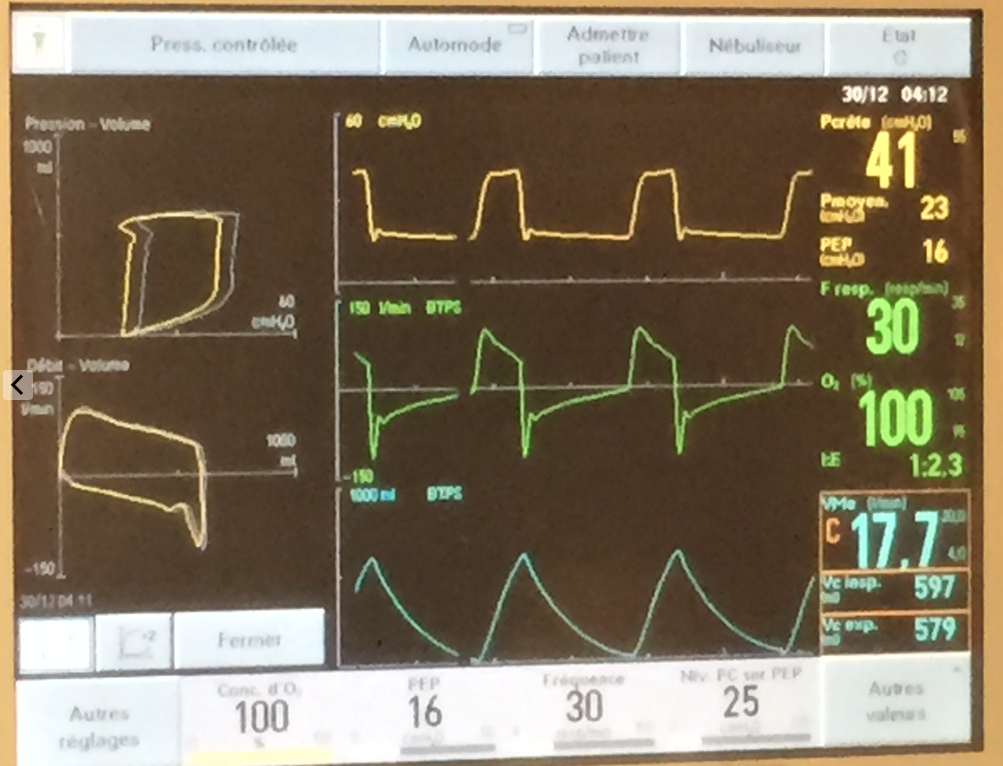
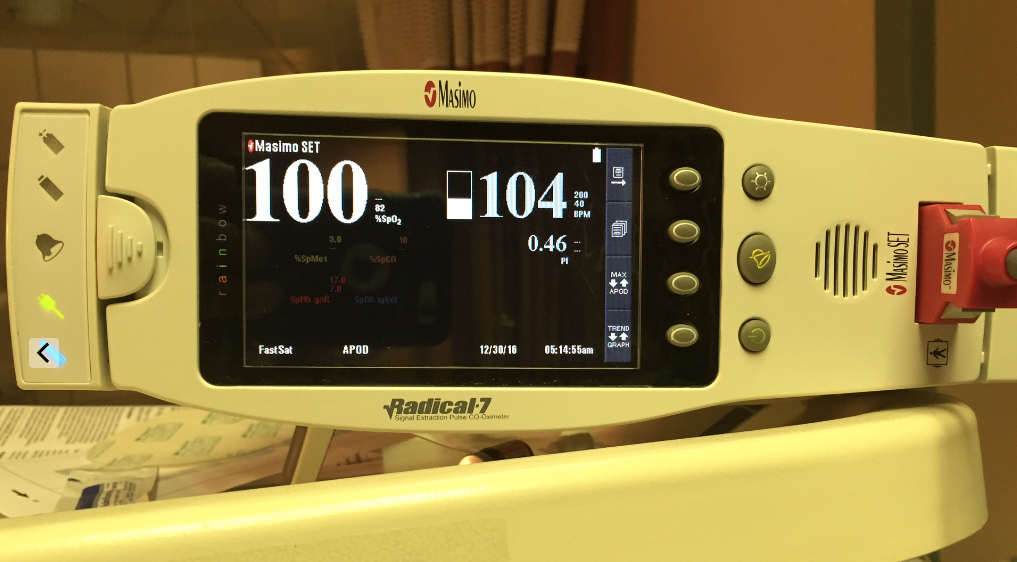
So now the sat finally starts to record in the low 60’s. We have a PEEP of 5, so start bringing it up. We hit 16 before the BP starts to drop, and that only gets us to the mid 70’s sat%. She actually squeezes my hand to command.

screen-shot-2017-01-05-at-10-45-21-pm

At this point I take a few seconds to recap in my mind. I’d spoken to the husband briefly and she had had recurrent episodes of feeling unwell with headache, nausea and diaphoresis, and that had been out for dinner earlier and she felt fine until later in the evening when this came on and eventually brought her to hospital. There was also a notion of hypertension at an ER visit a couple of weeks ago. Her history was otherwise not significant. Nonsmoker.

Pheo? Maybe, but shock?  I repeat the EKG, and now, in I and AVL, there is perhaps a 1mm ST elevation. She’s 39 and essentially dying. Lactate comes back >15, pH 6.9.  I give her a few more amps of NaHCO3. You can see the BP respond to each amp. I decide we need to go to the cath lab and get the cardiologist on call to get on the horn with the interventional team at a nearby hospital with a cath lab and ECMO, which is what I think she needs. Hb comes back at 116, making that initial 49 that prompted 2 PRBCs probably a technical or lab error…very unfortunate. There are no visible signs of significant bleeding.

But back to the patient, because this isn’t really a transferrable case.

Recap: a 39yr old woman in cardiogenic shock AND in severe congestive heart failure exacerbated by fluids and packed red cells, with a PO2 in the 40’s and sat in the 70’s.

So I decide to prone her.

screen-shot-2017-01-05-at-10-47-44-pm

Along with draining tamponades, this had to be one of the most rapid and rewarding maneuvers I’ve done. There was a scry drop of sat to the 40’s for a few seconds (may have been a technical thing), but then within a few minutes: BP to the 130’s, SctO2 to 59% and sat 100%!

screen-shot-2017-01-05-at-10-46-46-pmscreen-shot-2017-01-05-at-10-47-31-pm

screen-shot-2017-01-06-at-12-08-05-am


We dropped the vasopressors, the FiO2, and all breathed a collective sigh of relief. Now for the novices out there, prone ventilation improves VQ mismatch by moving perfusion from diseased, posterior lung fields to now-dependant, relatively healthy, anterior lung fields.

So transfer at this point was in the works. I planned to leave her prone until the last minute. The miraculous effect started to slowly wane within about 30 minutes, with sat and BP creeping down. At the time of transfer, we were back up to 80% FiO2.

So why is this?  Simple enough, this being simple pulmonary edema – rather than consolidated pneumonia – it migrated to dependent areas  relatively quickly. This was confirmed by a quick POCUS check:screen-shot-2017-01-05-at-10-48-06-pmscreen-shot-2017-01-05-at-10-48-26-pm

So in the still shots, you see a pristine “A” profile (normal, no edema) from the patient’s back, and a severe consolidation or “C” profile with ultrasound bronchograms in the antero-lateral (now dependant) chest. Impressive. (for those wanting some POCUS pearls see other posts and here). This is the reverse of her initial POCUS exam.

So we flipped her back and transported her – lights & sirens – the the cath lab, where they were waiting with ECMO cannulae. As an aside, it was quite refreshing to speak to the ICU fellow who spoke POCUS as well as french and english – it’s not usually the case, but I’m glad to see the change. I do believe it to be a direct effect of the influence of my friend and mentor, Dr. Andre Denault, one of the POCUS deities.

So she turned out to have a normal cath and a large adrenal mass. She did well on ECMO, being weaned off it today, and is now alpha-blocked and waiting for surgery, neurologically intact for all intents and purposes. A big thanks to the interventionists and the ICU team at the Montreal Heart Institute. Puts a smile on my face.


Take Home Points:

  1. don’t resuscitate without POCUS. I wouldn’t want anyone guessing with my life on the line, would you?
  2. keep pheo in mind as a cause of “acute MI” and shock
  3. if you’re not using some form of realtime monitor of perfusion (continuous CO, SctO2, ETCO2, ScvO2) then all you’ve got is looking at the skin and mentation, so you are essentially flying blind. Lactate and urine output are not realtime in real life.
  4. get ECMO in the house, it’ll come in handy. I’m working on it.


Love to hear some comments!

cheers


Philippe


ps I’ll try to add more ultrasound clips from this case in the next few days.

N=1 Principle in ARDS and esophageal pressure directed mechanical ventilation. #FOAMed, #FOAMcc

So i recently came across a review on esophageal pressure-guided ventilation in ARDS, which is in fact a technology I’ve had in my shop since 2008, but rarely use.

The truth is that I haven’t seen much “ARDS” in the last years, and I believe quite strongly that this reflects simply our hospital’s increased awareness of the nocive effects of over-zealous fluid resuscitation. Although in the ICU we still admit patients who, in our opinion, have received a bit more fluid than they should have, we have become more aggressive with diuresis “despite” the presence of shock, and usually see “ARDS” resolve. This is a direct consequence of actually “looking” at our patients’ volume status using ultrasound (for more see, well…most other posts on this blog!).

However, what seems like genuine ARDS does come around once in a while, and we recently had severe respiratory failure develop in a morbidly obese patient, and all of a sudden, in the presence of an FiO2 of 100%, a PEEP of 14, intra-abdominal pressures between 20 and 25, and on Flo-Lan, it seemed it might be a good idea to tailor ventilation.

Current Practice:

The most common practice currently is the ARDSnet type low volume (5-7ml/kg) lung protective ventilation, using a PEEP/FiO2 scale and aiming for plateau pressures (Pplat) below 30. Generally speaking a good idea, but one has to understand that this is, once again, a one-size-fits-all (except for the per kg) approach, which isn’t ideal if you try to follow  the N=1 Principle.

Why is this?  Because, due to physical characteristics (obesity, chest wall stiffness, etc,) and pathology (increased abdominal pressure, etc), the airway pressure reflects the respiratory system pressure (Prs) rather than the transpulmonary pressure (Ptp), which is the variable most related to volutrauma (which has eclipsed barotrauma as the mechanism for most ventilator-induced lung injury (VILI).  Ptp essentially relates to overdistension, which is what results in pneumothoraces. In terms of parenchymal micro-injury, it seems to be most related to atelectrauma, in essence the opening and closing of alveoli, with the resultant shear forces disrupting surfactant and cell surface. This type of injury relates best to finding optimal PEEP to both recruit and prevent de recruitment – in effect minimizing the amount of lung tissue collapsing and reopening.


Esophageal pressure (Pes)-guided Practice:

So Pes is used as a measure of pleural pleural pressure, and:

Ptp = Paw – Pes

That equation is the central tenet to this, and basically, you have to reset your goals to:

a. Ptp (exp) around zero – optimal PEEP – (meaning no over distension and no de-recruitment)

b. Ptp (insp) below 25 – though this is not really individualized as a hard data point, but has been shown to be a reasonable cutoff for volutrauma.


How do you do this?

By slipping in a special oro/naso-gastric tube with a balloon connected to the ventilator, one is able to simultaneously measure airway pressure (as is standardly done) and esophageal pressure. This is what it looks like:

img_6207

Here we can see that this patient has a PEEP of 20 (top), a Pes of about the same, and thus a Ptp (bottom) near zero.

We’ll discuss this case hopefully tomorrow, but just to show the mechanics/technique of it.


Bottom Line:

So this involves tossing out the ARDSnet charts and trying to individualize and optimize Ptp (insp and exp) instead of plateau pressures and PEEP.  How may it be useful clinically? Well, you may be able to detect unsuspected states of de-recruitment/ateletasis due to excessive chest wall or abdominal pressure, and allow you to increase PEEP “safely.”

When should I use this?

I’m not sure what everyone else is doing, but we are in the process of setting up a protocol where esophageal balloons will be inserted for any patient whose ventilator settings are approaching or exceeding FiO2 70%/PEEP 15, indicative of sufficiently severe respiratory failure warranting this additional level of fine-tuning.

I tend to use it when ventilating two groups: those with (a) elevated intraabdominal pressure, and (b) the obese patients, as they often have elevated Pes (usually due to diaphragmatic displacement. Interestingly, the correlation between obesity and Pes is not very good, so one should not “blindly” feel they can crank up the PEEP to 25 and ignore plateau pressures, as some obese patients have normal Pes (likely due to compliant abdominal walls.

Would love to hear what others do.


Here are the relevant articles/references:

talmor-nejm-2008

ajrccm-2014-review


Cheers!


Philippe


POCUS Course: Quebec city 2017!

Here’s a chance to learn with one of the masters in the field, my friend Andre Denault, internist-anaesthetist-intensivist extraordinaire, and a true mentor to me.

Designed for acute care docs, this is an approach to respiratory failure, shock and renal failure. I recommend it to anyone in the field!


screen-shot-2016-12-15-at-8-01-04-pm


I’ll likely be an instructor there is I can free up my schedule, so see you there!


cheers


Philippe

Bedside ultrasound case: Fibroids, Syncope and Dyspnea. #FOAMed, #FOAMus, #FOAMcc

So today, a 33F presented following syncope. She was mildly tachypneic wiyh a HR of 135 and BP of 130/80. I’m inserting the clip of my bedside ultrasound evaluation, as this takes place essentially simultaneously with my history-taking:

So this clip runs thru a few views, starting with an IVC long axis, showing a relatively plethoric IVC with minimal variation. This is not normal. Tells me to expect something abnormal downstream, unless someone has flooded the patient with IV fluids. The next view is the parasternal long, then short axis, showing an increased RV to LV ratio, and a small, hypercontractile LV, with septal flattening consistent with RV pressure overload, the “D” sign.  The apical 4 chamber follows with little else to add (difficult to measure TAPSE well in that segment).

So this is sure looking like pulmonary embolism, and I’m already toying with a half dose TPA, MOPETT-style, until the reveals that the cause of her starting oral contraceptives two months ago was to control heavy menses associated with large uterine fibroids… So I figure I’ll buy myself some decision time anyhow by ordering the CT angio – unless in pre-arrest, I don’t thrombolyse without formal confirmation – but I did start IV heparin on the echo findings. Here is the CT:

So this indeed confirms submissive embolism, particularly to the left PA.

Next?  I work in a community hospital, and although I’m totally comfortable thrombolysing PE, in this case, I was concerned about bleeding related to the fibroids, and I haven’t yet figured out a way to embolize bleeding vessels at the bedside, so I felt that the safest thing was to transfer her to a tertiary care center with a solid interventional radiology program. So off she went. I’ll update if anything funky was done like a catheter suction and I can get some clips.

So in terms of POCUS, I think this illustrates how speedily a diagnosis can be made, and although in this case the pre-test probability and index of suspicion was pretty high, it isn’t always!

cheers!


Philippe


For more POCUS tips, see here!