Bedside Ultrasound Picture Quiz 5 – #FOAMed, #FOAMcc

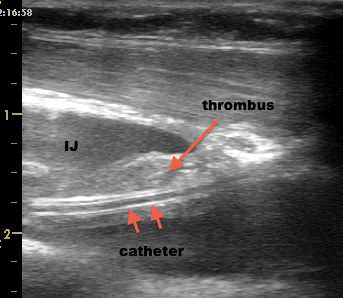
A 55 year old man admitted to the ICU for sepsis, recovering multi-organ failure with persistent culture-negative fever.

Longitudinal view of the left internal jugular vein.

What do you see?

BUPQ5-Q

scroll below for an answer!


BUPQ5-A


Thrombosed internal jugular catheter. This patient was anticoagulated. The fever disappeared within a few days and the thombosis decreased significantly.  It is difficult to be certain whether the fever was a cause but examining central lines is part of our fever workup.

Armani suits and recipe therapies…#FOAMed, #FOAMcc

Just a quick word to relate an interesting conversation I had with a colleague last evening.

I was taking over an ICU for a night’s coverage and going over the sicker patients with the current daytime attending, my friend and highly esteemed colleague Edgar Hockmann.  We were discussing a particularly challenging case of a young (40’s) patient with staph aureus sepsis and MSOF, and trying to come up with some tweaks, and ended up discussing the concept of tailored therapy to each patient’s physiology, which is right up my alley of N=1 thinking.

Now, as background, Edgar is a particularly bright guy who routinely challenges dogma, whether his own or others’, and I always learn from any conversation with him.  He has given awesome lectures in our conferences for the past several years. In this case (in addition to some fascinating microcirculation stuff I will have to digest and regurgitate at some point), he gave me a great teaching analogy:

Asking the question “what is the best treatment for disease x?”  is essentially analogous to asking “what’s the best size for a suit?”

You can debate it all you want, but ultimately, if you’re a 46 short or a 38 tall, the 42 regular on the store manikin won’t look too good on you.

And so I may be reiterating myself, but it is really key to assemble all the physiological evidence you and (physical exam, ultrasound, laboratory, etc…) and try to determine what this patient needs, not what most patients would need in a similar situation. Fluids in or fluids out? Which type of fluid? Blood pressure goals (MAP of 65 for everyone…really…)? Urine output goals?  We’ll try to go over each of these in the next weeks/months.

It’s a lot easier to follow a protocol.

…but my guess is that if you went to Savile Row, I doubt you’d see Shaquille O’Neal and Danny De Vito walking out with the same suit…the haberdashers would be fired…

Philippe

Bedside Ultrasound Picture Quiz 3 #FOAMed, #FOAMcc

Post-procedure transverse view of the neck…what do you see?


IJ with catheter sax


scroll down for the answer!


…an internal jugular catheter in the jugular vein!  Note the shadow behind it.  In fact, the use of ultrasound to confirm venous position as well as eliminate pneumothorax often obviates the need for a post-procedural CXR, sparing time, resources, and the risk of turning/moving a critically ill patient (how many tubes and lines have been lost this way…).

Bedside Ultrasound Picture Quiz 2 #FOAMed, #FOAMcc

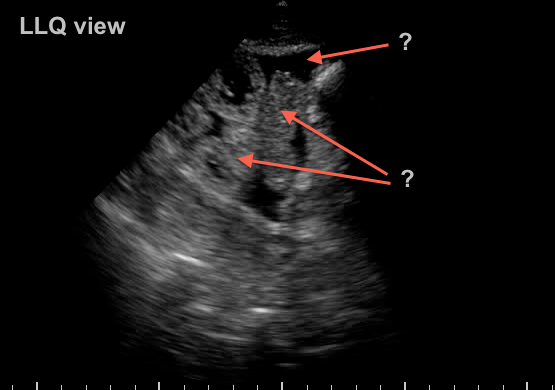
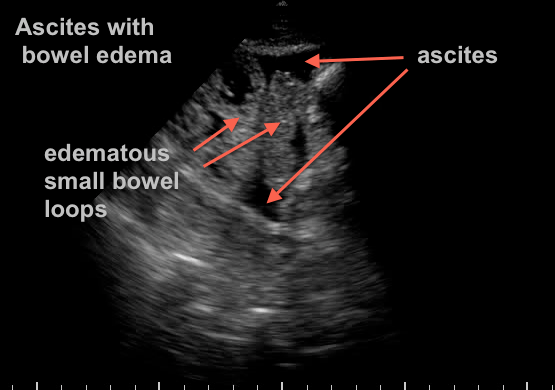
73 yr old woman recovering from septic shock with abdominal distension and difficulty tolerating enteral feeds…


what do you see?

BUPQ2


scroll below for the answer…..


BUPQ2 Answer


Extensive third spacing from resuscitation has resulted in bowel edema and ascites.  Another “benign” effect of massive crystalloid use… A bedside 22g US guided tap confirms benign transudate.

For students, residents, and anyone else: Key Articles! #FOAMed, #FOAMcc

For students or residents rotating though Santa Cabrini’s ICU, I will be attaching here a number of important articles – and adding to it frequently – which you should be familiar with and aware of. Please read them as we will undoubtedly be discussing these topics.

VISEP study

Fluid resuscitation in septic shock

Sepsis in European intensive care units_results of the SOAP study.

IVC ultrasound in CHF

Congestive RF in CHF – Mullens

Vasopressin review

SAFE study

Thanks,

Philippe Rola

Case Studies in Bedside Ultrasound

I’ll soon start putting up interesting bedside ultrasound loops and images (as soon as I can get this software figured out…), in the meantime, if anyone is interested, we have a casebook  which can be found on the CCUS website (http://www.ccusinstitute.org or an e-version on iTunes (https://itunes.apple.com/us/app/50-case-studies-in-bedside/id599201706?mt=8).

thanks!

Why do we bother checking CVP? #FOAMed, #FOAMcc

I was recently scanning the literature in preparation for our symposium, and came across what should have been a 2003 instead of a 2013 publication in the March issue of the CCM Journal, entitled “Point-of-Care Ultrasound to estimate Central Venous Pressure:  A Comparison of Three Techniques.”

I have to admit this is a pet peeve of mine, from the standpoint of a clinical physiologist, which is, as far as I’m concerned, what any physician looking after critically ill patients should be, at least some of the time.

So our real question is: is my patient fluid-responsive?  And perhaps a corollary question would be: is he fluid tolerant?

As a longtime bedside sonographer, physiology, experience and slowly growing evidence all support my using IVC sonography as a tool to assess volume responsiveness.  It isn’t perfect, and personally, I find the common M-mode, two-point measurement to be inadequate compared to a global assessment of the IVC, but it certainly is far closer to “the truth” we seek than CVP.

This then begs the question: why on earth would we be seeking to correlate one type of data to another which is clearly more removed from “the truth” we seek?

The use of CVP is largely cultural and deeply ingrained. There are some limited ways and pathologies in which it can be useful, but not as a measure of preload.  My friend Paul Marik published a piece that was both enlightening and entertaining in Chest a couple of years ago which I would have thought would have been the final nail in the coffin for the use of CVP as a preload tool, but it endures…even in the latest surviving sepsis guidelines

A testament to religion over science.

Philippe Rola

http://www.ccusinstitute.org

note that this was first posted in my buddy Matt’s awesome website pulmccmcentral (http://pulmccm.org/2013/critical-care-review/why-do-we-bother-to-check-cvp/) please check it out!