Ultrasound-guided central venous catheter insertion: standard of care or preventing procedural skills? #FOAMed, #FOAMcc

Ok, so let me preface this with the fact that I walk around with a handheld ultrasound rather than a stethoscope, and that I examine ALL patients with a focused cardiopulmonary and abdominal exam. My bias towards bedside ultrasound is ridiculously huge. I think practicing without it, once the skill is acquired, is unethical.

Having said that, I have an issue with the fact that it now seems to be “standard of care” for all lines to be ultrasound guided.

Hmm…here are the problems as I see them:

1.      I have come across junior staff intensivists who have never inserted a jugular or subclavian catheter without ultrasound, using landmark techniques. That is an utter shame and worse, a possible disaster in an instance of technology failure (ie the ultrasound is out for repair, etc…).   Intensivists who would be unable to put in a line???

2.      I have been teaching bedside ultrasound for the last 5 years, and practicing it for over a decade.  I teach ultrasound-guided line workshops. The ability to safely and properly follow a needle tip to venous puncture is an expert-level skill. I cannot count how many times a participant has sworn that his beam is right at the tip of the needle and been befuddled when I point to the blue phantom and show him how he is scanning just a bit beyond the hub and that the tip is in fact several centimetres into the blue phantom (better the phantom than the lung!).  The problem comes from a false sense of confidence and security that the procedure being “guided” provides. I’ve already seen several carotid insertions and pneumothoraces with IJ and SC guided procedures…

3.      The evidence is shabby in the following sense:  if you look at the papers comparing blind to guided, the stats on the blind procedures are not exactly very impressive to start with (time and number of attempts)… Also, did all trainees who are out there doing guided procedures receive the same training that those in the study did?  All residents with a probe are not trained/created equal, hate to break it to you…

So…what is my preference?  I spot all lines, meaning that I scan both sides of the neck for jugular size, position relative to the carotid and anomalies.  I then do the IJ line blind, unless it is particularly small or really anomalous (eg right on top of the carotid), then I would do it guided. I use ultrasound for ventilated subclavians.

In the interest of science I have timed myself and recorded stats. I can generally get a functional line (puncture to catheter insertion – not including suture time) in 60-90 seconds, with an average of about 1.1 punctures (eg 1 in 10 times I need to widthdraw and re-angle/puncture).   Obviously this comes with about 18 years of doing central lines (since I was an R1), but I know I’m not the only one out there with this type of skill – there are a lot of CC/ED/anasthesia..etc docs who can do the same.  But it does take practice.

My suggestion would be for trainees to spot the vein and keep a ready ultrasound probe (sheathed and sterile), and do a blind puncture.  If they find it on a first pass, then great. If not, then go ahead with the ultrasound (but here I would hope that they would have had some good training in guided insertion and not just that given by a senior resident who’s done all of 5 lines…).

So I think that this is yet another example of N=1, in this case the 1 being the physician rather than the patient, and I think we are in a bit of a tough spot with these recommendations, as the skills will deteriorate in time, and within a generation there will be few if any physicians well-versed in landmark insertion, which would be a shame. It has served us well in the last decades and, unlike the stethoscope, I don’t think its time has passed…

let me know what you think!

PR

ps when I have the opportunity, I will record a demo on my blind technique, for interested trainees.

Hi Philippe

just read your post on central line insertion. One of the things you mention is:

I cannot count how many times a participant has sworn that his beam is right at the tip of the needle and been befuddled when I point to the blue phantom and show him how he is scanning just a bit beyond the hub and that the tip is in fact several centimetres into the blue phantom 
 
This is one of the critical issues that we face with our hands-on intervention course…we’ve made videos, taken photos regarding ‘fanning the beam’ to keep the needle tip in view, etc … and still there are those whose spatial conception are challenged by the imaging…. many understand, but some do not ( my best guess is that it’s the narrow-window 2D image of a 3D structure that throws some people off ) 
 
Do you have any suggestions on how we can modify our approach to teaching this skill ? 
 
thanks for the great blog postings 
Chris
Tough question. The only way i get around that is one on one when a resident/student/attending is acutally rounding with me and we have time to really teach that 2d/3d relationship. You’re right some just have a hard time. Sometimes the long axis in plane works for those people, especially in subclavian access where this problem is more concerning. But its a tough issue, which i’m sure is happening everywhere.
 
Good question to ask some of the other faculty at CCUS 2014.
 
Cheers and looking forward to meeting you in a couple months!
 
Philippe

Bedside Ultrasound & the patient with Acute Renal Failure – an N=1 Podcast #3, #FOAMed, #FOAMcc

Hi!

So here is a quick and dirty approach to the patient with ARF using bedside ultrasound, which enables the rapid diagnosis or ruling out of two important and time-dependant conditions with significant clinical impact: hypovolemic and post-renal/obstructive renal failure.

Let me know what you think!

Philippe Rola

http://www.ccusinstitute.org

CCUS 2013 Lectures – #FOAMed, #FOAMcc

This past may we had an amazing two day conference, the theme of which was challenging dogmatic practice and myths in acute care medicine.  Many of the lectures are now available to watch on our website at http://www.ccusinstitute.org/e-Store.asp?method=evideos#, you need to be a member to access – which is free, just register.


Lectures on bedside ultrasound, shock, ECMO in the ED, physiology and a lot of really, really good stuff.


We will be adding more in the next weeks!


Thanks!


PR

Bedside Ultrasound Clip Quiz 2 – #FOAMed, #FOAMcc

64 yr old woman POD#3 Rt heimcolectomy with fever and abdominal pain.

Right costal longitudinal scan. What do you see?


A complex echogenic sliver of ascites over the liver…now what do you do? Here’s what I did…


…and it showed fecaloid material. Turned out to be anostomotic leak.  Didn’t have to push much for surgery.


Philippe


Bedside Ultrasound Picture Quiz 5 – #FOAMed, #FOAMcc

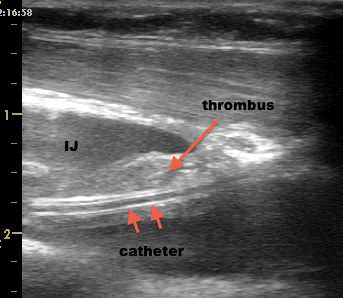
A 55 year old man admitted to the ICU for sepsis, recovering multi-organ failure with persistent culture-negative fever.

Longitudinal view of the left internal jugular vein.

What do you see?

BUPQ5-Q

scroll below for an answer!


BUPQ5-A


Thrombosed internal jugular catheter. This patient was anticoagulated. The fever disappeared within a few days and the thombosis decreased significantly.  It is difficult to be certain whether the fever was a cause but examining central lines is part of our fever workup.

Bedside Ultrasound Picture Quiz 3 #FOAMed, #FOAMcc

Post-procedure transverse view of the neck…what do you see?


IJ with catheter sax


scroll down for the answer!


…an internal jugular catheter in the jugular vein!  Note the shadow behind it.  In fact, the use of ultrasound to confirm venous position as well as eliminate pneumothorax often obviates the need for a post-procedural CXR, sparing time, resources, and the risk of turning/moving a critically ill patient (how many tubes and lines have been lost this way…).

The Ideal Resuscitation Fluid – an N=1 Podcast #FOAMed, #FOAMcc

So here is the first in a series of mini-talks geared towards having us think about fluid resuscitation, which, for those in acute care of almost any type (ER, wards, ICU, anasthesia, surgery, etc…) is part of our daily routine. And that’s exactly what it shouldn’t be, routine. It should be carefully thought out and adapted to each individual clinical situation we’re facing.

So I’ve decided to approach this from a completely different angle, not looking at what we do, what’s available, and see what has been stacked up against what, etc, etc… Instead, I’ve decided to start the discussion from a completely theoretical standpoint and talking about something that doesn’t exist:  The Ideal Resuscitation Fluid.

Please, let me know your thoughts!

Philippe

http://www.ccusinstitute.org

(sorry the last 40 seconds were cut – now the “full” 5 minutes are up!  apologies, I am techno-challenged!)

Intro to the N=1 Podcasts #FOAMed, #FOAMcc

Hi,

So here’s a short intro to what I’ll be calling the N=1 Podcasts.  Why N=1?  Because each patient we treat is just that, a single patient. Not a cumulated average result of a hundred or a thousand different people, and should be treated as such, meaning, know the good evidence that’s out there, be able to properly assess your patient and tailor your therapy appropriately.

Hope you like the concept, first real one should be up shortly!

Thanks

Philippe

Surviving Sepsis Guidelines: useful, but patients deserve individualized care! #FOAMed, #FOAMcc

First of all, I would like to commend those involved in the Surviving Sepsis Campaign’s Guidelines. It is a tremendous endeavour that, without a doubt, has heightened awareness and their growing implementation has and will save many lives.

I would, however, also like to point out that guidelines are exactly what the term implies, and not necessarily a gold standard to  aspire to and adhere to in religious fashion.  The reason this is so is the inherent variability in human physiology and pathology.  If, out of 100 patients a treatment would help 10 but harm 1, the numbers and studies would clearly support its broad use. We’d win more than we’d lose. However, as physicians, we treat the one patient in front of us, not the hundred, so I find it difficult to believe that such blind application of a recipe would be the most Hippocratic practice to apply.

We know that our patients are widely different, and around the corner is point of care immunology that will tell us, in all likelihood, that even patients we think are similar on the surface will have widely different immune profiles and will respond to treatment differently.

There are a few recommendations which, to me, make little physiological sense, particularly in certain circumstances:

I don’t think it necessary to belabour the point about CVP. As a static measure, CVP has clearly been disproven to have any relevance in predicting volume responsiveness. Its persistence is a testament to cultural faith rather than science.

I would find it unethical to blindly bolus large amount of crystalloids (which we all know end up 70-80% extravascular) in a patient when it takes about 10 seconds to rule out a pre-existing, septic cardiomyopathy or a volume-intolerant state. Even more so when dealing with pathologies where third-spacing is a concern (pulmonary and intra-abdominal pathologies) since those leaky capillaries is where most of that fluid resuscitation will end up. Yes, I am implying that a worsening chest x-ray is not always and only due to worsening disease… Physiologically, perhaps non synthetic colloids or hypertonics may be a better option…

I would find it equally unethical to blindly put a patient on dobutamine who may have hyperdynamic ventricles and possibly still a volume-responsive state. Again, determining this takes seconds.

Yes, clearly I admit to a bedside ultrasound bias. It allows us to look inside our patients. Isn’t that what we’re always trying to do?

I can already hear voices and keyboards claiming the “lack of evidence,” and they would partly be right. That evidence is slowly but surely growing.

Unfortunately, point of care ultrasound has come of age in the era of evidence based medicine, and, as such, is required to “pass” that scrutiny whereas most of what is currently being done was “grandfathered in” and given a bye. I would be interested in seeing the compelling evidence for the use of a stethoscope.

The evolution of evidence based medicine is an interesting scientific, commercial and social development. From the positive study publishing bias to the general lack of epidemiological knowledge of our community, and without mentioning the darker side of research and publishing, it is unfortunate that almost every statement by a physician, to be taken seriously, must be backed by a hand raising a publication. And how many of those do we see torn down a month, a year or five later, thoroughly disproven? The pendulum of evidence-based medicine has perhaps swung too far…

Note that I’m not trying to discredit the countless number of truly well-designed and well-executed studies that contribute immensely to medicine – which would otherwise be reduced to little more than expert opinion – just that careful analysis of both the evidence and the case at hand is primordial.

I think that as physicians, it is our duty to look very closely at the individual patient, the care of whom we are privileged to have as a responsibility, and individualize our treatment plan to his specific problem given his specific physiology, and not blindly implement a recipe, even if it would happen to be the right one 9 out of 10 times.

Philippe Rola

http://www.ccusinstitute.org

please note that this was first posted on september 5th, 2013 on my buddy Matt’s website, pulmccm.org (http://pulmccm.org/2013/uncategorized/surviving-sepsis-guidelines-useful-patients-deserve-individualized-care/)

Go visit, its great, and you can see some fun follow up comments, too!

Glenn says:

it’s a sensitive decease in a sensitive time. Time is of the essence in treating septic shock and severe sepsis. If you wait for primary MD to individualized the care for these patients,it’s probably too late.EGDT save lives.

Thanks for commenting Glenn, and I can’t agree more. EGDT does save lives when compared to the usual care of 2001 (see my latest post on the ProCESS trial as that may no longer be the case in some institutions), but the mistake is strict adherence when you do have the capabilities to detect conditions where a protocol “violation” would be beneficial to the individual patient in front of you. Again, I’m not knocking EGDT, it was a great step, but in a set of stairs we have to keep climbing.


Philippe